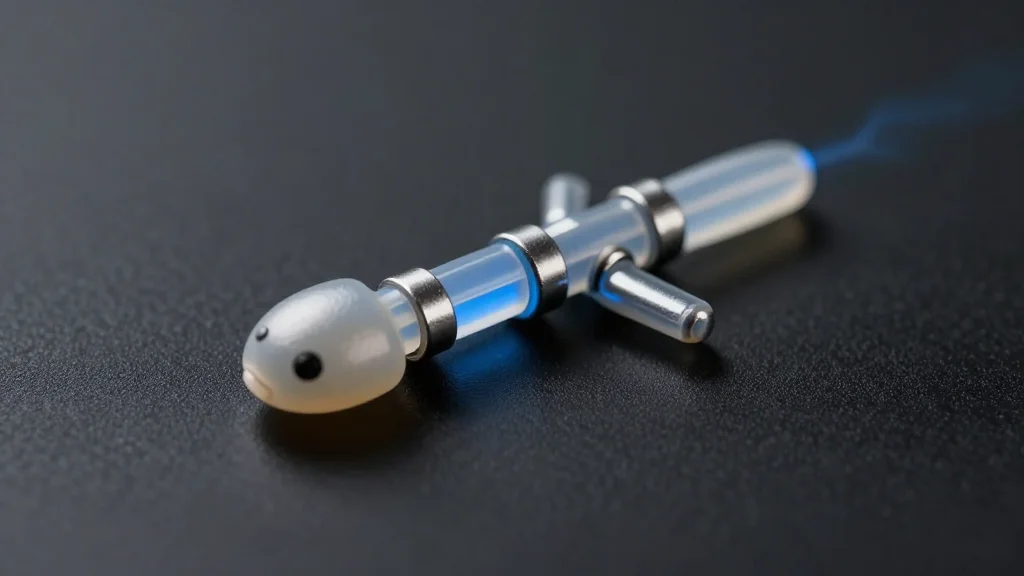
New 3D-Printed Microrobot Mimics Worm-Like Motion at Microscopic Scale
Why It Matters
The device shows that adaptive microrobotic functions can be achieved without embedded power or circuitry, lowering complexity and expanding biomedical application potential.
Key Takeaways
- •5 µm robot moves via electric field, mimicking worm locomotion.
- •Flexible 0.5 µm joints enable shape‑motion coupling.
- •No onboard power; behavior driven solely by external stimulus.
- •Potential for targeted drug delivery in constrained environments.
- •Insight may reshape microrobot design principles.
Pulse Analysis
Microrobotics has long been constrained by a trade‑off between size and flexibility. Conventional designs either shrink to a few micrometres but remain rigid, or stay larger to incorporate compliant mechanisms and onboard electronics. This dichotomy limits the ability of tiny machines to navigate the tortuous pathways found in biological tissues or microfluidic channels. Researchers are therefore turning to bio‑inspired strategies, borrowing locomotion concepts from worms and snakes, to achieve adaptive movement without sacrificing the miniature footprint required for medical interventions.
The Leiden University team demonstrated a 5‑micrometre chain fabricated with a Nanoscribe two‑photon polymeriser, linking sub‑micron bars into a flexible backbone. When an alternating electric field is applied, each segment experiences induced electro‑osmotic flow, propelling the whole structure at roughly 7 µm s⁻¹. Because the rear links are softer, the robot bends, twists and “weaves” its tail in response to constraints, creating a feedback loop where shape influences propulsion and vice‑versa. Remarkably, the device contains no circuitry or battery, relying entirely on external fields for actuation and control.
This proof‑of‑concept suggests a new class of low‑complexity microrobots capable of autonomous‑like adaptation, a feature highly prized for targeted drug delivery, biopsy sampling, or clearing clogged vessels. Eliminating on‑board power reduces manufacturing cost and biocompatibility concerns, while the worm‑like gait may enable navigation through dense extracellular matrices that rigid swimmers cannot traverse. Future work will focus on quantifying the underlying physics, scaling the approach to functional payloads, and integrating sensing modalities, potentially accelerating the commercialization of smart, minimally invasive medical nanodevices.
New 3D-printed microrobot mimics worm-like motion at microscopic scale
Comments
Want to join the conversation?
Loading comments...