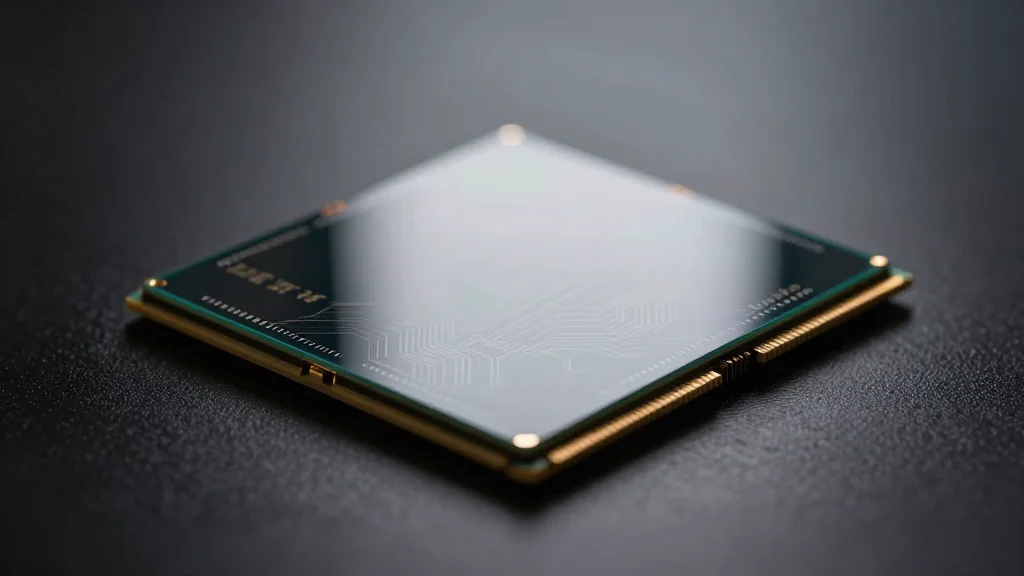
Nvidia CEO Highlights Blackwell GPU Architecture as Revenue Target Tops $100 B

Companies Mentioned
Why It Matters
The Blackwell architecture represents Nvidia’s next leap in GPU performance, directly influencing the pace at which AI models can be trained and deployed. By potentially unlocking new levels of compute efficiency, the chip could accelerate breakthroughs in fields ranging from drug discovery to autonomous systems, reinforcing Nvidia’s role as the de‑facto hardware platform for AI. Moreover, the architecture’s success will shape the competitive dynamics of the semiconductor industry, forcing rivals to accelerate their own high‑performance GPU programs or risk losing market share in the fast‑growing data‑center segment. Energy considerations highlighted by Huang also have broader implications. As AI workloads consume ever‑greater power, the balance between performance gains and energy costs will become a decisive factor for data‑center operators. Nvidia’s ability to deliver higher FLOPS per watt could set a new industry benchmark, influencing everything from cloud pricing models to national policy on AI infrastructure investment.
Key Takeaways
- •Jensen Huang highlighted Nvidia's Blackwell GPU architecture at a recent event
- •Analysts project 2026 revenue to exceed $100 billion, with price targets near $270 per share
- •Nvidia's market cap tops $4 trillion and shares trade around $200
- •Huang emphasized energy as the foundational constraint for AI hardware
- •Competition from AMD, Intel and custom hyperscaler chips intensifies valuation debate
Pulse Analysis
Nvidia’s Blackwell rollout is less a product launch than a strategic inflection point. The company has spent the past two years building a software‑centric moat—CUDA, cuDNN, and a sprawling ecosystem of AI frameworks—that makes any new silicon iteration instantly valuable to its customers. Blackwell’s promise, therefore, is not just raw compute but a seamless upgrade path that preserves existing software investments. This lock‑in effect has allowed Nvidia to command premium pricing and sustain a valuation that, while lofty, reflects the scarcity of comparable alternatives.
Historically, each Nvidia architecture (Pascal, Volta, Ampere, Hopper) has coincided with a wave of AI adoption spikes. Blackwell arrives at a moment when AI capex is projected to triple to $1.2 trillion globally, and data‑center demand is outpacing supply. If Nvidia can deliver a meaningful performance‑per‑watt improvement—as Huang’s energy comment suggests—it will not only capture more of the capex pie but also alleviate one of the sector’s biggest bottlenecks: power availability. This could give Nvidia a decisive edge over rivals who are still grappling with the thermal and power budgets of their own designs.
However, the upside is not guaranteed. The market’s current premium pricing assumes that Blackwell will translate into immediate, large‑scale orders. Any delay in adoption—whether due to supply‑chain hiccups, export restrictions, or a faster‑than‑expected shift to custom silicon by hyperscalers—could pressure Nvidia’s margins and trigger a valuation correction. Investors should watch the upcoming earnings season for early Blackwell shipment data, as well as any policy shifts around AI‑related energy consumption, which could reshape the economics of large‑scale AI deployments.
Nvidia CEO Highlights Blackwell GPU Architecture as Revenue Target Tops $100 B
Comments
Want to join the conversation?
Loading comments...