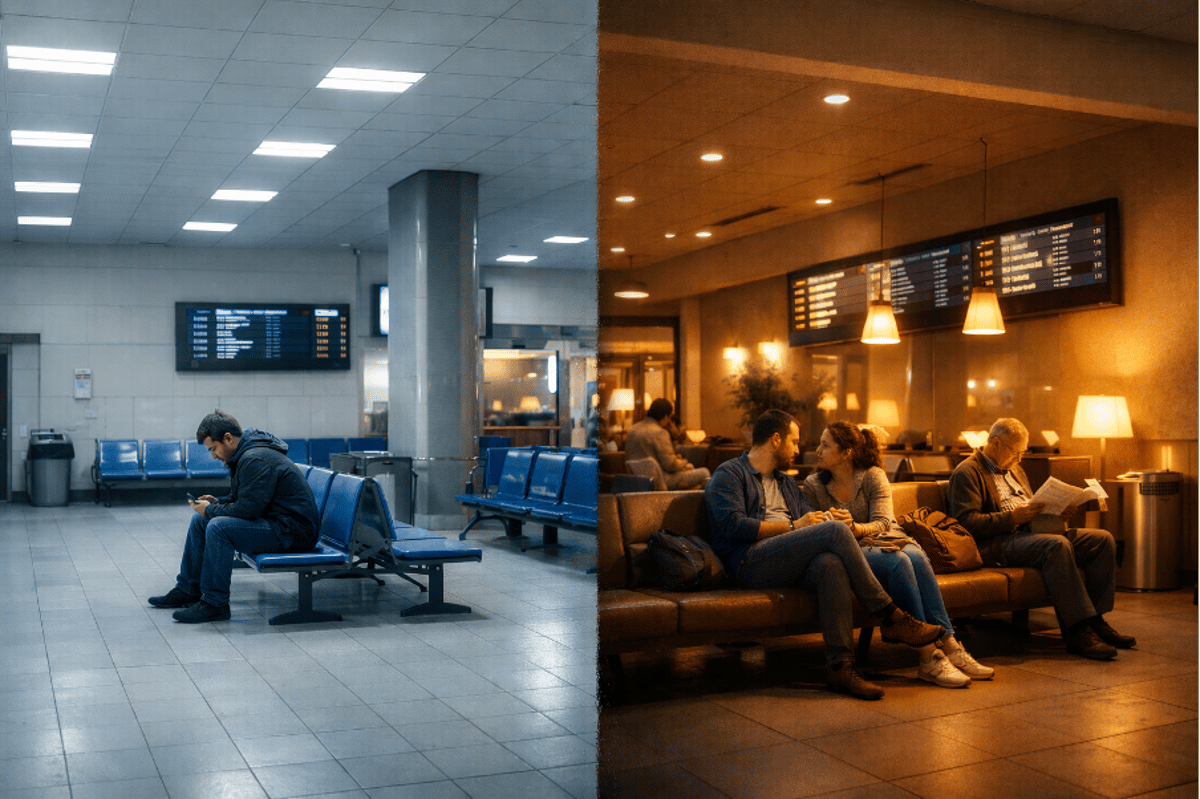
Passenger Expectations Are Changing – Rail Lighting Hasn’t Kept Up
Why It Matters
Static lighting undermines passenger comfort and perceived safety, eroding the experience‑driven edge rail operators need to stay competitive.
Key Takeaways
- •Smart home penetration reaches 30% of EU homes, ~73 M households
- •Rail lighting stays fixed, ignoring occupancy and time‑of‑day cues
- •DALI, occupancy sensors, daylight response already exist for adaptive lighting
- •Main barrier is specification and commissioning, not hardware limitations
Pulse Analysis
The rapid diffusion of smart‑home lighting across Europe and the United States has reshaped what travelers expect from public spaces. With roughly one‑third of European households equipped with connected lighting and half of U.S. homes on a similar trajectory, passengers now use environments that dim, brighten, or change colour based on presence, time of day, or personal preference. Those experiences set a new baseline for comfort and perceived safety, making the stark contrast of static rail lighting increasingly noticeable.
Rail infrastructure has traditionally emphasized safety, reliability and low‑maintenance operation, resulting in lighting designs that deliver uniform illumination regardless of real‑time conditions. While this approach satisfies regulatory requirements, it ignores the nuanced benefits of adaptive control—such as occupancy‑based dimming, gradual transitions, and daylight harvesting—that are already embedded in protocols like DALI. The technology exists; the challenge lies in integrating it without compromising the non‑negotiable minimum illumination levels required for safe passenger movement.
For rail operators, embracing adaptive lighting represents a low‑cost avenue to enhance passenger experience and differentiate service offerings. By revising specification documents, training commissioning teams, and defining clear performance criteria for adaptability, railways can deploy occupancy sensors and time‑of‑day schedules that maintain safety while improving comfort. Such upgrades can reduce energy consumption, extend lamp life, and align rail environments with the expectations set by smart‑home ecosystems, positioning operators as forward‑thinking and passenger‑centric in a competitive mobility market.
Passenger Expectations Are Changing – Rail Lighting Hasn’t Kept Up
Comments
Want to join the conversation?
Loading comments...