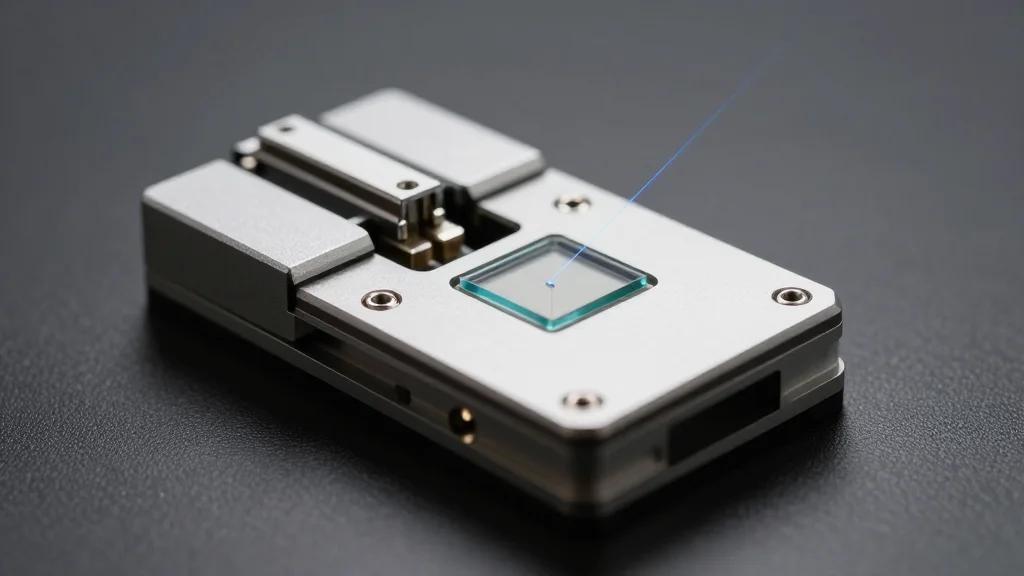
Physik Instrumente Highlights 2-Axis Piezo Scanning Stage
Companies Mentioned
Why It Matters
The P‑733 enables manufacturers to boost sensor resolution and reduce motion‑induced blur without redesigning hardware, giving them a competitive edge in high‑performance imaging and metrology markets.
Key Takeaways
- •P‑733 offers sub‑nanometer repeatability for XY motion
- •Frictionless flexure guide enables high‑speed, vibration‑free operation
- •Direct position feedback supports active error correction in real time
- •Ideal for super‑resolution microscopy and pixel‑shift imaging systems
- •Compact footprint fits space‑constrained optical instruments
Pulse Analysis
The demand for nanometer‑scale motion control is accelerating across photonics, semiconductor inspection, and biomedical imaging. Piezoelectric scanners, prized for their rapid response and sub‑nanometer precision, have become a cornerstone of next‑generation optical platforms. Physik Instrumente, a long‑standing leader in nanopositioning, leverages its global R&D network to deliver compact, high‑performance devices such as the P‑733. By combining a lightweight flexure architecture with integrated position sensors, the stage meets the speed‑stability trade‑off that many manufacturers struggle to balance, positioning PI ahead of emerging competitors.
The P‑733’s two‑axis design delivers repeatability below one nanometer while sustaining kilohertz‑range scan rates. Its frictionless flexure guidance eliminates backlash, and the built‑in closed‑loop feedback corrects drift in real time, a critical requirement for pixel‑shift imaging and super‑resolution microscopy. In practice, the stage can execute sub‑pixel offsets that, when combined computationally, double the effective resolution of a standard sensor array. This capability translates directly into sharper medical diagnostics, more accurate metrology, and higher‑throughput inspection lines without costly hardware upgrades.
Adoption of the P‑733 is likely to expand as AI‑driven image reconstruction algorithms demand ever finer motion granularity. OEMs integrating the stage into compact cameras or laser‑based measurement tools can differentiate their products through faster frame rates and superior image fidelity. Meanwhile, the broader piezo market is projected to grow double‑digit percentages annually, driven by autonomous vehicle LIDAR and quantum‑science research. PI’s focus on modular, plug‑and‑play solutions positions it to capture a sizable share of this growth, while competitors must match its blend of speed, precision, and footprint.
Physik Instrumente Highlights 2-Axis Piezo Scanning Stage
Comments
Want to join the conversation?
Loading comments...