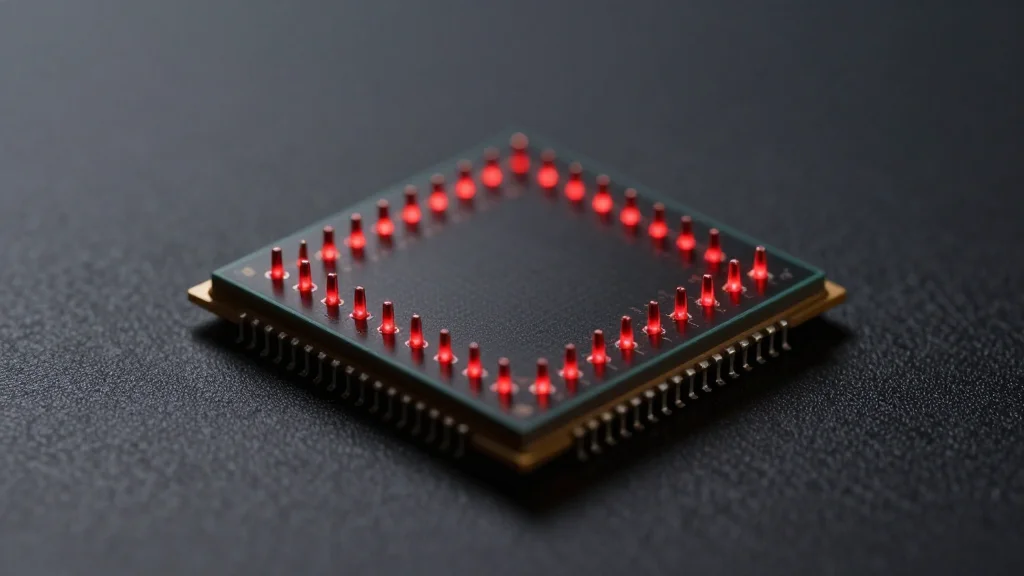
PicoJool Introduces 200G VCSELs for Scale-Up AI Data Centers
Why It Matters
By delivering terabit‑class optical links at copper‑competitive cost, PicoJool could unlock faster, more efficient AI training clusters and reshape data‑center economics.
Key Takeaways
- •200 G VCSELs deliver >37 GHz bandwidth for AI data centers
- •Sampling starts Q3 2026: quad 100 G, quad 200 G, 32×50 G
- •Partnership with WIN Semiconductor leverages billion‑chip production experience
- •Roadmap targets 800 G, 1.6 T, and 3.2 T optical speeds
- •Claims cost parity with copper at hyperscale volumes
Pulse Analysis
Vertical‑cavity surface‑emitting lasers have been the workhorse of data‑center optics since the mid‑1990s, prized for low power, high reliability and ease of integration. As AI models grow in size and inference workloads demand ever‑greater bandwidth, traditional copper interconnects face latency and thermal limits. Optical solutions, especially VCSEL‑based links, offer a path to scale beyond 100 G per lane, but cost and manufacturability have remained hurdles for widespread adoption.
PicoJool’s 200 G VCSEL family pushes the envelope with a measured bandwidth of over 37 GHz, enabling NRZ data rates that rival early 400 G PAM4 systems. The company plans to ship sampling chips in the third quarter of 2026, featuring quad‑100 G, quad‑200 G, and a dense 32‑by‑50 G micro‑VCSEL array for both narrow‑ and wide‑angle applications. A strategic partnership with WIN Semiconductor—renowned for producing more than a billion 3‑D‑sensing VCSELs—provides a mature 6‑inch GaAs fab line, ensuring high‑volume, low‑cost production. This collaboration blends PicoJool’s parallel‑optics packaging innovations with WIN’s proven wafer‑scale processes, positioning the product as a drop‑in replacement for copper in pluggable and co‑packaged optics modules.
If the cost claims hold, hyperscale operators could replace copper back‑plane links with compact optical modules without inflating CAPEX, accelerating AI training cycles and reducing energy per bit. Competitors such as Intel and Broadcom are also racing to commercialize 400 G and 800 G optical transceivers, but PicoJool’s aggressive roadmap to 1.6 T and 3.2 T speeds could set a new benchmark. For cloud providers and AI‑focused enterprises, the technology promises to shrink rack footprints, lower power budgets, and future‑proof infrastructure against the relentless growth of model complexity.
PicoJool introduces 200G VCSELs for scale-up AI data centers
Comments
Want to join the conversation?
Loading comments...