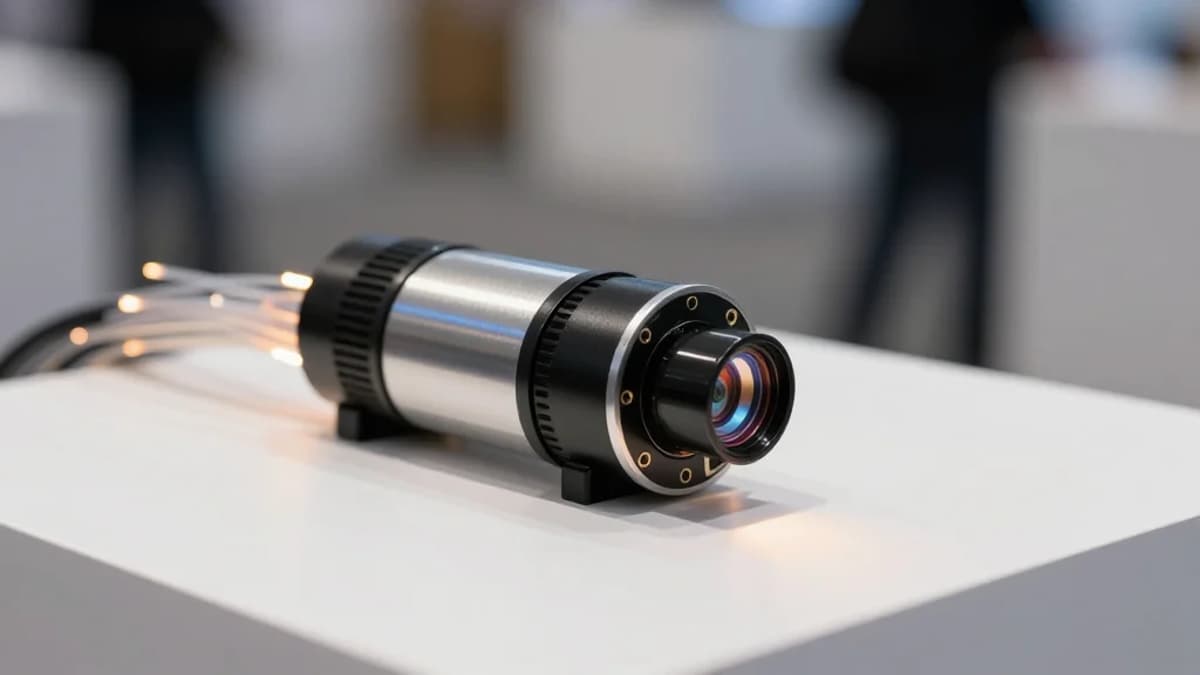
POET Demos Hybrid Laser and Next-Gen High-Power External Light Source for AI at OFC
•March 11, 2026
0
Companies Mentioned
Why It Matters
The demos highlight POET’s push to semiconductorize photonics, potentially reducing AI interconnect costs and accelerating deployment of high‑bandwidth optical links, while the award validates its competitive edge in the fast‑growing AI data‑center market.
Key Takeaways
- •POET demoed hybrid laser Blazar at OFC 2026
- •Blazar offers multi‑channel, high‑power output, lower cost
- •Starlight introduces eight‑channel high‑power lasers for AI
- •POET won Lightwave Elite Score for Teralight 1.6 Tbps engine
- •Advanced packaging reduces cost, boosts chip‑to‑chip links
Pulse Analysis
The explosion of artificial‑intelligence workloads has forced data‑center operators to seek faster, more efficient interconnects, and silicon‑photonic solutions are emerging as the preferred path. By integrating optical functions directly onto semiconductor wafers, companies can cut the size, power, and expense of traditional fiber‑optic modules. POET’s recent demonstrations at OFC illustrate how this approach is moving from prototype to production, positioning the firm to capture a sizable share of the AI‑driven optical market.
Blazar represents a new class of hybrid laser that merges the high output of indium‑phosphide gain media with the scalability of wafer‑level manufacturing. Its multi‑channel, multi‑wavelength architecture delivers the power needed for co‑packaged optics and chip‑to‑chip links while sidestepping the cost and supply constraints of discrete DFB lasers. The wafer‑scale integration also improves reliability and enables larger production volumes, which could translate into lower total‑of‑ownership costs for AI accelerators and networking equipment.
Starlight builds on the Blazar foundation by packing eight high‑power channels into a compact engine optimized for the emerging ELSFP module format. The advanced packaging techniques showcased reduce thermal resistance and streamline assembly, directly addressing the industry’s push for denser, higher‑bandwidth connections. Coupled with POET’s recent Lightwave Innovations Elite Score award for its Teralight 1.6 Tbps engine, the company’s portfolio signals a strong competitive advantage in delivering next‑generation photonic solutions for AI and high‑performance computing ecosystems.
POET demos hybrid laser and next-gen high-power external light source for AI at OFC
0
Comments
Want to join the conversation?
Loading comments...