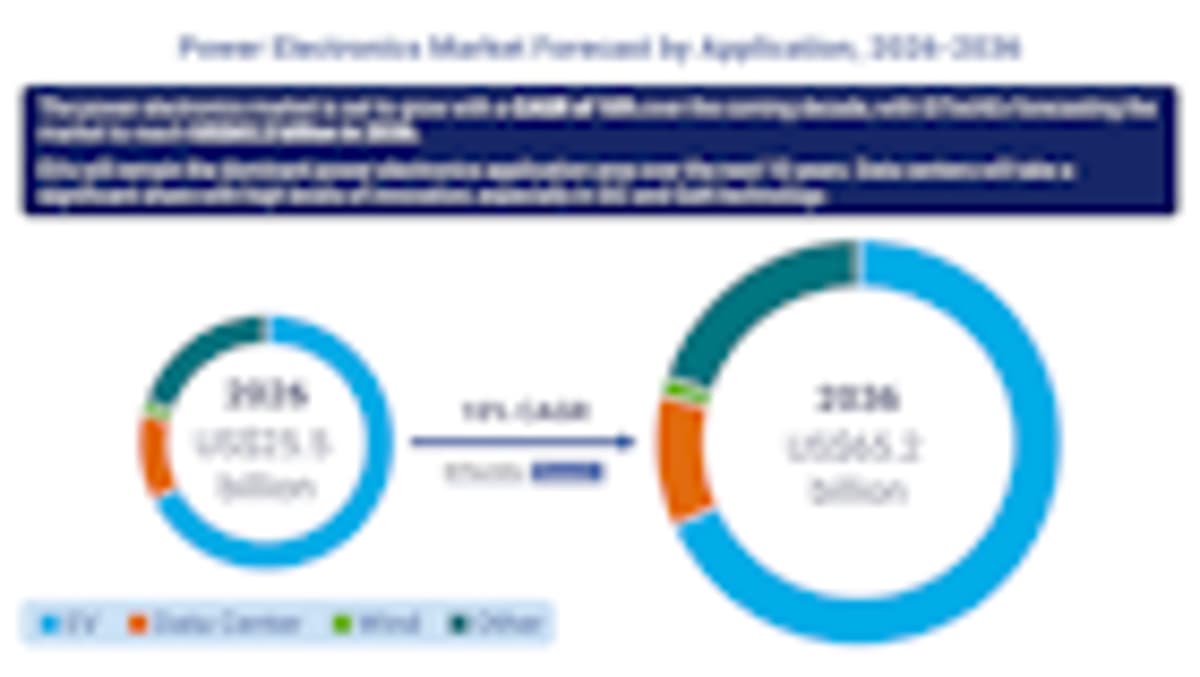
Power Electronics Market to Exceed US$65 Billion by 2036
Why It Matters
The surge in WBG semiconductor demand reshapes supply chains and creates a competitive moat for firms that master SiC and GaN production. Faster, more efficient power conversion will accelerate performance gains across EVs, AI data centers, and renewable energy, driving broader industry transformation.
Key Takeaways
- •Market to exceed $65 billion by 2036, 10% CAGR
- •SiC expected to dominate EV traction‑inverter market by 2036
- •Data centers moving to 800 VDC architecture, boosting efficiency
- •GaN adoption accelerating in data‑center power supplies and point‑of‑load
- •Wind turbines gradually adopting SiC as reliability proves
Pulse Analysis
The power‑electronics sector is on the cusp of a multi‑billion‑dollar expansion, fueled by the relentless push for higher efficiency and power density across three high‑growth verticals. As AI models become more compute‑intensive, data‑center operators are overhauling their power delivery from traditional AC to an 800 VDC architecture. This shift reduces conversion stages, cuts losses, and enables the 1 MW rack footprints that next‑generation training clusters demand. Wide‑bandgap devices—particularly SiC for high‑voltage handling and GaN for ultra‑fast switching—are the linchpins of this transformation, promising smaller footprints and lower total‑cost‑of‑ownership.
In the automotive arena, electric‑vehicle manufacturers are rapidly replacing legacy silicon IGBTs with SiC MOSFETs. SiC’s high‑temperature tolerance and superior switching speed translate into lighter, more compact inverters and chargers, directly extending vehicle range and reducing cooling requirements. While GaN still faces reliability hurdles at the 800‑volt level, its potential for high‑frequency operation makes it a strong contender for future on‑board converters. The convergence of EV and data‑center power‑electronics requirements is creating a shared innovation pipeline, accelerating component maturation and driving down costs for both markets.
Renewable‑energy applications, especially wind turbines, have been slower to adopt WBG technology due to harsh operating environments and a legacy preference for proven silicon solutions. However, recent partnership announcements between turbine OEMs and SiC suppliers signal growing confidence in SiC’s durability under extreme temperature swings and salt exposure. As SiC modules become more cost‑effective, they will enable higher conversion efficiencies and lighter converter packages, improving turbine availability and reducing levelized cost of electricity. The cross‑industry diffusion of WBG semiconductors underscores a broader strategic imperative: companies that secure robust SiC and GaN supply chains will capture outsized market share as power‑electronics become the backbone of the digital and green economies.
Power Electronics Market to Exceed US$65 billion by 2036
Comments
Want to join the conversation?
Loading comments...