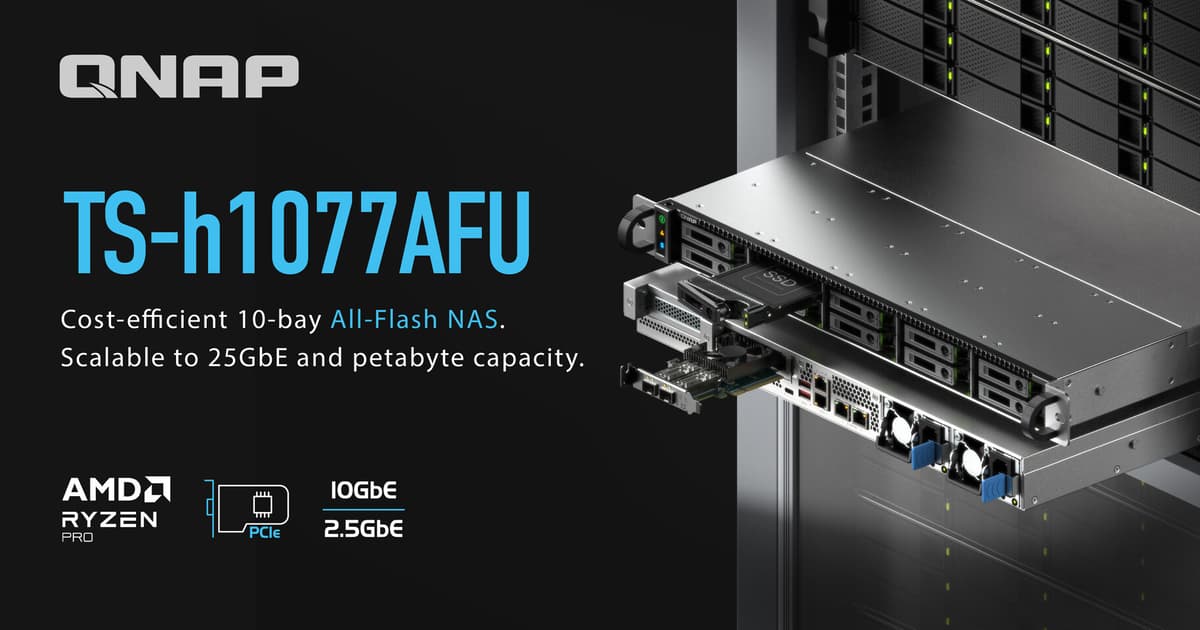
(PR) QNAP Releases TS-H1077AFU 10-Bay, High-Density All-Flash NAS with AMD Ryzen PRO 7000 CPUs
•March 4, 2026
0
Key Takeaways
- •10‑bay all‑flash NAS powered by AMD Ryzen PRO 7000
- •Runs ZFS‑based QuTS hero OS with ECC DDR5 memory
- •Targeted at virtualization, media workflows, databases, backup consolidation
- •Compact alternative to 30‑bay TS‑h3077AFU, retains enterprise performance
- •Offers high density flash storage with cost‑effective deployment
Summary
QNAP announced the TS-h1077AFU, a 10‑bay all‑flash NAS built on the ZFS‑based QuTS hero operating system and powered by AMD Ryzen PRO 7000 Series CPUs. The unit ships with ECC‑protected DDR5 memory, delivering enterprise‑grade performance and data integrity in a compact chassis. Designed for virtualization, high‑speed media processing, database workloads, and multi‑site backup consolidation, it mirrors the capabilities of QNAP’s larger 30‑bay model while offering greater flexibility. The launch expands QNAP’s flash‑storage portfolio for midsize and large enterprises seeking dense, cost‑effective storage solutions.
Pulse Analysis
The enterprise flash‑storage market has been racing toward higher density and lower latency, and QNAP’s TS-h1077AFU arrives at a pivotal moment. By integrating AMD’s Ryzen PRO 7000 series, the device leverages a modern x86 architecture that balances raw compute power with energy efficiency, a combination rarely seen in traditional NAS appliances. Coupled with the ZFS‑based QuTS hero OS, administrators gain advanced data protection features such as snapshots, checksums, and self‑healing, while ECC‑enabled DDR5 memory safeguards against bit‑rot and corruption, ensuring mission‑critical reliability.
From a technical standpoint, the TS-h1077AFU’s 10‑bay design packs a substantial amount of flash capacity into a footprint comparable to a mid‑range rack unit. The platform’s support for NVMe caching, tiered storage, and native virtualization extensions enables seamless integration with VMware, Hyper‑V, and containerized workloads. Media production houses benefit from sustained high‑throughput reads and writes, essential for 4K/8K editing pipelines, while database administrators appreciate the low‑latency access patterns that flash delivers for OLTP environments. Moreover, the built‑in multi‑site backup consolidation tools simplify disaster‑recovery strategies, reducing the need for separate appliances.
Strategically, QNAP’s move signals a broader shift toward converged infrastructure that blurs the line between traditional storage arrays and compute nodes. Competitors such as Dell EMC and NetApp are also pushing flash‑centric solutions, but QNAP differentiates itself through a tighter hardware‑software integration and a price point aimed at cost‑conscious enterprises. Early adopters can expect faster project delivery, lower operational expenses, and a scalable path to future upgrades as flash prices continue to fall. The TS-h1077AFU thus positions QNAP as a credible contender in the high‑performance NAS arena, likely influencing buying decisions across data‑center, media, and enterprise IT segments.
Comments
Want to join the conversation?