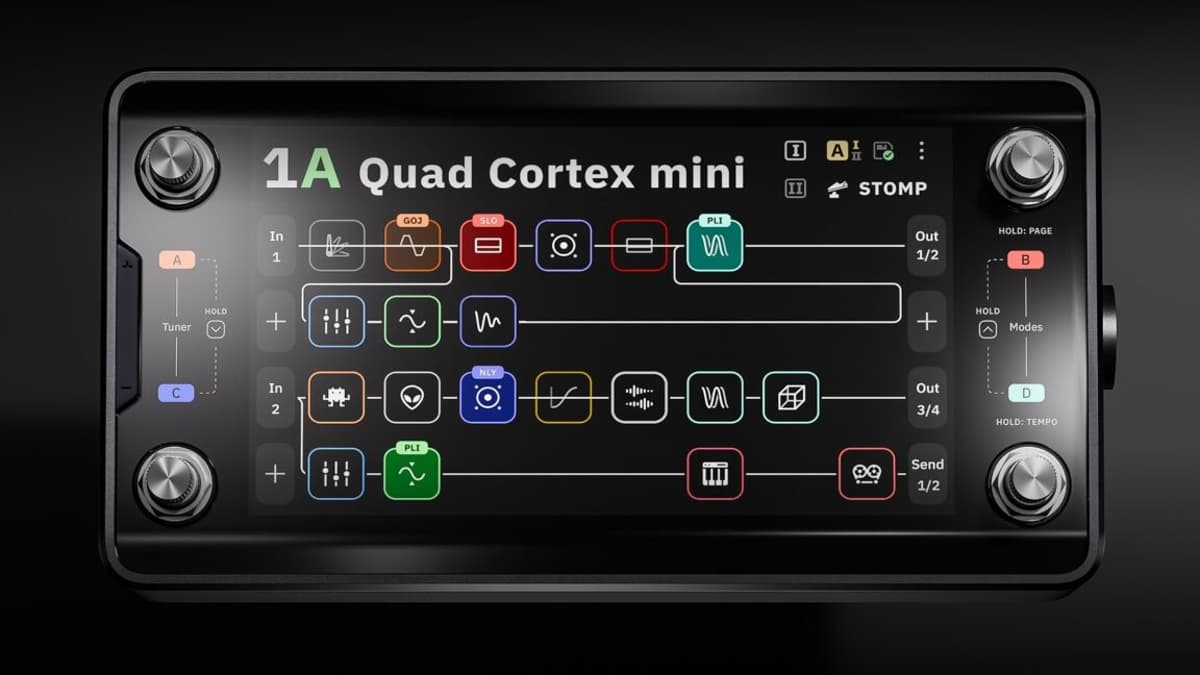
Quad Cortex Mini Amp Modeler: All the Power, Half the Size
•March 9, 2026
0
Companies Mentioned
Why It Matters
The Quad Cortex mini gives professional guitarists a studio‑grade tone arsenal at a fraction of the cost and footprint of traditional gear, reshaping how players approach live and recording setups.
Key Takeaways
- •Mini reduces footprint, keeps full Quad Cortex processing.
- •Priced $1,400, under full-size unit’s $2,000.
- •Offers 90 amps, 100 effects, 1,000 IRs out of box.
- •Supports USB‑C audio interface and Cortex Cloud captures.
- •Complex UI may need desktop app for efficient editing.
Pulse Analysis
Neural DSP has turned amp modeling into a data‑driven science, leveraging machine‑learning algorithms and a robotic arm named TINA to automate the capture of thousands of control positions per device. This approach sidesteps traditional circuit‑by‑circuit analysis, allowing the company to generate dynamic models that respond to any knob setting in real time. By publishing a massive library of Neural Captures, the firm has democratized access to tones that once required expensive hardware stacks, setting a new benchmark for accuracy and flexibility in the digital amp‑modeling space.
The Quad Cortex mini translates that technological edge into a portable, stage‑ready format. Housed in an 8.9×4.6×2.5‑inch chassis, the unit runs Neural’s CorOS operating system, boots in 45 seconds, and offers a 7‑inch touch display paired with four programmable footswitches. Its I/O suite—guitar/bass input, XLR with phantom power, balanced outputs, MIDI, expression pedal, USB‑C, and a dedicated capture port—makes it a versatile hub for both live performance and studio recording. Priced at $1,400, it undercuts the full‑size Quad Cortex while still delivering over 2,000 factory captures and seamless integration with the Cortex Cloud for endless expansion.
For musicians, the mini’s impact is twofold: it eliminates the need for a physical amp and pedal cabinet, and it streamlines workflow through the optional Cortex Control desktop app. The ability to act as a 24‑bit/48 kHz USB‑C audio interface further blurs the line between hardware and DAW environments, enabling simultaneous dry and processed tracking. As competitors like Fractal and Kemper introduce their own compact solutions, Neural DSP’s blend of AI‑driven modeling, robust feature set, and aggressive pricing is likely to accelerate the shift toward all‑in‑one digital tone platforms across gigging and home‑studio markets.
Quad Cortex mini amp modeler: All the power, half the size
0
Comments
Want to join the conversation?
Loading comments...