Radxa Cubie A7S Integrates A733 SoC, RISC-V MCU, and LPDDR5 Memory
•February 13, 2026
0
Why It Matters
The Cubie A7S brings high‑performance AI acceleration to a sub‑$30 SBC, lowering entry barriers for edge computing and embedded vision projects. Its heterogeneous architecture and extensive I/O make it a compelling alternative to pricier developer kits.
Key Takeaways
- •A733 SoC combines Cortex-A76/A55 cores, LPDDR5 up to 16 GB
- •Integrated NPU delivers 3 TOPS INT8 performance for edge AI
- •RISC‑V XuanTie MCU handles low‑power real‑time tasks
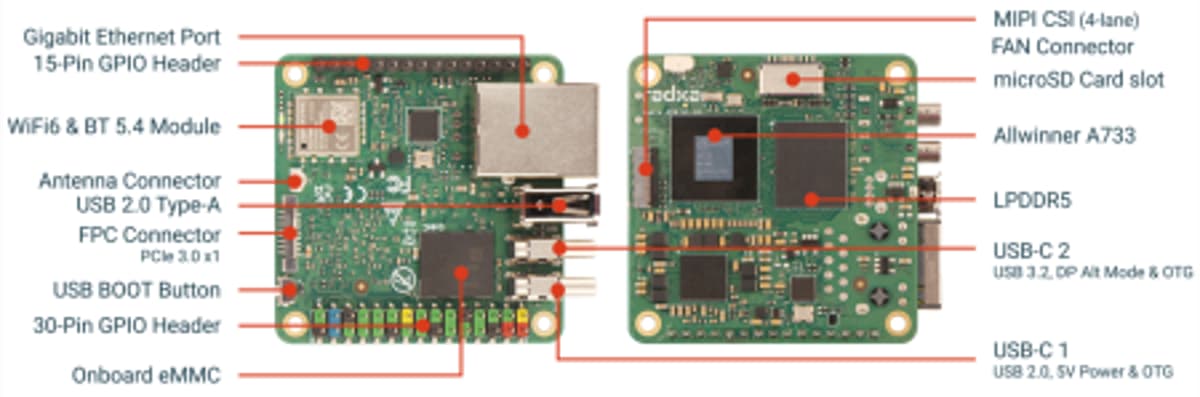
- •PCIe 3.0×1 supports NVMe SSD expansion, boosting storage speed
- •Wi‑Fi 6, Bluetooth 5.4, Gigabit Ethernet enable robust connectivity
Pulse Analysis
Edge AI is rapidly moving from prototype to production, and developers need affordable hardware that can keep pace with evolving models. The Cubie A7S answers that demand by embedding a 3 TOPS NPU alongside a heterogeneous CPU cluster, enabling on‑device inference for TensorFlow, PyTorch, and ONNX without sacrificing power efficiency. LPDDR5 memory up to 16 GB further reduces latency, positioning the board as a strong contender for real‑time vision, robotics, and smart‑camera deployments.
Beyond raw compute, the A7S differentiates itself with a dedicated RISC‑V XuanTie microcontroller. This low‑power core offloads sensor fusion, motor control, and other deterministic tasks, allowing the main Arm cores to remain in idle states and extend battery life. The inclusion of PCIe 3.0 ×1 with NVMe support provides enterprise‑grade storage speeds uncommon in the sub‑$30 segment, while USB‑C DisplayPort Alt Mode and a 4‑lane MIPI CSI interface simplify high‑resolution display and camera integration. Compared with legacy SBCs like the Raspberry Pi or even Nvidia’s Jetson Nano, the Cubie A7S offers a more balanced mix of AI performance, connectivity, and expandability.
Pricing at roughly $25 for a 4 GB configuration makes the Cubie A7S one of the most cost‑effective AI‑ready boards on the market, potentially accelerating adoption in IoT gateways, edge servers, and industrial automation. Radxa’s comprehensive documentation and open‑source tooling lower the learning curve for engineers, fostering a vibrant developer ecosystem. As AI workloads continue to migrate to the edge, platforms that combine heterogeneous processing, high‑speed I/O, and aggressive pricing—like the Cubie A7S—are poised to shape the next wave of intelligent devices.
Radxa Cubie A7S Integrates A733 SoC, RISC-V MCU, and LPDDR5 Memory
0
Comments
Want to join the conversation?
Loading comments...