Rambus Targets Agentic AI Workloads with Faster Client Memory Chipset

Why It Matters
Higher‑speed DDR5 memory removes a key bottleneck for real‑time, agentic AI applications on client devices, accelerating adoption of AI‑enhanced PCs across enterprise and consumer markets.
Key Takeaways
- •Rambus launches DDR5‑9600 chipset for client PCs
- •Supports CUDIMM, CQDIMM, and CSODIMM formats
- •Enables up to 9,600 MT/s memory speeds
- •Targets memory‑intensive agentic AI workloads
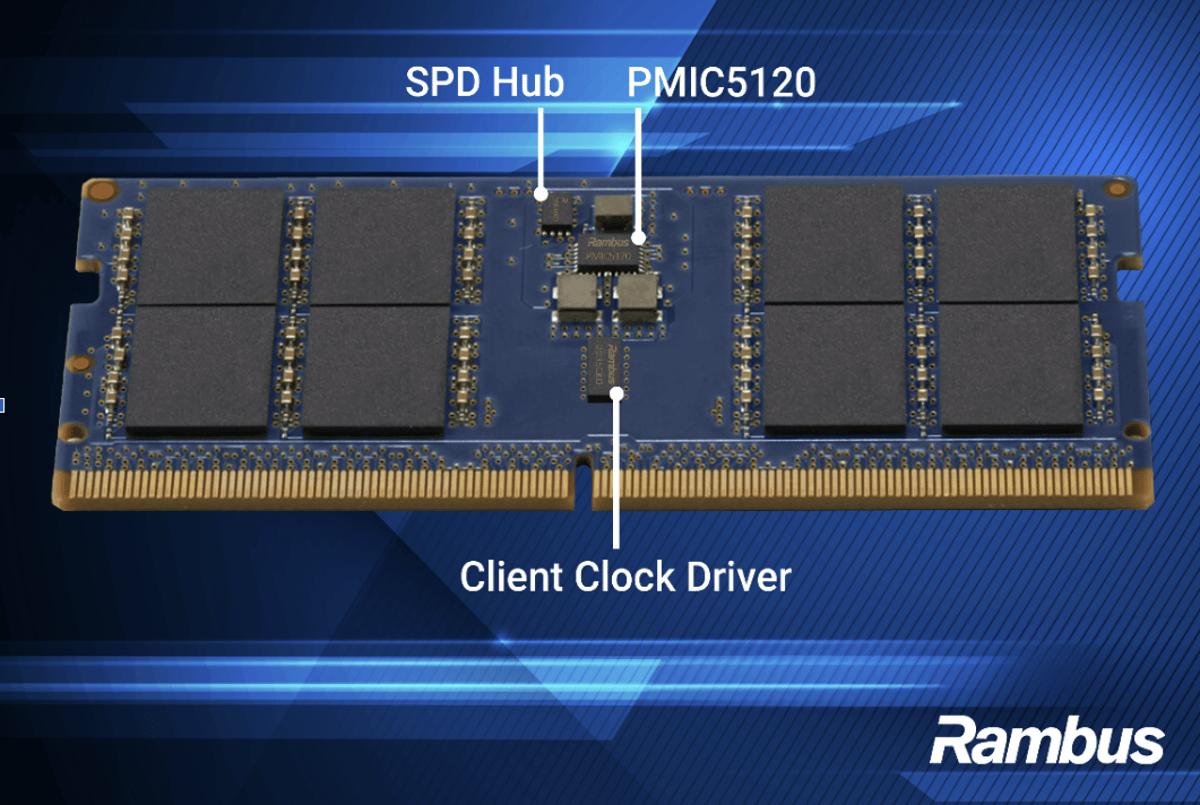
- •Full solution includes clock driver, PMIC, and SPD hub
Pulse Analysis
The race to higher‑speed DDR5 memory has intensified as AI workloads migrate from data centers to the edge. Traditional DDR5 modules top out around 6,400 MT/s, where signal‑integrity and clock‑jitter become limiting factors for bandwidth‑hungry applications. Agentic AI—systems that plan, execute, and adapt tasks in real time—demands continuous data movement between CPU and memory, making the next leap in client‑side memory performance a strategic priority for chipmakers and OEMs alike.
Rambus’s DDR5 9600 client chipset tackles these challenges with a three‑chip architecture. The Gen2 CKD02 clock driver retimes and redistributes the processor’s clock across the DRAM chips, preserving signal fidelity at 9,600 MT/s. The PMIC5120 steps down system voltage to optimal levels for the memory array, while the SPD hub provides module identification and telemetry. By packaging these functions for emerging CUDIMM, CQDIMM, and CSODIMM formats, Rambus offers a turnkey solution that sidesteps the costly redesigns typically required to push DDR5 beyond its conventional limits.
For the market, this advancement could accelerate the rollout of AI‑enabled laptops, workstations, and gaming rigs that rely on on‑device inference and generative models. Faster, more efficient memory translates to lower latency and higher throughput for tasks such as real‑time video upscaling, AI‑assisted design, and immersive gaming experiences. Analysts anticipate that as the ecosystem adopts these high‑speed modules, OEMs will differentiate products on AI performance, prompting a cascade of software optimizations and further investment in client‑side AI accelerators. Rambus’s move therefore not only addresses a technical bottleneck but also reshapes the competitive landscape for next‑generation intelligent PCs.
Rambus targets agentic AI workloads with faster client memory chipset
Comments
Want to join the conversation?
Loading comments...