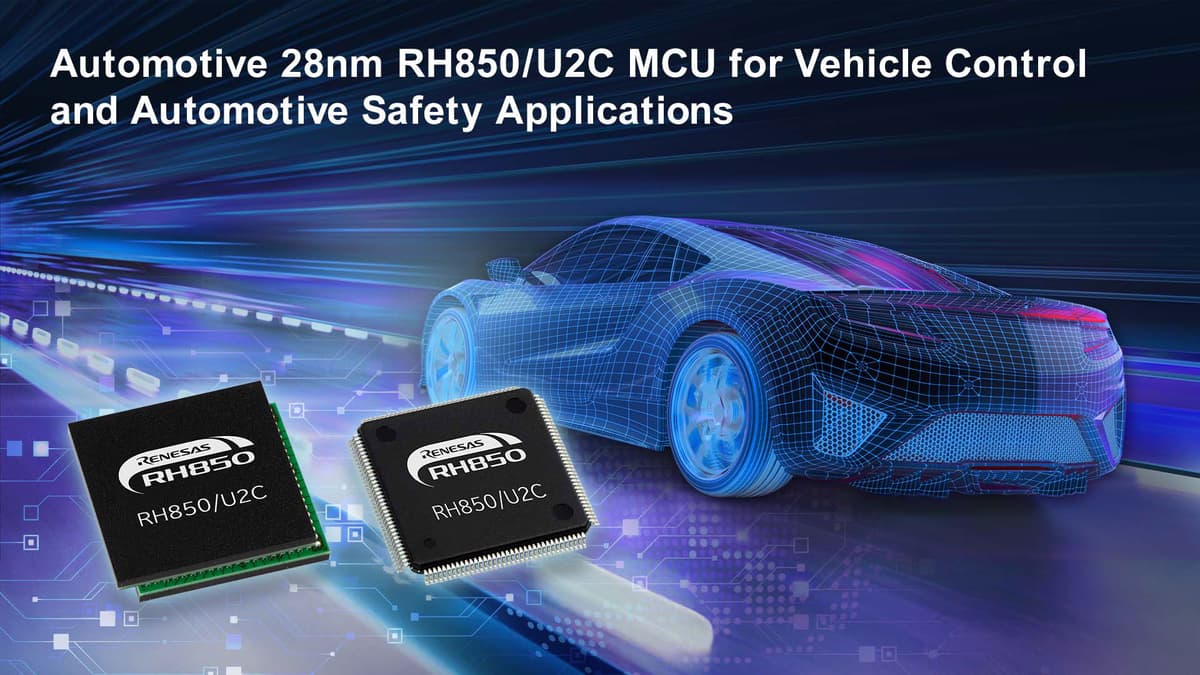
Renesas Launches RH850/U2C Automotive Controller
•March 4, 2026
0
Why It Matters
The RH850/U2C gives OEMs a cost‑effective, high‑performance MCU that satisfies stringent functional‑safety and cybersecurity requirements, accelerating the rollout of next‑generation vehicle ECUs.
Key Takeaways
- •28nm RH850/U2C adds four cores up to 320 MHz
- •Includes dual lockstep cores for ASIL‑D safety
- •Supports Ethernet TSN, CAN‑XL, I3C, CAN‑FD, LIN
- •Up to 8 MB flash enables complex ECU functions
- •Enables migration from RH850/P1x and F1x families
Pulse Analysis
The automotive semiconductor market is rapidly consolidating around high‑density, low‑power microcontrollers that can handle the growing computational load of modern vehicles. Renesas’ decision to launch a 28 nm RH850/U2C reflects industry pressure to deliver more cores and larger memory footprints without sacrificing power efficiency. By offering a four‑core architecture with lockstep capability, the chip addresses the need for deterministic performance in safety‑critical domains such as chassis control and battery management, while remaining affordable for mass‑market body‑control units.
Technical specifications set the RH850/U2C apart from its peers. The dual lockstep cores provide redundancy required for ASIL D compliance under ISO 26262, and the inclusion of Ethernet Time‑Sensitive Networking (TSN) alongside CAN‑XL and I3C equips designers with a versatile communications stack for high‑bandwidth sensor fusion and over‑the‑air updates. With up to 8 MB of flash, developers can integrate sophisticated algorithms directly on the ECU, reducing reliance on external memory and simplifying board layouts. Moreover, the MCU’s adherence to ISO/SAE 21434 ensures that cybersecurity considerations are baked into the hardware, a growing priority as vehicles become increasingly connected.
From a market perspective, the RH850/U2C strengthens Renesas’ position against competitors like NXP and Infineon, who are also expanding their automotive MCU portfolios. OEMs seeking a migration path from legacy RH850/P1x and F1x devices will find the new part’s software reusability attractive, shortening development cycles and lowering validation costs. As vehicle architectures evolve toward centralized domain controllers, the RH850/U2C’s blend of performance, safety, and connectivity makes it a compelling choice for next‑generation electric and autonomous platforms.
Renesas launches RH850/U2C automotive controller
0
Comments
Want to join the conversation?
Loading comments...