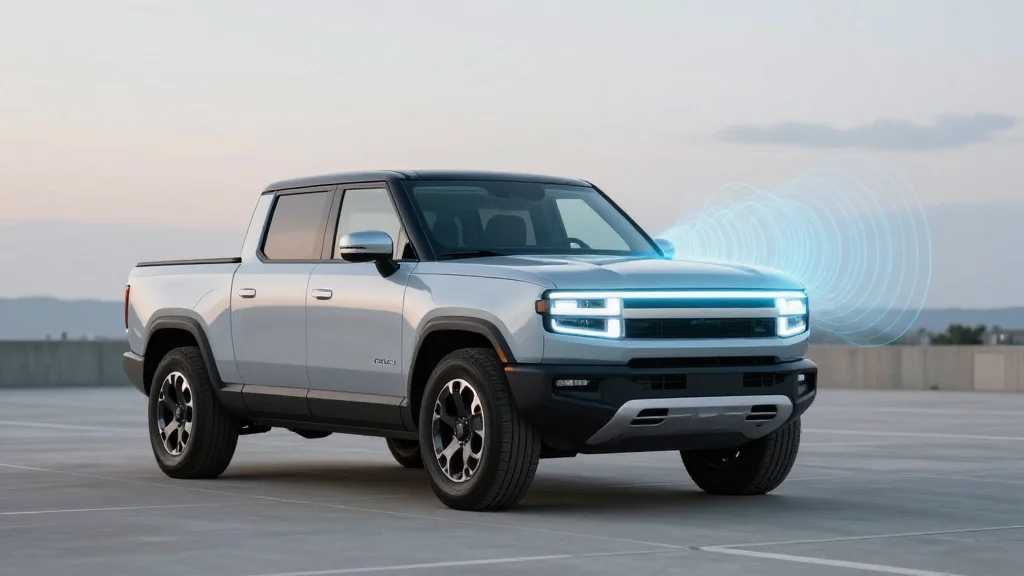
Rivian Deploys AI Voice Assistant to R1T, R1S and Future R2 via OTA Update

Companies Mentioned
Why It Matters
Rivian’s AI assistant illustrates how EV manufacturers can turn existing compute hardware into a platform for consumer‑facing services, blurring the line between vehicle and smart device. By delivering the assistant OTA, Rivian demonstrates that hardware upgrades are no longer the sole path to new functionality; software can unlock value throughout a vehicle’s lifecycle. The approach also pressures competitors to integrate similar native AI layers, potentially accelerating a race to embed more sophisticated, privacy‑aware voice interfaces in next‑generation EVs. For investors and suppliers, the announcement signals growing demand for high‑performance automotive processors, memory, and sensor suites capable of supporting multimodal AI workloads. It also highlights the importance of robust OTA infrastructure, a capability that could become a differentiator in the crowded EV market.
Key Takeaways
- •Rivian Assistant launched OTA to all R1T and R1S owners on Connect Plus plan
- •Feature will be native to the upcoming R2 at launch later this year
- •Assistant runs on vehicle’s onboard compute hardware via Unified Intelligence platform
- •Supports context‑aware commands such as "Make everyone's seat toasty except mine"
- •OTA delivery reduces reliance on phone mirroring and external cloud services
Pulse Analysis
Rivian’s decision to embed a full‑stack AI assistant directly into its vehicles marks a strategic pivot from treating voice control as an afterthought to positioning it as a core user experience. The company’s Unified Intelligence architecture mirrors trends in consumer tech where a single AI model powers multiple services, but the automotive context adds layers of complexity: real‑time safety constraints, limited bandwidth, and stringent privacy requirements. By keeping inference on the vehicle, Rivian sidesteps latency issues that could compromise driver confidence, especially in scenarios like adjusting drive mode or ride height while the vehicle is in motion.
Historically, automakers have relied on third‑party ecosystems—Apple CarPlay, Android Auto—to provide voice interaction, effectively outsourcing the experience. Rivian’s native solution could force a reevaluation of those partnerships, especially if the assistant proves more reliable or offers deeper integration with vehicle subsystems. The move also aligns Rivian with a broader industry push toward software-defined vehicles, where OTA updates become the primary mechanism for feature rollouts and revenue generation.
From a market perspective, the rollout may accelerate demand for automotive‑grade GPUs and AI accelerators, benefitting chipmakers that have positioned themselves for in‑car AI workloads. Suppliers that can deliver low‑power, high‑throughput compute modules will find a growing customer base as more OEMs adopt similar strategies. However, the success of Rivian’s assistant will hinge on user adoption and the perceived value of context‑aware commands versus existing smartphone assistants. If drivers find the native system more convenient and trustworthy, it could set a new benchmark for in‑vehicle AI, prompting a wave of competitive responses from legacy manufacturers and new entrants alike.
Rivian Deploys AI Voice Assistant to R1T, R1S and Future R2 via OTA Update
Comments
Want to join the conversation?
Loading comments...