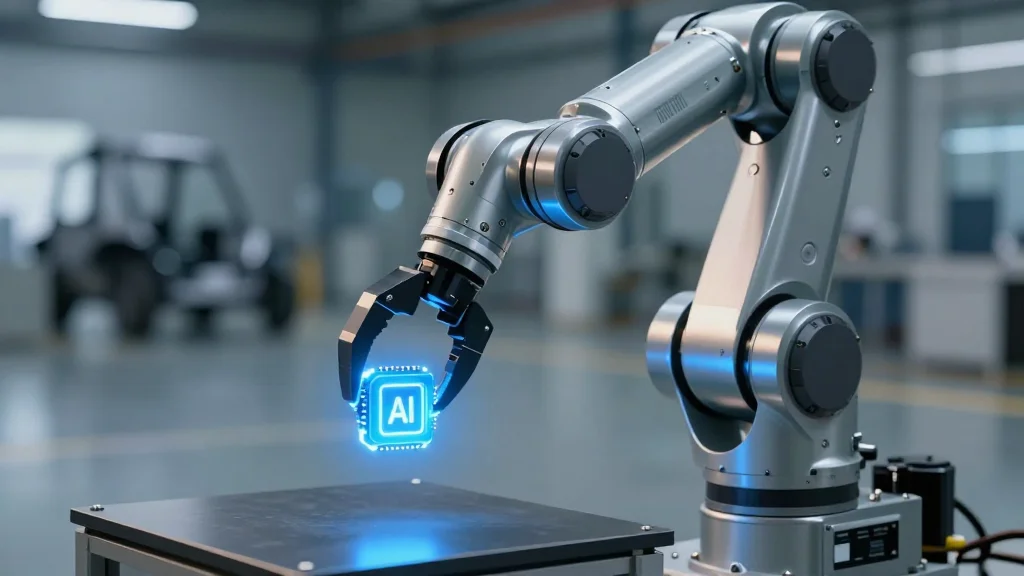
Rivian’s Mind Robotics Valued at $3.4 B After $400 M Funding Round

Companies Mentioned
Why It Matters
The valuation of Mind Robotics marks a pivotal moment for hardware startups that blend robotics with AI. By securing $400 million at a $3.4 billion valuation, the company demonstrates that investors see tangible upside in automating manufacturing—a sector under pressure from labor shortages and rising costs. For Rivian, the move diversifies its business model, potentially offsetting the capital intensity of EV production with a high‑margin hardware offering. If Mind Robotics can deliver on its promise of cost‑reducing, AI‑enhanced robots, it could set a new benchmark for how automakers integrate advanced hardware into their supply chains. Success would likely spur other OEMs to accelerate similar spin‑outs or partnerships, reshaping the competitive dynamics of both the automotive and industrial automation markets.
Key Takeaways
- •Mind Robotics raised $400 million, pushing its valuation to $3.4 billion.
- •Rivian holds approximately 38 % of Mind Robotics, linking the spin‑out’s success to its own balance sheet.
- •Robots aim to cut Rivian’s cost of goods and address labor shortages in vehicle manufacturing.
- •Mind Robotics targets non‑humanoid industrial robots, differentiating from competitors like Tesla.
- •The global industrial robotics market is forecast to reach $70 billion by 2030.
Pulse Analysis
Rivian’s decision to spin out and heavily back Mind Robotics reflects a broader shift among capital‑intensive manufacturers toward vertical integration of automation technology. Historically, automakers have relied on third‑party suppliers for robotics, but the high cost of EV production and the need for rapid scaling have made in‑house solutions more attractive. By owning a majority stake in a robotics firm, Rivian can internalize the R&D spend, accelerate iteration cycles, and potentially monetize the technology through external sales.
The funding round also underscores the growing convergence of AI and hardware. Mind Robotics is not just building mechanical arms; it is developing a proprietary AI stack to enable perception, planning, and adaptive control. This dual focus could give it a defensible moat against pure‑hardware players that lack sophisticated software, and against AI‑only firms that must partner with hardware manufacturers. If Mind can demonstrate measurable cost reductions in Rivian’s factories, it will create a compelling case study that could attract a broader industrial customer base, driving revenue diversification for Rivian and validating the $3.4 billion valuation.
However, execution risk remains high. Scaling robot production to meet external demand requires robust supply chains for sensors, actuators, and compute hardware—areas where supply constraints have already impacted the broader semiconductor and EV markets. Moreover, the timeline for achieving meaningful margin improvements is uncertain; investors will likely scrutinize Rivian’s quarterly reports for early signs of cost savings. In sum, while the financing round is a strong vote of confidence, the true test will be whether Mind Robotics can translate its capital into commercial hardware that delivers on its cost‑cutting promise.
Rivian’s Mind Robotics valued at $3.4 B after $400 M funding round
Comments
Want to join the conversation?
Loading comments...