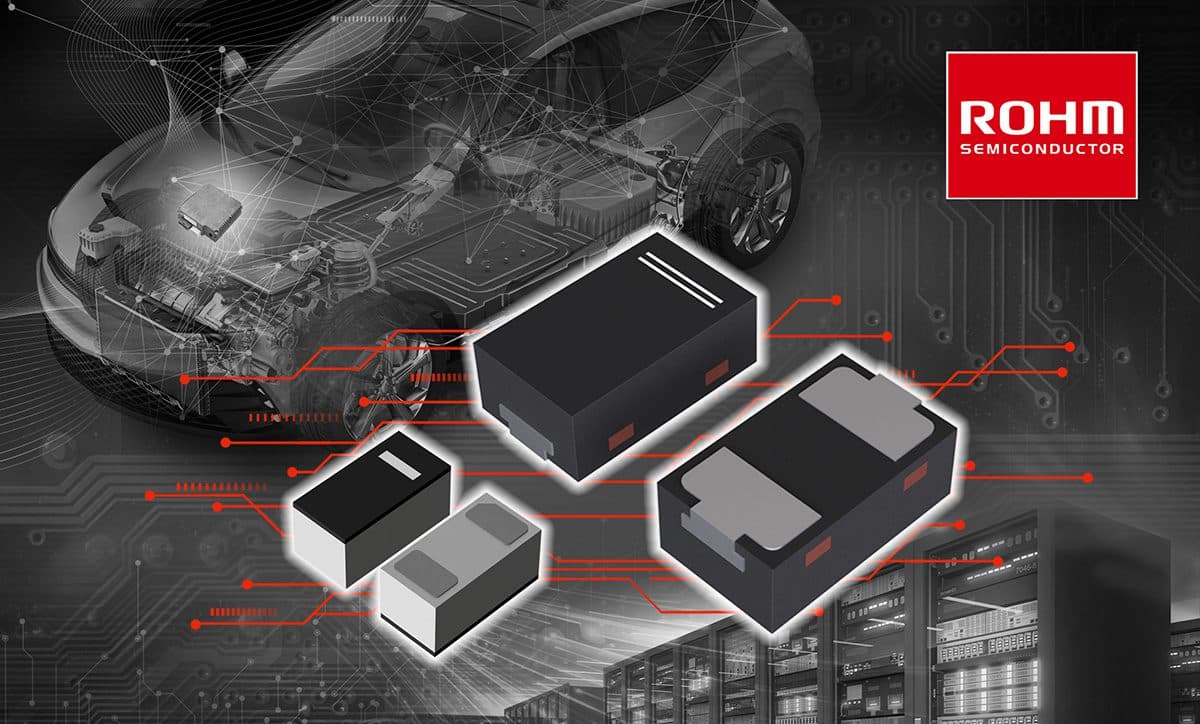
ROHM’s New ESD Diodes Protect 10+ Gbps Automotive Interfaces
Why It Matters
The new diodes enable reliable 10 Gbps+ communication in vehicles without degrading signal integrity, accelerating the rollout of advanced driver‑assistance and autonomous‑driving features. Their broader applicability also strengthens ROHM’s position in high‑speed data‑center and telecom markets.
Key Takeaways
- •RESDxVx diodes achieve 0.24 pF capacitance with 0.28 Ω resistance
- •Clamping voltage 40% lower than competing products at same capacitance
- •Automotive variants hold AEC‑Q101 certification for ADAS and camera systems
- •Non‑automotive versions target AI servers, 5G/6G base stations, USB4
Pulse Analysis
High‑speed automotive networks such as Ethernet‑based ADAS and autonomous‑driving cameras demand ESD protection that does not compromise signal fidelity. Traditional solutions either add parasitic capacitance, which blurs eye‑patterns at 10 Gbps and above, or increase dynamic resistance, weakening the clamping response. ROHM’s RESDxVx series tackles both issues by delivering sub‑0.5 pF capacitance while maintaining a low 0.28 Ω resistance, a combination that preserves waveform integrity and safeguards downstream ICs from electrostatic discharge.
The RESDxVx family includes four automotive‑qualified parts—RESD3V3BASAFH, RESD5V0BASAFH, RESD3V3UASAFH, and RESD5V0UASAFH—packaged in DFN1006‑2W and certified to AEC‑Q101 standards. These devices are positioned for critical vehicle subsystems such as surround‑view cameras, lidar interfaces, and high‑speed ECUs that rely on SerDes links. By offering a clamping voltage roughly 40% lower than legacy competitors at equivalent capacitance, the diodes improve protection margins without adding jitter, a key factor for meeting the stringent latency and reliability requirements of next‑generation driver‑assist platforms.
Beyond the automotive sphere, ROHM extends the RESDxVx line to data‑center switches, AI accelerator boards, and 5G/6G base stations, where similar high‑frequency signaling challenges exist. The low‑capacitance, low‑resistance profile aligns with the needs of USB4, Thunderbolt 4, PCIe, and HDMI interfaces, potentially influencing component selection across the broader high‑speed ecosystem. As vehicle architectures converge with data‑center and telecom standards, ROHM’s solution could become a common denominator, driving economies of scale and accelerating the adoption of unified high‑speed interconnects across industries.
ROHM’s new ESD diodes protect 10+ Gbps automotive interfaces
Comments
Want to join the conversation?
Loading comments...