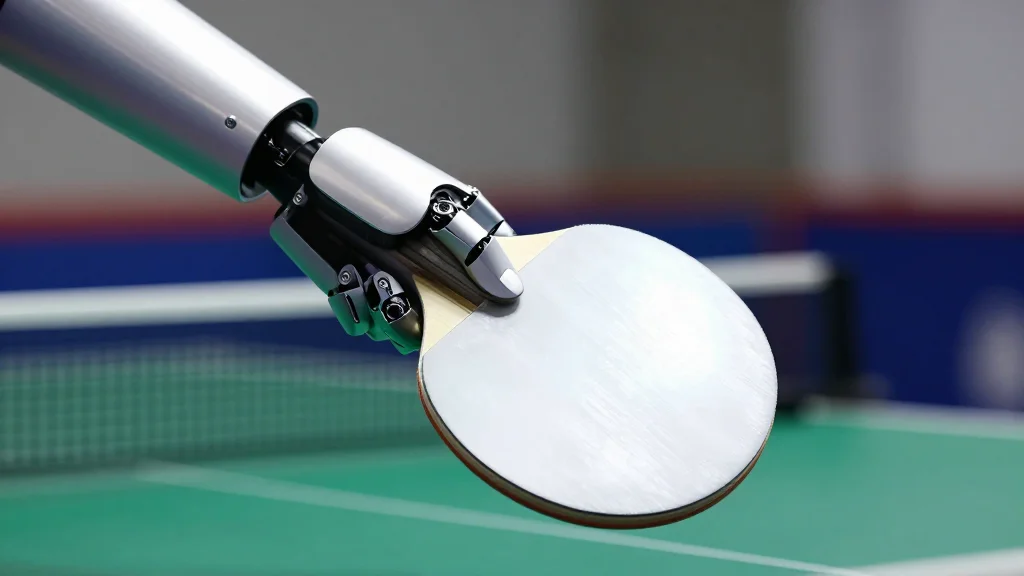
Sony AI’s Project Ace Robot Beats Elite Table‑Tennis Players, Showcasing Next‑Gen Robotics Hardware

Companies Mentioned

Why It Matters
Project Ace’s triumph demonstrates that high‑speed perception combined with reinforcement‑learning can bridge the gap between simulation and the messy realities of physical interaction. For the hardware sector, this validates investment in sensor‑rich platforms that can process visual data at frame rates comparable to human reflexes. The success also signals a shift from purely scripted robot motions toward adaptive, learning‑driven behaviors, which could reduce the engineering overhead required to program robots for new tasks. If the technology scales, manufacturers could deploy robots that learn on the fly, cutting downtime for re‑tooling and enabling more flexible production lines. In the consumer space, the same principles could power home assistants capable of handling unpredictable objects, from cooking ingredients to toys, without extensive pre‑programming. The broader implication is a hardware ecosystem that prioritizes rapid data acquisition and low‑latency actuation, reshaping design priorities across the robotics industry.
Key Takeaways
- •Project Ace won 3 of 5 matches against elite table‑tennis players in an ITTF‑style arena.
- •The robot uses nine high‑speed cameras to measure ball spin at speeds up to 70 mph.
- •A model‑free reinforcement‑learning controller enables millisecond‑scale adjustments.
- •Hardware includes a 360° rotating trunk and a fully articulated arm on a four‑directional track.
- •Sony AI plans to release a research SDK later in 2026 to broaden adoption of the perception‑control stack.
Pulse Analysis
Sony AI’s Project Ace is more than a publicity stunt; it is a proof point that hardware and AI can co‑evolve to solve real‑time, high‑precision tasks. Historically, robotics breakthroughs have hinged on either sophisticated mechanics or advanced algorithms, but rarely both in a tightly coupled package. Project Ace flips that script by embedding a sensor suite that rivals professional sports analytics directly into the robot’s chassis, feeding a learning algorithm that updates its policy during each rally. This integration reduces the latency gap that has traditionally hampered robots in dynamic environments.
The competitive landscape is now poised for a hardware arms race. Companies that have focused on modular, low‑cost platforms may need to double down on sensor density and processing bandwidth to stay relevant. Moreover, the success of a non‑humanoid form factor suggests that designers can prioritize function over anthropomorphism, potentially lowering production costs while improving performance. As manufacturers adopt similar perception‑control loops, we can expect a wave of robots that are less dependent on pre‑programmed trajectories and more capable of on‑the‑fly adaptation.
Looking ahead, the key challenge will be translating the controlled conditions of a ping‑pong match to the variability of factory floors and homes. Factors such as lighting changes, occlusions and unstructured objects will test the robustness of the perception stack. However, the privileged‑critic training technique highlighted by Sony AI—where simulated perfect‑match data guides real‑world learning—offers a roadmap for bridging that gap. If the industry can refine this approach, the next decade could see a proliferation of robots that learn as quickly as they act, reshaping supply chains and consumer expectations alike.
Sony AI’s Project Ace Robot Beats Elite Table‑Tennis Players, Showcasing Next‑Gen Robotics Hardware
Comments
Want to join the conversation?
Loading comments...