SRAM Compilers Targeting Automotive SoCs on Advanced Nodes
Key Takeaways
- •Distributed SRAM reduces latency for AI workloads in automotive SoCs.
- •Up to 50% of a car SoC's die area may be SRAM.
- •Synopsys compilers target TSMC N5A (5nm) and N3A (3nm) automotive nodes.
- •Compilers offer high‑speed, ultra‑high‑density, and ASIL‑D‑ready options.
- •Optimized SRAM cuts power, leakage, and improves reliability under harsh conditions.
Pulse Analysis
The automotive semiconductor market is shifting from isolated domain controllers to zonal architectures that consolidate CPUs, GPUs, and neural processing units on a single chip. This consolidation drives a need for distributed on‑chip SRAM, which places data close to compute engines and eliminates the latency penalties of off‑chip DRAM. AI inference in vehicles—such as object detection and driver‑assist functions—generates unpredictable data streams that traditional cache hierarchies cannot handle efficiently, making SRAM placement a critical performance lever.
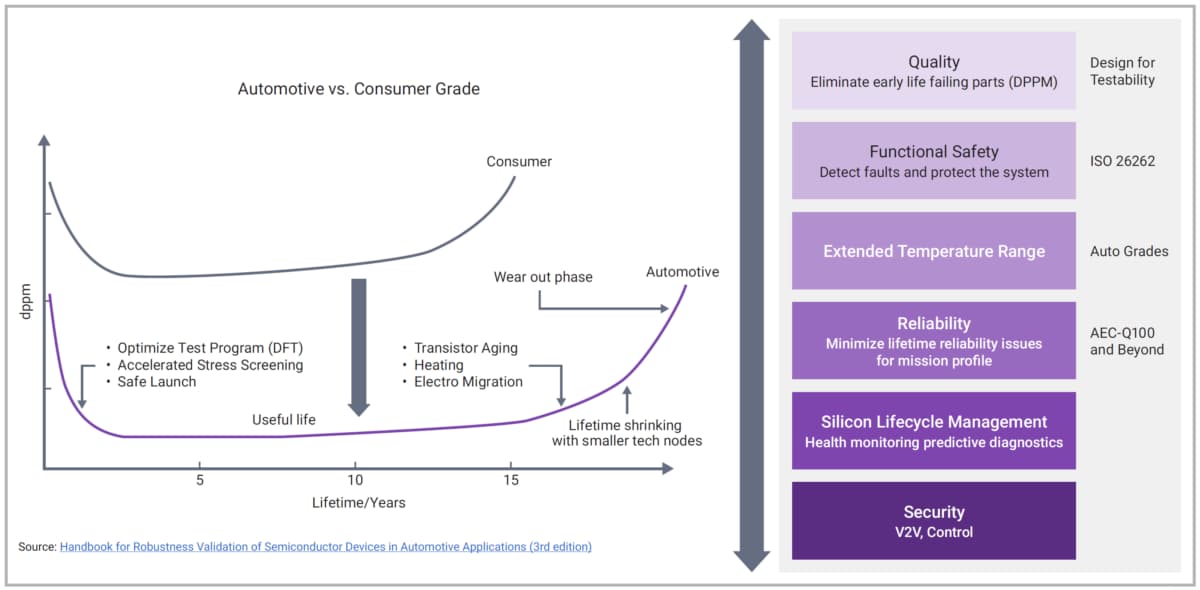
Moving these designs to aggressive process nodes like TSMC’s N5A and N3A introduces new reliability hurdles. The higher defect densities and thermal stresses of 5 nm and 3 nm technologies raise defective parts‑per‑million (DPPM) concerns, especially for automotive parts that must meet ISO 26262 ASIL‑D safety levels. Synopsys’s SRAM compilers address these challenges by offering high‑speed bit‑cells for maximum frequency, ultra‑high‑density cells for area‑constrained designs, and pseudo‑two‑port architectures that reduce power while preserving access bandwidth. Integrated techniques such as dynamic voltage and frequency scaling further curb leakage, directly improving thermal performance and long‑term reliability.
For chip makers, the availability of specialized SRAM compilers translates into faster time‑to‑market and lower engineering risk. By automating PPA optimization and embedding safety‑grade verification, designers can focus on system functionality rather than low‑level memory layout. The result is a new class of automotive SoCs that deliver AI‑level performance, meet stringent functional‑safety certifications, and remain cost‑effective despite the premium of advanced nodes. As vehicles become increasingly software‑defined, such memory‑centric innovations will be a cornerstone of future automotive electronics.
SRAM compilers targeting automotive SoCs on advanced nodes
Comments
Want to join the conversation?