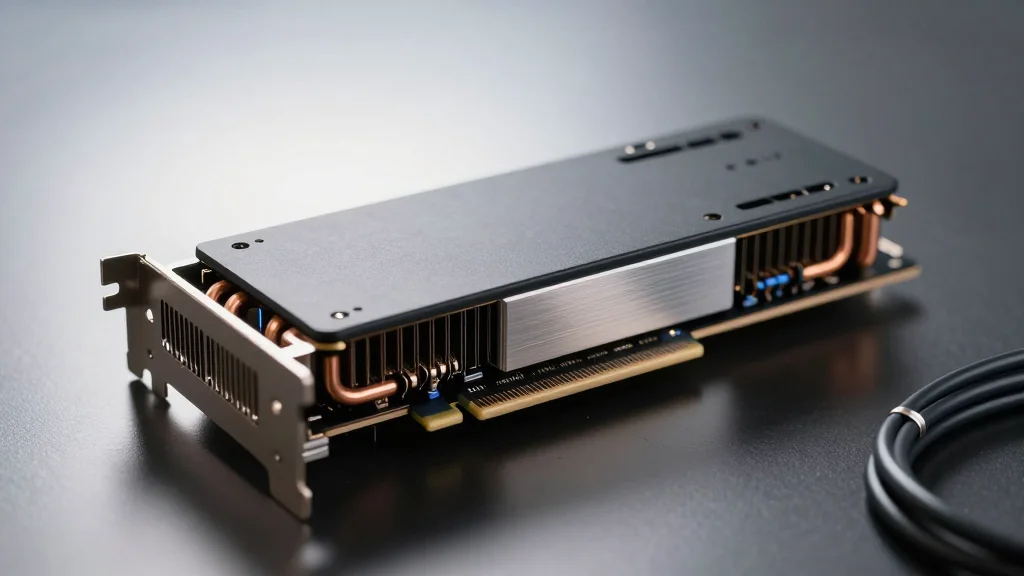
Startup Bolt Graphics Promises 5x Performance over Nvidia’s Best GPU
Companies Mentioned
Why It Matters
If the performance and efficiency claims hold, Zeus could disrupt Nvidia’s dominance in high‑end graphics and scientific computing, opening a new competitive frontier for GPU‑intensive workloads.
Key Takeaways
- •Zeus GPU claims 5× faster path tracing than Nvidia RTX 5090.
- •Power consumption 250 W, half of RTX 5090’s 575 W.
- •HPC version offers 20 TFLOPs FP64, far exceeding RTX 6000’s 1.4 TFLOPs.
- •Card includes 384 GB memory via two SO‑DIMM slots.
- •Native 400 GbE/800 GbE Ethernet enables large‑scale GPU interconnects.
Pulse Analysis
The GPU market has long been a duopoly, with Nvidia and AMD vying for dominance while newcomers struggle to gain traction. Bolt Graphics’ decision to tape out its Zeus chip on TSMC’s 12 nm node reflects a strategic bet on a mature, cost‑effective process that can meet the power‑efficiency targets it touts. By positioning the launch for late 2027, the startup gives itself a multi‑year runway to refine its architecture, secure silicon partners, and build a software ecosystem that can leverage its claimed performance gains.
Zeus’s headline numbers—five‑fold faster path‑tracing at 250 W and a 20 TFLOP FP64 HPC variant—directly challenge Nvidia’s flagship RTX 5090 and RTX 6000 cards. The reduced power envelope could lower total‑cost‑of‑ownership for data centers and professional studios, while the unprecedented 384 GB memory configuration, enabled by two SO‑DIMM slots, addresses the growing demand for massive datasets in AI‑assisted rendering and scientific simulation. Moreover, native 400 GbE and 800 GbE Ethernet ports simplify large‑scale GPU clustering, eliminating the need for additional networking hardware and potentially accelerating workflows in fields such as electromagnetic‑wave modeling.
Industry analysts see Zeus as a potential catalyst for greater competition, especially in niche markets like visual effects, engineering simulation, and high‑performance computing where absolute accuracy outweighs AI‑driven upscaling tricks. Adoption will hinge on real‑world benchmarks, driver stability, and ecosystem support from major software vendors. Should Bolt deliver on its promises, investors could see a shift in GPU pricing dynamics, and enterprises may diversify away from Nvidia’s premium pricing, fostering a more competitive landscape that benefits end users across gaming, content creation, and scientific research.
Startup Bolt Graphics promises 5x performance over Nvidia’s best GPU
Comments
Want to join the conversation?
Loading comments...