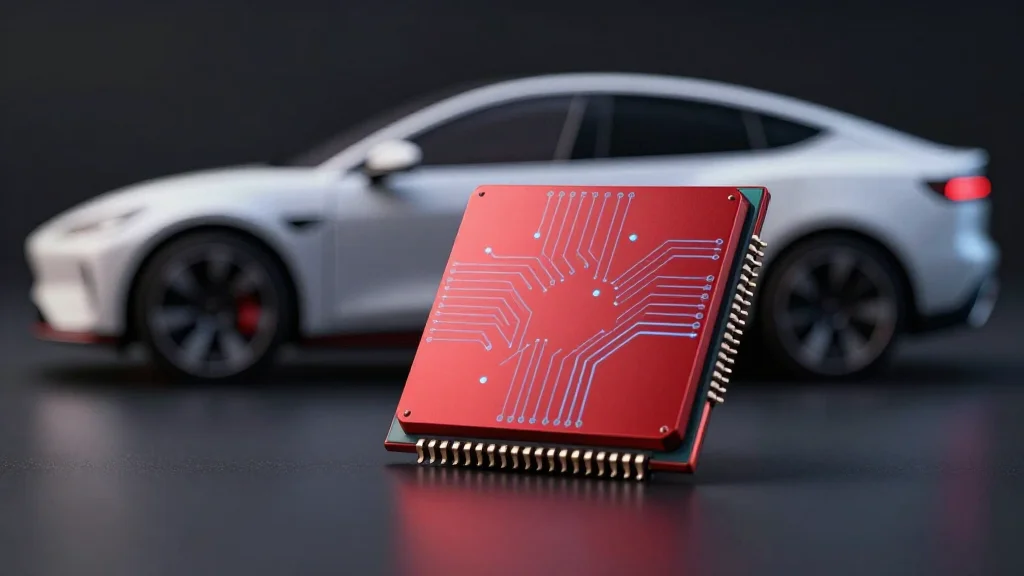
Tesla to Spend $2 B on AI‑Hardware Acquisition and Leverage Intel 14A for Terafab Chips

Companies Mentioned
Why It Matters
Tesla’s $2 billion AI‑hardware acquisition and its partnership with Intel on the 14A node mark a decisive shift toward vertical integration in the automotive AI market. By controlling more of the silicon supply chain, Tesla can reduce reliance on external foundries, accelerate feature rollouts for Full Self‑Driving, and potentially capture higher margins from software‑driven services. The move also intensifies competition with Nvidia, which has long dominated automotive AI, and could reshape the broader semiconductor ecosystem as other automakers seek similar in‑house solutions. The deal also underscores the growing convergence of automotive, robotics and data‑center workloads, all of which demand massive AI compute. Tesla’s Terafab ambition—building a dedicated fab for its own chips—could set a precedent for other high‑volume, high‑performance hardware manufacturers to pursue bespoke silicon strategies, influencing capital allocation and R&D priorities across the industry.
Key Takeaways
- •Tesla agreed to acquire an undisclosed AI‑hardware firm for up to $2 billion, with $1.8 billion tied to performance milestones.
- •Musk announced Tesla will use Intel’s upcoming 14A process for its Terafab chips, targeting a 2027‑2028 production window.
- •The AI4 Plus upgrade will double RAM per chip to 32 GB, matching Nvidia’s latest automotive GPUs.
- •Intel’s market cap hits a 25‑year high, buoyed by the Terafab partnership and a multi‑year Google contract.
- •Tesla’s total 2026 capital expenditure budget is $25 billion, with a large share earmarked for AI and silicon development.
Pulse Analysis
Tesla’s hardware gambit is more than a financial headline; it’s a strategic pivot that could redefine the economics of autonomous vehicle technology. Historically, automakers have been content to source chips from established foundries, accepting the trade‑off of higher unit costs for lower R&D risk. Tesla, however, is betting that owning the silicon stack will unlock a virtuous cycle: faster feature deployment, higher‑margin software services, and a defensible moat against rivals. The $2 billion acquisition likely brings in talent and IP that can accelerate the Terafab roadmap, reducing the typical 5‑7‑year lag between design and volume production.
The Intel 14A partnership is equally consequential. Intel has struggled to attract external customers for its advanced nodes, often ceding ground to TSMC and Samsung. Securing Tesla as a first‑customer for 14A not only validates the node’s viability but also injects a high‑volume, high‑performance workload that can justify the massive capital outlay required for advanced lithography. If Tesla can successfully tape‑out and qualify chips on 14A, it may force other automotive OEMs to reconsider their reliance on Nvidia’s Orin and explore alternative foundry options, potentially reshaping the competitive dynamics of the automotive silicon market.
Looking forward, the real test will be whether Tesla can translate these hardware investments into measurable performance gains for FSD and its robotaxi service. The AI4 Plus upgrade suggests incremental progress, but the ultimate payoff hinges on the Terafab chips delivering the compute density needed for unsupervised autonomy. If Tesla meets those targets, it could set a new benchmark for software‑defined automotive revenue, shifting the industry’s focus from vehicle sales to AI‑driven services. Conversely, delays or technical setbacks could expose Tesla to heightened capital risk and give competitors a window to consolidate their own silicon strategies. The coming year will be decisive for both Tesla’s hardware ambitions and the broader trajectory of automotive AI.
Tesla to Spend $2 B on AI‑Hardware Acquisition and Leverage Intel 14A for Terafab Chips
Comments
Want to join the conversation?
Loading comments...