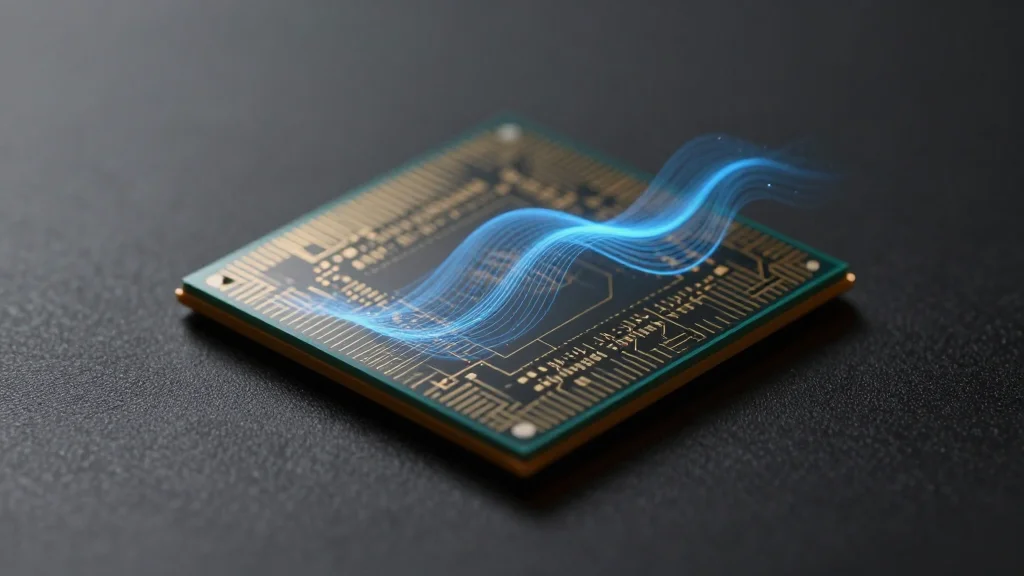
TetraMem Announces 22nm Multi-Level RRAM Analog In-Memory Computing SoC Milestone
Why It Matters
By eliminating costly data movement between memory and processors, the MLX200 can dramatically lower power consumption and latency for edge AI, accelerating the commercial adoption of analog in‑memory computing.
Key Takeaways
- •Tape‑out of MLX200 on TSMC 22 nm marks first commercial multi‑level RRAM SoC.
- •Multi‑level RRAM offers low‑voltage, high‑density compute‑in‑memory with CMOS compatibility.
- •Evaluation kits expected H2 2026 for voice, audio, wearables, and IoT edge AI.
- •TetraMem’s IP licensing opens path for other manufacturers to adopt analog IMC.
Pulse Analysis
Analog in‑memory computing (IMC) has emerged as a response to the "memory wall" that limits modern AI accelerators. Traditional architectures shuttle massive data sets between separate memory and compute units, inflating energy use and latency. Emerging non‑volatile memories such as resistive RAM (RRAM) enable computation to occur where data resides, delivering orders‑of‑magnitude efficiency gains for vector‑matrix workloads that dominate neural‑network inference. Industry analysts see IMC as a key enabler for the next generation of edge devices that must operate continuously on limited power budgets.
TetraMem’s MLX200 platform pushes the concept toward production readiness. Leveraging TSMC’s 22 nm node, the chip integrates multi‑level RRAM arrays with mixed‑signal compute engines, achieving low‑voltage, low‑current operation while maintaining CMOS compatibility. Early silicon validation shows consistent functionality across thousands of conductance levels, confirming the device’s retention, endurance, and density advantages. By embedding both memory and compute, the SoC can execute high‑throughput vector‑matrix multiplications with minimal data movement, a critical advantage for voice, audio, and always‑on sensing applications at the edge.
The commercial implications are significant. With evaluation kits slated for H2 2026, developers can prototype AI workloads that run longer on battery‑powered devices, opening new markets in wearables, IoT gateways, and autonomous sensors. TetraMem’s decision to license its multi‑level RRAM IP further lowers barriers for other semiconductor firms to adopt analog IMC, potentially spurring a broader ecosystem shift away from purely digital accelerators. As AI models grow larger and edge deployment expands, the energy‑efficiency edge offered by analog in‑memory computing could become a differentiator for next‑generation silicon, positioning TetraMem as a pivotal player in the emerging landscape.
TetraMem Announces 22nm Multi-Level RRAM Analog In-Memory Computing SoC Milestone
Comments
Want to join the conversation?
Loading comments...