Uncle Sam's Next Big Supercomputer Might Use Something More Exotic than GPUs

Companies Mentioned
Why It Matters
The validation gives the Department of Energy a non‑GPU path for exascale scientific simulations, preserving U.S. leadership in high‑performance computing as AI dominates GPU roadmaps.
Key Takeaways
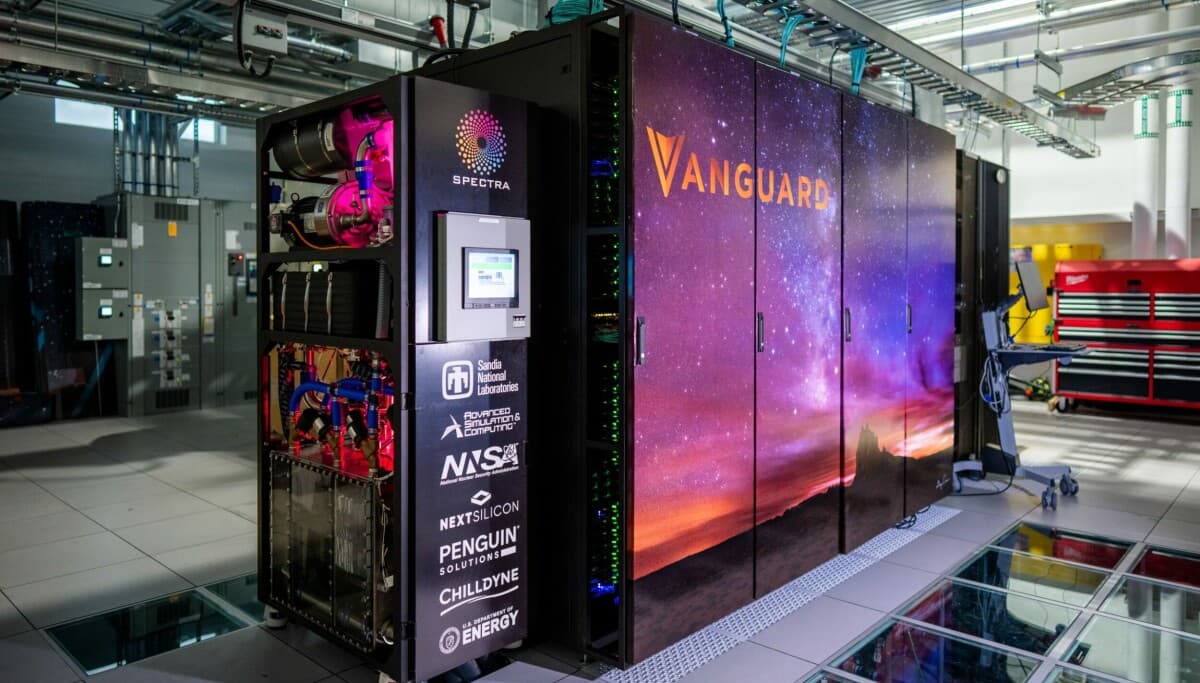
- •Sandia’s Spectra validated NextSilicon Maverick‑2 chips for FP64 workloads.
- •Maverick‑2 uses reconfigurable dataflow architecture, promising half the power of GPUs.
- •Single chip claims ~600 GFLOPS FP64, comparable to leading GPUs.
- •Nvidia’s new Rubin GPUs prioritize AI, limiting native FP64 performance.
- •China continues building custom silicon, highlighting US need for alternative HPC accelerators.
Pulse Analysis
The Department of Energy’s push for a new supercomputing paradigm stems from a widening gap between AI‑centric GPU designs and the high‑precision floating‑point needs of scientific research. While nine of the top ten supercomputers rely on Nvidia or AMD GPUs, those chips now emphasize FP4 and AI tensor cores, sacrificing native FP64 throughput. NextSilicon’s Maverick‑2 offers a dataflow‑first approach, configuring arithmetic units at runtime to eliminate traditional load‑store bottlenecks. By compiling existing C, Python, Fortran, or CUDA code into compute graphs, the startup promises a smoother migration path for legacy HPC applications, a critical advantage for labs wary of extensive software rewrites.
Maverick‑2’s architecture diverges sharply from the von Neumann model, arranging ALUs in a grid that processes data as soon as it arrives. Early benchmarks on Sandia’s Spectra system show the chip delivering roughly 600 gigaFLOPS of FP64 performance while consuming about half the power of comparable GPUs. In contrast, Nvidia’s upcoming Rubin GPUs, though delivering up to 50 petaFLOPS of AI‑oriented FP4, cap native FP64 at 33 teraFLOPS and rely on emulation techniques that can degrade accuracy for vector‑heavy workloads like computational fluid dynamics. AMD’s dual‑track strategy—AI‑focused MI455X and HPC‑tuned MI430X—highlights the industry’s split focus, yet both still operate within the GPU ecosystem.
Strategically, diversifying beyond GPUs mitigates supply‑chain risks and counters China’s home‑grown silicon initiatives, such as the Sunway TaihuLight and the rumored LineShine exascale system. As U.S. export controls tighten, fostering domestic alternatives like NextSilicon becomes a national security priority. Successful scaling of Maverick‑2 could spur a new class of exascale machines that blend AI agility with uncompromised scientific precision, reshaping the competitive landscape of high‑performance computing worldwide.
Uncle Sam's next big supercomputer might use something more exotic than GPUs
Comments
Want to join the conversation?
Loading comments...