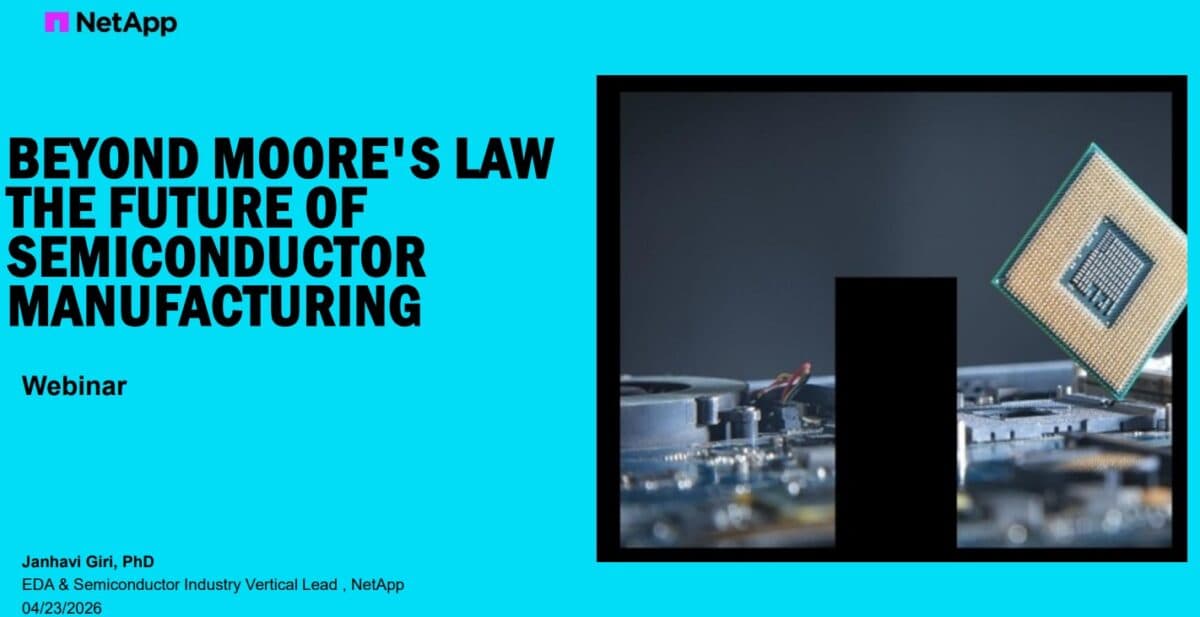
WEBINAR: Beyond Moore’s Law and The Future of Semiconductor Manufacturing Intelligence
Key Takeaways
- •AI digital twins enable predictive yield optimization
- •Agentic AI systems automate defect classification in real time
- •Generative design reduces mask costs for sub‑3nm nodes
- •Intelligent fab assistants streamline cross‑ecosystem workflow
- •Autonomous factories lower energy use and improve sustainability
Pulse Analysis
The semiconductor sector is confronting the end of Moore’s Law, with manufacturers racing toward sub‑3 nm processes that demand unprecedented precision. Traditional reactive automation can no longer keep pace with the exponential rise in design complexity, defect rates, and capital intensity. Companies are therefore investing in advanced data pipelines and AI frameworks that can ingest sensor streams, model process physics, and forecast yield outcomes before silicon leaves the fab floor. This strategic pivot is reshaping how fabs allocate resources and manage risk.
At the core of this transformation are AI‑driven digital twins and predictive metrology platforms that create virtual replicas of manufacturing lines. By simulating process variations in real time, these twins allow engineers to test corrective actions without halting production, dramatically shortening cycle times. Agentic AI systems further augment this capability by autonomously classifying defects and recommending process tweaks, while generative design algorithms optimize mask layouts to shave nanometers off critical dimensions. Together, these technologies form a feedback loop that continuously refines performance, driving both yield improvements and cost reductions.
For executives, the emergence of autonomous "AI Factories" signals a new competitive frontier. Cross‑ecosystem collaboration—linking equipment vendors, EDA tools, and cloud providers—enables a shared intelligence layer that scales across multiple fabs. Intelligent fab assistants act as digital copilots for process engineers, translating complex data into actionable insights. Beyond financial upside, these innovations also advance sustainability goals by lowering energy consumption and material waste. As the industry embraces this intelligent manufacturing paradigm, firms that integrate AI at the core of their production will secure a decisive edge in the global microelectronics market.
WEBINAR: Beyond Moore’s Law and The Future of Semiconductor Manufacturing Intelligence
Comments
Want to join the conversation?