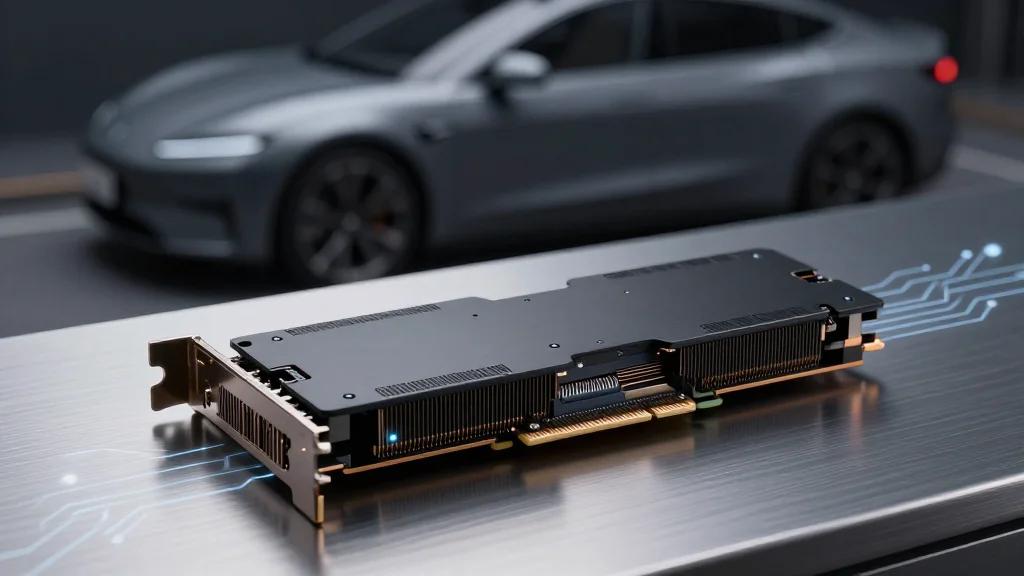
XPENG Launches X‑Cache Accelerator, Promising 2.7× Faster AI Inference for Autonomous Driving

Companies Mentioned
Why It Matters
X‑Cache represents a shift from brute‑force compute scaling to intelligent reuse of intermediate results, a strategy that could dramatically lower the cost of deploying high‑fidelity world models at scale. By cutting inference latency, the accelerator brings real‑time perception closer to the theoretical limits required for safe, high‑speed autonomous driving. Moreover, the plug‑and‑play approach lowers barriers for OEMs and tier‑1 suppliers, potentially accelerating the rollout of advanced driver‑assistance systems (ADAS) that rely on generative AI. If the technology proves robust across varied environments, it may set a new benchmark for hardware‑software co‑design in the automotive sector, prompting rivals to prioritize caching and safety‑aware inference shortcuts alongside raw processing power. This could reshape investment flows toward more efficient AI accelerators and influence standards for on‑vehicle AI safety mechanisms.
Key Takeaways
- •XPENG unveiled X‑Cache, a plug‑and‑play AI accelerator for autonomous‑driving world models.
- •X‑Cache claims up to 2.7 × faster denoising inference without requiring model retraining.
- •The system reuses intermediate features across temporally continuous video segments, skipping redundant layer computations.
- •Safety mechanism triggers full computation during scene transitions to prevent visual corruption.
- •Deployment begins in XPENG’s X‑World fleet in H2 2026, with pilots in China and Europe.
Pulse Analysis
XPENG’s X‑Cache is less a new silicon chip than a sophisticated control layer that sits atop existing compute stacks. By treating the video stream as a series of overlapping segments and caching feature maps when visual change is minimal, XPENG sidesteps the classic trade‑off between model fidelity and latency. Historically, automotive AI has leaned on custom ASICs—NVIDIA’s DRIVE Orin, Qualcomm’s Snapdragon Ride—to push raw FLOPS. X‑Cache flips that script, extracting more performance from the same silicon through algorithmic insight.
The 2.7× speedup figure, while impressive, must be contextualized. It applies to denoising inference within diffusion‑based world models, a niche yet increasingly important component of generative perception pipelines. If XPENG can demonstrate consistent gains across the full perception stack—including object detection, trajectory prediction, and planning—the broader industry may adopt similar caching heuristics. This could democratize high‑fidelity simulation, allowing smaller players without massive GPU farms to field competitive autonomous systems.
From a market perspective, X‑Cache could erode the premium that chipmakers charge for higher‑end automotive GPUs. OEMs may opt for a mixed strategy: a modest GPU paired with X‑Cache‑style software to meet latency targets at lower cost. In the short term, XPENG’s early mover advantage may translate into a measurable edge in vehicle range and thermal management, factors that directly influence consumer acceptance. Long‑term, the approach may inspire a new class of “intelligent accelerators” that blend caching, safety gating, and dynamic workload scheduling, reshaping the hardware roadmap for autonomous driving.
Overall, X‑Cache underscores the growing importance of software‑centric performance gains in a sector traditionally dominated by hardware breakthroughs. Its success will hinge on real‑world validation, but the concept could catalyze a wave of efficiency‑first designs across the automotive AI ecosystem.
XPENG launches X‑Cache accelerator, promising 2.7× faster AI inference for autonomous driving
Comments
Want to join the conversation?
Loading comments...