
The ACA’s 2027 Overhaul: What the NBPP Proposed Rule Actually Means for Health Tech Entrepreneurs
•February 11, 2026
0
Why It Matters
These rule changes reshape the ACA marketplace, turning it from a static, regulator‑driven environment into a fertile ground for health‑tech entrepreneurship and investment. Understanding the new levers—distribution, plan design, and long‑term contracts—helps founders and investors target underserved consumer segments and build compliance‑aware solutions that can capture emerging market share.
The ACA’s 2027 Overhaul: What the NBPP Proposed Rule Actually Means for Health Tech Entrepreneurs
Abstract
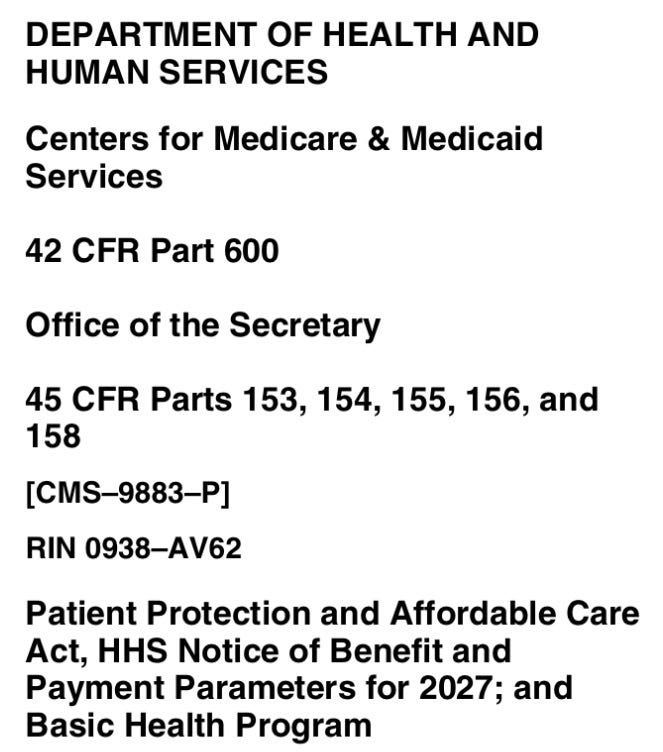
Source Rule: CMS-9883-P, HHS Notice of Benefit and Payment Parameters for 2027 (2027 Payment Notice Proposed Rule)
Comment Deadline: March 11, 2026
Codification: 42 CFR Part 600; 45 CFR Parts 153, 154, 155, 156, 158
Key provisions covered in this essay:
- State Exchange Enhanced Direct Enrollment (SBE-EDE) option
- Non-network QHP certification
- Standardized plan option repeal
- Non-standardized plan option limit removal
- ECP threshold reduction (35% to 20%)
- Multi-year catastrophic plan terms (up to 10 years)
- Bronze plan cost-sharing restructuring
- SEIPM improper payment program for state exchanges
- SEP pre-enrollment verification (75% threshold)
- Agent/broker marketing crackdown and consent standardization
- HHS-RADV methodology updates
- MLR standard comment solicitation
Who should care:
- Founders building in ACA marketplace infrastructure
- Investors with portfolio exposure to payer tech, benefits navigation, enrollment tech, or direct primary care
- Anyone building in the commercial insurance adjacent space who keeps confusing “the market” with “Medicare” (it’s not just Medicare, promise)
Table of Contents
Why this rule matters more than the usual CMS boilerplate
The SBE-EDE option and what it does to distribution tech
Non-network plans get QHP certification: the direct care play
Plan design liberation: standardized options out, creativity in
ECP threshold cut and what that means for safety-net adjacent tech
Multi-year catastrophic plans: the chronic care engagement opportunity
Enrollment integrity crackdown: compliance tech gets its moment
Risk adjustment updates and the data infrastructure angle
The MLR wildcard: what CMS is actually signaling
How to think about the opportunity stack as an investor or founder
Why this rule matters more than the usual CMS boilerplate
Every year CMS drops a payment notice and every year most people in health tech skim the press release, nod along to the risk adjustment user fee update, and move on with their lives. The 2027 Payment Notice proposed rule is different, and not in a performative “this one changes everything” kind of way. It is different because several provisions in it represent a genuine, structural shift in how individual market insurance is designed, distributed, and administered, which creates real greenfield for entrepreneurs who are paying attention.
The backstory here matters. The current administration came into office with a deregulatory posture, and the Working Families Tax Cut legislation (Pub. L. 119-21), enacted July 4, 2025, functionally reshaped who gets subsidized on the ACA exchanges. The 2027 rule is largely a downstream codification exercise implementing WFTC’s eligibility restrictions, but it is also using that vehicle to push through a bunch of structural changes that are not just technocratic cleanup. Non-network QHP certification, the SBE Enhanced Direct Enrollment option, the repeal of standardized plan requirements, the multi-year catastrophic plan framework, the ECP threshold reduction from 35 to 20 percent – these are real product market implications.
The individual market is currently covering somewhere north of 21 million people through ACA exchanges, with that figure having grown significantly over the enhanced APTC period that began under the American Rescue Plan. The WFTC changes will compress eligibility somewhat, particularly by removing APTC access for undocumented immigrants and certain lawfully present noncitizens below 100 percent FPL. But the market is still enormous, still growing in certain demographics, and still deeply underserved by modern product design. That context is the backdrop against which every provision discussed below should be read.
The SBE-EDE option and what it does to distribution tech
The State Exchange Enhanced Direct Enrollment option is probably the single most interesting provision in this rule from a distribution technology standpoint. Here is what it actually does: it allows a state-based exchange to forgo operating its own consumer-facing eligibility and enrollment website entirely, and instead route everything through HHS-approved web brokers. Read that again. A state exchange could become functionally invisible to the end consumer, with the entire enrollment experience running through a private sector web interface.
This builds on existing Enhanced Direct Enrollment infrastructure that already exists in the federal exchange context, but it dramatically expands the surface area of private sector involvement. Today the EDE model allows web brokers to offer an enrollment experience as an alternative to healthcare.gov(http://healthcare.gov) in FFE states. The SBE-EDE proposal would allow states to make that the only experience. No state portal. Just web brokers.
For founders building in enrollment technology, this is significant. The incumbent enrollment tech landscape is dominated by a handful of legacy platforms that were built for the pre-EDE world and have been retrofitting to accommodate modern UX. A market where states are actively choosing to fully privatize the enrollment interface is a market where new distribution technology can actually gain traction against entrenched players without having to fight through state procurement. The barrier to winning in this space shifts from government contract relationships toward consumer experience quality and data fidelity, which is a far more favorable battlefield for startups.
Simultaneously, the rule proposes tighter standards of conduct for agents, brokers, and web brokers, including mandating HHS-approved consent forms, prohibiting cash inducements, and cracking down on misleading marketing around zero-dollar premiums. This is not incidental. CMS has been dealing with a wave of fraudulent enrollment activity, and the enhanced distribution pathway comes paired with enhanced compliance infrastructure. That creates a two-sided opportunity: build the distribution UX, and build the compliance infrastructure underneath it. Both are real businesses.
The vendor training program is also being sunset under this rule, with agents and brokers moving to direct access through the Marketplace Learning Management System. This further decentralizes the training ecosystem and opens surface area for new education and credentialing products in the broker enablement space.
Non-network plans get QHP certification: the direct care play
This is the provision that should have every DPC founder and DPC-adjacent investor paying close attention. CMS is proposing to allow non-network plans to receive QHP certification beginning in plan year 2027. That is a structural change, not a marginal one.
Currently, every QHP on an exchange has to use a contracted provider network. That is the foundational assumption baked into how plan design, network adequacy review, ECP contracting, and essentially the entire regulatory scaffold of exchange certification works. Removing that requirement, even for a subset of plans, rewrites the rules of engagement for how care delivery and insurance can intersect.
Under the proposed framework, a non-network plan would instead need to demonstrate “sufficient choice of providers that accept the plan’s benefit amount as payment in full.” The plan sets a benefit amount. Consumers can go to any provider who accepts that amount. CMS frames this as a price transparency and competition play – let consumers shop, let providers compete on price, let the market clear. That is very much the current administration’s ideological lane.
The commercial analogy here is the reference-based pricing model that has gotten traction in self-funded employer markets over the last decade. Companies like MultiPlan, Zelis, and others have built significant businesses helping payers execute on non-network or reference-based payment logic. Now that framework has a potential pathway into the individual exchange market, which was previously off-limits for this approach. That is a new market.
For DPC operators specifically, this is worth watching carefully. A QHP designed around a reference-based payment structure, paired with a DPC membership as the primary care layer, could clear a much simpler regulatory path than has historically existed. The DPC world has been largely orthogonal to the exchange market because DPC memberships are not insurance and the exchange market required comprehensive QHP coverage. If non-network QHPs can be certified, and if those plans are designed to pair with direct care relationships for primary care functions, you start to see a path toward a bundled product that could actually clear QHP certification. That is not trivially easy to build and it would face meaningful pushback from the insurance and hospital lobbies, but the regulatory door is now at least ajar in a way it was not before.
Plan design liberation: standardized options out, creativity in
The repeal of standardized plan option requirements is getting less attention than it deserves. Since 2022, CMS has required issuers on federal exchange states to offer standardized plan options at each metal level, with specific cost-sharing structures dictated by CMS. This was a consumer protection and simplicity measure – fewer, more comparable plans make for easier shopping. It also was a meaningful constraint on product design innovation.
The 2027 rule proposes to eliminate the standardized plan requirement entirely. It also proposes to eliminate the cap on non-standardized plan options. Previously, issuers were limited in how many non-standardized variants they could offer, with an exceptions process for chronic and high-cost condition plans. All of that goes away under this proposal.
From a payer technology standpoint, this opens up significant design space. Actuarial teams at regional carriers, CO-OPs, and insurtech companies will now have more freedom to build products tailored to specific population segments, condition-specific cost sharing structures, or value-based benefit designs. The flip side is that more plan complexity typically means consumers need more help navigating it, which means the guidance and decision support layer of the market gets more valuable.
A few specific builds become more interesting here. Condition-specific plan designs that have been constrained by the standardized option framework can now be brought to market with more creative cost-sharing structures. Think about an insurer that wants to offer a plan with zero cost-sharing for GLP-1 medications combined with structured lifestyle intervention, building the incentive for adherence into the plan design itself. The standardized option framework made that kind of targeted design hard to execute cleanly at the exchange level. Without that constraint, the design space gets genuinely interesting.
The decision support technology angle is also worth flagging. When every plan looks similar because of standardization requirements, choosing among them is still hard but not dramatically differentiated by condition-specific factors. In a world with more plan variation, consumers with specific chronic conditions, specific utilization patterns, or specific preferred provider relationships need significantly better decision support tools. The benefits navigation and plan selection space – already populated by companies like Picwell, ALEX, and similar players – gets structurally more important in a less standardized market.
ECP threshold cut and what that means for safety-net adjacent tech
The reduction in essential community provider contracting thresholds from 35 percent to 20 percent is a somewhat technical provision that has real downstream consequences. ECPs are providers who disproportionately serve low-income and medically underserved populations – FQHCs, family planning providers, Ryan White HIV clinics, and similar organizations. The current rule requires QHP issuers to contract with at least 35 percent of ECPs in their service area, with separate sub-thresholds for FQHCs and family planning providers at the same 35 percent minimum.
Dropping that to 20 percent gives issuers more flexibility and less administrative burden around ECP contracting, but it also means that exchange plans are structurally less obligated to maintain deep relationships with safety net providers. That shifts the connectivity burden. If a large portion of a health plan’s membership historically accessing care through FQHCs and similar facilities is on an exchange plan that now has weaker contractual threads to those facilities, you get care fragmentation and care coordination challenges at the population level.
For health tech founders building in the community health center or FQHC space, this is relevant in two ways. First, FQHCs and similar providers need better infrastructure to maintain patient relationships through insurance transitions as plan networks become more variable. The care continuity and panel management challenge at FQHCs is already significant, and it gets more complicated if exchange plan network participation becomes more volatile. Second, the data sharing and attribution infrastructure between payers and safety net providers becomes more important precisely when the contractual foundation for that relationship gets weaker. Startups helping ECPs with payer contracting negotiation, credentialing, and claims optimization have a bigger value proposition in a world where those relationships are harder to maintain.
There is also a FQHC network aggregation play here. Several companies have been building aggregated FQHC network models for payer contracting, essentially doing for safety net providers what physician practice management companies have done for independent physicians. Lower ECP thresholds combined with more plan design flexibility creates a market where an aggregated FQHC network could be a meaningful asset for an insurer trying to cost-effectively hit even the lower 20 percent threshold while maintaining some community health credibility.
Multi-year catastrophic plans: the chronic care engagement opportunity
The multi-year catastrophic plan proposal is genuinely novel and probably the most underappreciated provision in the rule. CMS is proposing to allow catastrophic plan terms of up to 10 consecutive years. That is not a typo. Ten years. And embedded within that structure are some mechanics that are worth understanding in detail.
Multi-year catastrophic plans under the proposal would be allowed to offer value-based insurance design benefits for preventive services before the deductible is met. They would also be allowed to pool cost-sharing limits across the full term of the plan, rather than resetting annually. An issuer could structure a 10-year catastrophic plan where the annual cost-sharing limits are effectively spread as a monthly figure across the contract lifetime. CMS also proposes allowing issuers to make plan-level index rate adjustments for multi-year contracts, which gives actuarial flexibility to price a long-term enrollment commitment differently than a single-year contract.
The population this provision targets is the relatively young, healthy, income-constrained individual who qualifies for catastrophic coverage – essentially under-30 or over-30 with a hardship or affordability exemption. These are people who are chronically under-enrolled or cyclically churning through insurance coverage. A 10-year plan with embedded preventive service coverage before the deductible creates something that functionally resembles a long-term engagement product rather than a one-year transactional insurance purchase.
From a health tech standpoint, this is an engagement infrastructure opportunity. If an insurer is writing a 10-year catastrophic plan, the actuarial logic of investing in prevention and chronic disease interception changes dramatically. A single-year plan has almost no actuarial incentive to invest in behavioral change or early chronic disease management because the odds of retaining the member long enough to see the cost offset are low. A 10-year contract changes that math entirely. Suddenly it makes sense to build longitudinal engagement infrastructure, invest in remote monitoring, deploy condition management programs, and generally treat the member as a long-term relationship rather than a short-term cost exposure.
Companies building in the health engagement, remote patient monitoring, or chronic disease management space should be thinking about what a product looks like designed specifically for the long-term catastrophic plan population. That population has been historically hard to build for because the insurance infrastructure did not support multi-year relationships. This rule starts to create that infrastructure.
Enrollment integrity crackdown: compliance tech gets its moment
There is a compliance and fraud prevention theme running through this entire rule that deserves its own focused discussion. CMS is not being subtle about the fact that they believe the current enrollment ecosystem has significant improper enrollment problems, and the 2027 rule is deploying multiple mechanisms simultaneously to address it.
The pre-enrollment SEP verification requirement is back, reproposed after being stayed by a federal district court following its finalization in June 2025. The new version would require Exchanges on the federal platform to conduct pre-enrollment verification for at least 75 percent of new enrollments through special enrollment periods, not just loss of minimum essential coverage SEPs. The goal is to prevent unauthorized plan switching and enrollment fraud, which has been a documented problem in the enhanced APTC environment. When subsidies are generous, the incentive for brokers or consumers to game SEP eligibility increases.
The mandatory HHS-approved consent forms and eligibility application review forms are another piece of this. Rather than allowing brokers to use their own templates, everyone moves to a standardized federal form. This sounds mundane but it is actually a meaningful data standardization event. Standardized consent documentation creates a uniform data trail that is much easier to audit algorithmically than the current patchwork of broker-specific forms.
The State Exchange Improper Payment Measurement program is also in this rule, establishing a structured process for measuring APTC improper payments at state-based exchanges, mirroring what already exists at the federal exchange. State exchanges have historically not been subject to the same improper payment measurement infrastructure as the federal platform, and this closes that gap.
For health tech founders, the compliance infrastructure theme translates to several specific opportunities. Broker workflow software that natively supports HHS consent form requirements and creates auditable documentation trails is now more valuable. The market for agent and broker compliance tooling has been somewhat sleepy, but as enforcement standards tighten and documentation requirements become more prescriptive, purpose-built compliance workflow tools get a real value proposition. Companies like Quotit, AgentLink, and various smaller broker CRM players are already in this neighborhood, but the functionality demanded by the new standards is substantially more rigorous than what most of these platforms currently deliver.
The 75 percent SEP verification threshold also creates infrastructure demand. Someone needs to build the verification logic, the identity verification integrations, and the eligibility determination workflow that allows exchanges to actually hit that threshold without creating massive consumer friction. The technical build for that is non-trivial, and it sits at the intersection of identity tech, eligibility data, and enrollment workflow – exactly the kind of multi-stakeholder data problem that purpose-built health tech companies are well positioned to solve.
Risk adjustment updates and the data infrastructure angle
The HHS risk adjustment model recalibration for 2027 is one of those provisions that is easy to skip over because it reads like actuarial wallpaper. But for investors with portfolio companies in payer analytics, value-based care infrastructure, or health data platforms, it is worth understanding.
CMS is recalibrating the 2027 models using 2021, 2022, and 2023 EDGE data – the three most recent consecutive years available at rulemaking. The model update methodology is stable and well-understood at this point, using blended coefficients across three years of enrollee-level data. The more interesting piece is the HHS-RADV methodology update, which adds a scaling factor to the error estimation calculation to account for the removal of no-HCC enrollees from the initial validation audit sample. This is a technical fix to a methodological gap that the 2026 Payment Notice created when it excluded those no-HCC enrollees from the audit sample, which introduced a denominator problem in how error rates were estimated.
For investors, the relevant takeaway is that risk adjustment remains the central financial mechanism through which commercial insurers on the ACA exchange live or die, and the RADV audit process is the enforcement mechanism that keeps risk score accuracy honest. As plan design flexibility increases under this rule, the actuarial and data governance burden on issuers also increases. Plans that are innovating on benefit design, contracting with non-network providers, and serving new population segments have a harder time maintaining clean, auditable risk score logic than incumbents running vanilla silver plans with well-established documentation practices.
That creates demand for risk adjustment analytics and data validation infrastructure. The market for RADV audit preparation, HCC coding quality, and risk adjustment data governance has been growing steadily for years, but the combination of new plan types and tighter RADV enforcement creates a more acute need. Companies in the clinical coding intelligence space – leveraging NLP and machine learning against clinical documentation to improve HCC capture – should be looking at how non-network plan designs specifically create new documentation challenges that their existing products may or may not address well.
The MLR wildcard: what CMS is actually signaling
The medical loss ratio solicitation is not a proposed rule change – it is a comment solicitation. CMS is asking whether the 80 percent MLR floor in the individual market should be adjusted, and whether the administrative process for states to request MLR adjustments should be simplified. That is not nothing.
The MLR requirement, finalized under the ACA, mandates that insurers in the individual market spend at least 80 percent of premium revenue on medical care and quality improvement. If they do not hit that threshold, they owe rebates to consumers. The rule has been reasonably effective at constraining administrative overhead and profit margins at larger insurers, but it has also been a structural constraint on smaller market entrants, including insurtech startups, because it limits the capital available for technology investment and customer acquisition.
An adjustment to the MLR standard would have significant second-order effects on the competitive landscape. If the minimum drops from 80 percent to, say, 78 percent, the incremental administrative and tech budget unlocked for a mid-size regional insurer is not trivial. It also potentially makes the unit economics of building on the exchange more viable for smaller, technology-forward issuers that currently struggle to hit the 80 percent threshold while also investing in the infrastructure needed to compete on care quality and consumer experience.
The more important signal here is directional. CMS soliciting comment on MLR flexibility is a sign that the regulatory appetite exists for adjustments that have historically been considered politically untouchable. Entrepreneurs and investors building in the payer or payer infrastructure space should watch how this comment process unfolds and what the eventual final rule signals about the administration’s willingness to use MLR as a competitive lever.
How to think about the opportunity stack as an investor or founder
Pulling back to the 30,000-foot view, the pattern across this rule is fairly coherent. The 2027 Payment Notice is essentially a deregulatory document dressed in administrative compliance language. It expands distribution pathways, loosens plan design constraints, reduces ECP contracting minimums, creates new plan structures for long-term engagement, and simultaneously tightens up fraud and integrity standards. That combination – more design freedom, higher compliance expectations – is actually a fairly ideal environment for technology-enabled market participants relative to pure administrative incumbents.
The opportunity stack, roughly in order of time-to-market and clarity of business model, looks something like this. The enrollment and distribution technology plays are the most near-term. The SBE-EDE option, once states begin adopting it, creates immediate demand for consumer-facing enrollment experiences, broker enablement platforms, and compliance workflow tools. These are businesses that can be built and sold relatively quickly and that have a clear buyer in either the broker distribution channel or the exchange administration layer.
The plan design and analytics plays are medium-term. Repealing standardized options and non-standardized plan limits creates demand for actuarial modeling tools, plan configuration software, and consumer decision support technology. The non-network QHP pathway, if it matures, creates a whole new category of plan design and network management tooling that does not currently exist in the exchange context. These are businesses with longer development timelines but potentially more durable competitive positions because the infrastructure being built is genuinely new.
The long-term engagement and chronic care plays are the most speculative but potentially the most valuable. The multi-year catastrophic plan framework, if it gains adoption, creates the actuarial foundation for investing in long-term member health at a population level in a way that has not been viable in the single-year exchange context. Building the engagement infrastructure, remote monitoring, and chronic disease interception programs designed specifically for that context is a 3-5 year build, but the total addressable market is real and the competitive landscape is greenfield.
For early-stage investors, the most interesting thing about this rule is not any single provision but the overall direction of travel. The trend across the last several payment notices under the current administration has been consistent: more private sector involvement, more state flexibility, more design freedom for issuers, and stronger enforcement at the fraud and integrity layer. That regulatory environment rewards technology-enabled market entrants who can execute on the new design possibilities while managing the heightened compliance burden. The old model of winning on distribution through regulatory capture of the enrollment infrastructure is getting harder. The new model rewards genuine product differentiation and execution quality.
One practical note for anyone tracking this: the comment period closes March 11, 2026. These are proposed rules, not final rules, and several provisions – including the non-network QHP certification and the SBE-EDE option – are significant enough to attract substantial comment from incumbent insurers, hospital systems, and consumer advocacy groups who will push back hard. The final rule will look different from what CMS proposed, and specific provisions may be modified or pulled. Anyone building against these provisions as market assumptions should be tracking the comment process and the final rule publication closely before committing significant capital or engineering resources to bets that depend on specific regulatory outcomes.
The comments from hospital systems on the ECP threshold reduction alone will be substantial. The comments from consumer advocates on the standardized plan repeal will be vigorous. CMS has proposed this package, but the distance between a proposed rule and a final rule in a politically contested regulatory space can be significant. Build awareness of the opportunity, do the technical diligence on the feasibility, and calibrate the go-to-market timing to the regulatory calendar. That is the right posture for founder and investor alike.
[
](https://substackcdn.com/image/fetch/$s_!bN7y!,f_auto,q_auto:good,fl_progressive:steep/https%3A%2F%2Fsubstack-post-media.s3.amazonaws.com%2Fpublic%2Fimages%2Fd3a11718-ec30-4c9d-b326-8951878ee360_663x752.jpeg)
0
Comments
Want to join the conversation?
Loading comments...