Beyond Compliance: What KLAS’ Brief Reveals About the Real ROI of Legacy Data Decommissioning
Why It Matters
The findings highlight that health‑system executives should prioritize operational ROI from decommissioning over speculative AI benefits, reshaping capital allocation in a pressure‑filled fiscal environment. Ignoring the gap between vendor hype and on‑the‑ground adoption could lead to wasted spend on under‑utilized archive capabilities.
Key Takeaways
- •60% of deep adopters have zero interest in AI on archived data
- •Legacy system decommissioning delivers the most consistent financial ROI
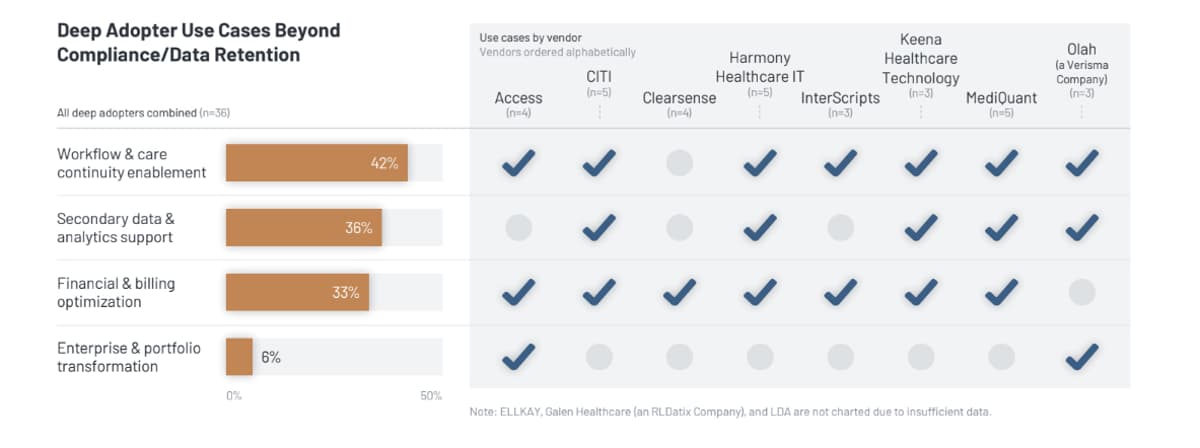
- •42% use archives for EHR-integrated workflow and care continuity
- •Only two organizations currently train AI models on archived data
- •External governance platforms required for true enterprise analytics from archives
Pulse Analysis
The KLAS Data Archiving 2026 brief provides a rare, data‑driven snapshot of how hospitals actually employ archival platforms. While vendors tout next‑generation AI, NLP and real‑time analytics, the survey of 36 deep adopters shows a stark contrast: most organizations still view archives as a compliance‑driven storage silo. By focusing on real‑world deployment, the report cuts through marketing hype and surfaces the operational priorities that drive purchasing decisions today.
A key surprise is the pronounced AI disconnect. Despite industry chatter about machine‑learning‑enabled clinical decision support, 60% of respondents explicitly reject using archived data for AI or research, and only two health systems have operationalized model training on historic records. The barrier isn’t just cultural; archives are often isolated from enterprise data pipelines, demanding costly extraction, normalization and governance layers. Consequently, leaders must treat the archive as a component, not a turnkey AI engine, and invest in separate data‑refinery platforms to unlock true analytics value.
Where the money talks is in legacy system decommissioning and workflow integration. Health systems retiring outdated applications can eliminate maintenance contracts, server footprints and associated security risks, delivering immediate capital relief. Moreover, 42% of deep adopters now embed archives directly into EHR workflows, giving clinicians seamless access to longitudinal patient histories and reducing manual chart‑review labor. In an era of squeezed margins, these operational gains provide the fiscal breathing room needed to fund genuine AI initiatives elsewhere, reinforcing the strategic importance of viewing data archiving as an efficiency catalyst rather than a futuristic analytics hub.
Beyond Compliance: What KLAS’ Brief Reveals About the Real ROI of Legacy Data Decommissioning
Comments
Want to join the conversation?
Loading comments...