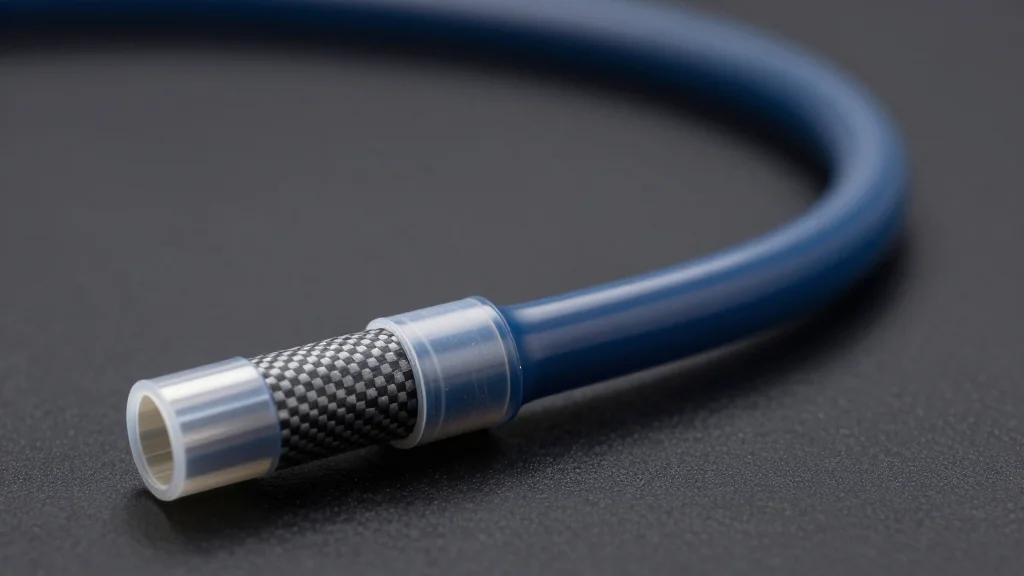
Engineering Insights: Polyimide, PTFE & Reinforced Tubing for Next-Gen Devices
Why It Matters
Advanced tubing materials directly influence catheter reliability, procedural success, and time‑to‑market, giving manufacturers a competitive edge in the fast‑growing minimally invasive sector.
Key Takeaways
- •Polyimide maintains stiffness and dimensional stability under thermal stress
- •Braided reinforcement delivers superior torque response and pushability
- •Coil reinforcement enhances flexibility and kink resistance for tortuous anatomy
- •PTFE‑polyimide composites combine low friction with high strength
- •Laser machining enables multi‑zone tubing designs with precise performance zones
Pulse Analysis
The surge in minimally invasive procedures has forced catheter designers to chase tighter tolerances and more intricate shaft geometries. Traditional thermoplastics often soften or creep under the heat generated during sterilization, compromising lumen consistency. Polyimide, a high‑performance thermoset, resists these effects, preserving inner diameter and stiffness across a wide temperature range. This reliability makes it a cornerstone for devices that must navigate narrow vessels while maintaining precise fluid delivery, positioning it as a material of choice for next‑generation medical tubing.
Beyond the base polymer, reinforcement strategy determines a catheter’s mechanical personality. Braided fibers transmit torque efficiently, giving physicians fine rotational control during navigation, whereas coil structures prioritize flexibility and kink resistance for tortuous anatomy. Selecting the appropriate reinforcement—and fine‑tuning braid density or coil pitch—allows engineers to balance pushability with trackability. Meanwhile, PTFE‑polyimide composites marry PTFE’s ultra‑low friction with polyimide’s structural integrity, but bonding these dissimilar layers demands specialized expertise that few suppliers can reliably provide.
Laser machining has emerged as a decisive enabler, carving micro‑holes, slots, and bonding transitions directly into tubing walls. This precision creates multi‑zone architectures where stiffness, flexibility, and lubricity can be locally optimized, accelerating prototype iteration and reducing tooling costs. MicroLumen’s integrated capabilities—material science, reinforcement engineering, composite bonding, and laser processing—give OEMs a streamlined path from concept to production, shortening time‑to‑market and bolstering device performance in an increasingly competitive landscape.
Engineering Insights: Polyimide, PTFE & Reinforced Tubing for Next-Gen Devices
Comments
Want to join the conversation?
Loading comments...