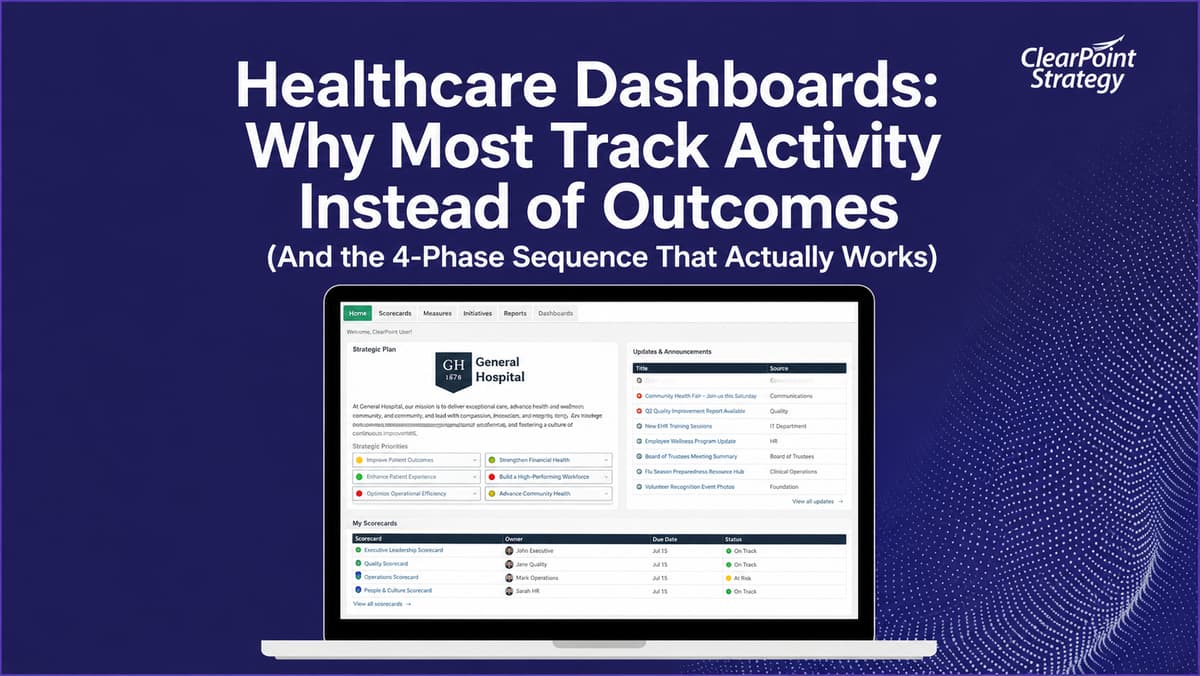
Healthcare Dashboards That Change Decisions | ClearPoint | ClearPoint Strategy Blog
Why It Matters
Outcome‑focused dashboards turn data into actionable decisions, improving patient care and financial performance. Health systems that adopt the phased, outcome‑first approach see higher adoption rates and measurable efficiency gains.
Key Takeaways
- •SOMC phased dashboard rollout, aligning outcomes before operational layers.
- •Activity metrics exceed 70% cause adoption failure across hospitals.
- •SJRMC cut reporting time 89% and built outcome-driven metrics.
- •Single metric owner predicts dashboard collapse when unavailable.
- •Public‑facing dashboards require aggregated, PHI‑free outcome data.
Pulse Analysis
Healthcare organizations have long struggled with dashboards that showcase volume—admissions, length of stay, or nurse‑to‑patient ratios—without revealing whether care actually improves. This "activity trap" inflates data collection effort while delivering little strategic insight, leading executives to ignore the tools altogether. Industry analysts now emphasize the "outcome test": a metric belongs on a dashboard only if its movement prompts a concrete decision. By shifting the focus to outcomes such as 30‑day readmission rates or stroke‑care door‑to‑needle times, hospitals can align data with clinical goals and regulatory expectations, turning dashboards from static reports into decision‑making engines.
The four‑phase sequence championed by ClearPoint starts with outcome‑centric clinical scorecards, then adds operational flow views, followed by executive roll‑ups, and finally public‑facing dashboards. Southern Ohio Medical Center’s deliberate phased rollout, anchored in its "Big Five Strategic Values," produced over 400 linked scorecards and integrated provider dashboards into credentialing incentives, fostering daily engagement. San Juan Regional Medical Center’s migration cut reporting time by 89% and accelerated new report builds by 83% by automating a critical outcome metric—stroke‑care door‑to‑needle time—directly from EHR timestamps. Both cases illustrate that governance, clear ownership, and embedding metrics into existing workflows are more decisive than the underlying software.
For vendors and health‑system leaders, the implications are clear: prioritize outcome metrics, enforce a 70% activity‑to‑outcome ceiling, and distribute ownership across functional teams. Platforms must support real‑time data refresh, narrative annotations, and seamless scaling from unit‑level huddles to board‑room summaries. Moreover, designing dashboards with a future public view in mind ensures compliance with privacy rules while enhancing community transparency. As hospitals adopt this phased, outcome‑first methodology, they can expect faster insight cycles, stronger cross‑departmental alignment, and ultimately, higher quality patient care coupled with improved financial stewardship.
Healthcare Dashboards That Change Decisions | ClearPoint | ClearPoint Strategy Blog
Comments
Want to join the conversation?
Loading comments...