Healthcare News and Headlines
  • All Technology
  • AI
  • Autonomy
  • B2B Growth
  • Big Data
  • BioTech
  • ClimateTech
  • Consumer Tech
  • Crypto
  • Cybersecurity
  • DevOps
  • Digital Marketing
  • Ecommerce
  • EdTech
  • Enterprise
  • FinTech
  • GovTech
  • Hardware
  • HealthTech
  • HRTech
  • LegalTech
  • Nanotech
  • PropTech
  • Quantum
  • Robotics
  • SaaS
  • SpaceTech
AllNewsDealsSocialBlogsVideosPodcastsDigests

Healthcare Pulse

EMAIL DIGESTS

Daily

Every morning

Weekly

Sunday recap

NewsDealsSocialBlogsVideosPodcasts
HealthcareNewsOPTION: IV Tenecteplase Boosts Outcomes Late After Non-LVO Stroke
OPTION: IV Tenecteplase Boosts Outcomes Late After Non-LVO Stroke
HealthcareBioTech

OPTION: IV Tenecteplase Boosts Outcomes Late After Non-LVO Stroke

•February 11, 2026
0
TCTMD
TCTMD•Feb 11, 2026

Why It Matters

Extending the thrombolysis window offers a therapeutic option for a large subset of ischemic stroke patients lacking endovascular access, potentially reshaping acute stroke protocols.

Key Takeaways

  • •Tenecteplase improves 90‑day functional outcome in non‑LVO strokes
  • •Benefit observed when administered 4.5‑24 hours after onset
  • •Symptomatic intracranial hemorrhage risk rises modestly with tenecteplase
  • •Trial limited to Asian cohort; broader validation needed
  • •CT perfusion selection critical for late‑window thrombolysis

Pulse Analysis

Late‑window thrombolysis has long been constrained to the 4.5‑hour window, primarily for large‑vessel occlusions amenable to mechanical thrombectomy. Non‑LVO strokes, which account for over half of acute ischemic events, have relied on early‑time‑frame IV alteplase despite limited evidence beyond the conventional window. Tenecteplase, a genetically engineered variant of tissue‑type plasminogen activator, offers a longer half‑life and higher fibrin specificity, making it an attractive candidate for extended‑window use. The OPTION trial leverages these pharmacologic advantages, pairing them with advanced CT perfusion imaging to identify salvageable penumbra in patients who would otherwise receive only antiplatelet therapy.

The trial’s primary endpoint—an excellent functional outcome (mRS 0‑1) at 90 days—favored tenecteplase by a relative 32% increase, a statistically robust signal given the 566‑patient sample. Early reperfusion metrics and 24‑hour clinical response also trended positively, suggesting that the drug may achieve meaningful recanalization even without endovascular assistance. However, the rise in symptomatic intracranial hemorrhage, though numerically small, underscores the need for meticulous imaging selection, particularly avoiding patients with extensive non‑contrast CT hypodensity. Mortality and systemic bleeding remained comparable, indicating that the net clinical benefit may outweigh the hemorrhagic risk in carefully screened cohorts.

Looking ahead, the Asian‑centric enrollment limits generalizability, prompting calls for multinational phase III studies that encompass diverse ethnic and comorbidity profiles. Should broader data confirm efficacy and safety, regulatory bodies could expand tenecteplase labeling to include late‑window non‑LVO strokes, prompting hospitals to revise stroke pathways and invest in perfusion imaging capabilities. For Genentech, such an indication would deepen market penetration beyond the current LVO niche, potentially driving significant revenue growth as clinicians adopt tenecteplase as a standard late‑window therapy.

OPTION: IV Tenecteplase Boosts Outcomes Late After Non-LVO Stroke

Although additional trials in more diverse populations are needed, the results are promising, experts say.

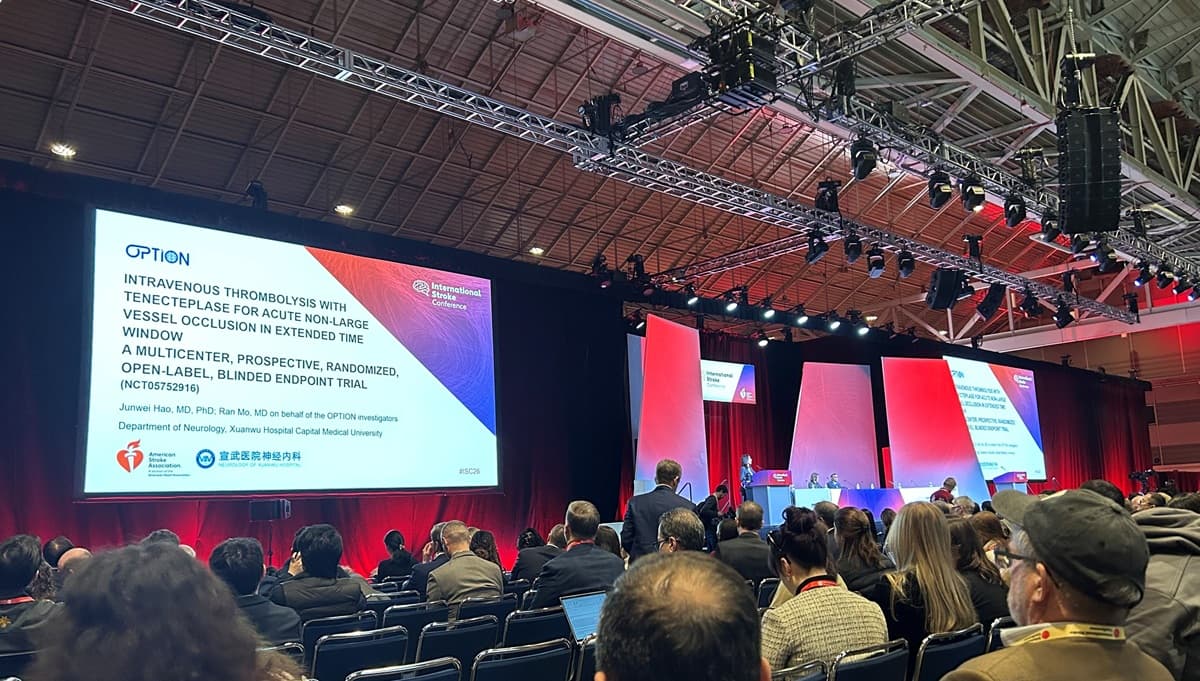
NEW ORLEANS, LA—Intravenous tenecteplase (TNKase; Genentech) improves functional outcomes versus standard care when administered 4.5 to 24 hours after onset of an acute ischemic stroke not caused by a large‑vessel occlusion (LVO), according to the results of the randomized OPTION trial.

The proportion of patients achieving an excellent functional outcome—modified Rankin Scale score 0‑1—at 90 days was 43.6 % in the tenecteplase arm and 34.2 % in the control arm (adjusted risk ratio 1.32; 95 % CI 1.08‑1.61), Ran Mo, MD (Xuanwu Hospital, Capital Medical University, Beijing, China), reported here at the International Stroke Conference (ISC).

That benefit came at the cost of a higher rate of symptomatic intracranial hemorrhage within 36 hours (2.8 % vs 0; P = 0.004), but as a whole the results “support extending the thrombolysis time window in this patient population,” Mo said.

The findings were published simultaneously online in JAMA.

Lauren Sansing, MD (Yale School of Medicine, New Haven, CT), chair of ISC 2026, told TCTMD that the types of patients included in this trial have not typically been treated with tenecteplase, so this represents a promising option for them.

Bijoy Menon, MBBS, MD (University of Calgary, Canada), vice chair of the meeting, added that the “clearly positive” trial will be “one more step in our effort to actually change guidelines and practice.”

The caveat, however, is that the trial included only Asian patients, he commented to TCTMD, calling for additional trials to understand the risks and benefits in more diverse populations around the world. “But I feel quite positive that this is going to push the envelope further in us treating these patients up until 24 hours when there’s no other option—if thrombectomy is not available,” said Menon.

In both early and late time windows, endovascular thrombectomy is the go‑to treatment for eligible patients with LVO strokes, but the procedure is not always possible. The TRACE‑III trial showed that in patients with LVOs presenting from 4.5 to 24 hours after stroke onset who were not able to undergo endovascular treatment, administration of IV tenecteplase improved functional outcomes.

More than half of acute ischemic strokes, however, are caused by non‑LVOs. In this population, IV thrombolysis has been shown to be beneficial within the first 4.5 hours after symptom onset, with uncertainty about the risks and benefits in later time windows.

The OPTION trial, conducted at 48 centers in China, examined the impact of tenecteplase among patients with acute non‑LVO strokes presenting 4.5 to 24 hours after stroke onset who had salvageable brain tissue identified on CT perfusion imaging. Eligible participants had a disabling stroke (NIHSS score 6‑25 or NIHSS score 4‑5 plus a disabling deficit) and no plan to undergo endovascular treatment.

Investigators randomized 566 patients (median age 68 years; 34.6 % women) to IV tenecteplase 0.25 mg/kg (maximum dose 25 mg) or standard medical treatment, which included antiplatelet therapy. The median NIHSS score at baseline was 7, and patients were randomized a median of 12 hours from when they were last seen well.

Patients treated with IV tenecteplase were significantly more likely to achieve an excellent functional outcome at 90 days, with similar results across subgroups. Reperfusion at 24 hours (37.7 % vs 28.8 %; P = 0.03) and an early clinical response at 24 hours (11.4 % vs 5.0 %; P = 0.007) also were better with tenecteplase.

Though all cases of symptomatic intracranial hemorrhage occurred in the tenecteplase group, there were no significant differences between the treatment and control arms in mortality (5.0 % vs 3.2 %; P = 0.28) or moderate or severe systemic bleeding (0.7 % in both groups; P = 0.99) at 90 days.

The investigators note that symptomatic intracranial hemorrhage occurred in two of the 21 patients who had CT hypodensities larger than the core defined by perfusion imaging. “Careful evaluation of non‑contrast CT hypodensity is advisable, especially when considering the late‑window thrombolytic therapy,” Mo said.

Menon said that the degree of functional improvement observed in OPTION is enough to justify the increase in the rate of symptomatic intracranial hemorrhage, which was quite low.

“Overall, I just feel that trial result seems to suggest that there is value in giving thrombolysis,” he said, reiterating the need for additional evidence.

Read Original Article
0

Comments

Want to join the conversation?

Loading comments...