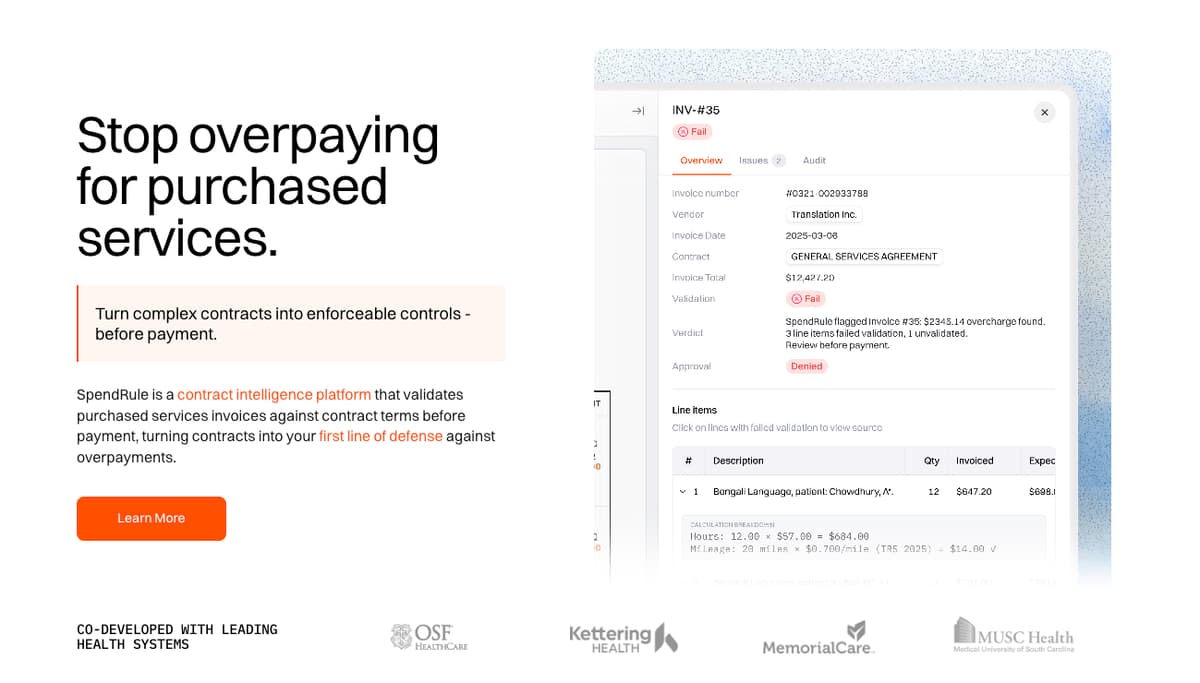
SpendRule Launches AI-Powered Contract Intelligence Platform with OSF HealthCare and MemorialCare
Why It Matters
The technology promises to recover billions in wasted spend for hospitals while streamlining AP processes, reshaping how healthcare providers manage service contracts.
Key Takeaways
- •Purchased services spend totals $323 billion in U.S. hospitals.
- •SpendRule adds contract terms as fourth validation layer.
- •AI automates compliance, catching $32 billion annual overpayments.
- •Platform integrates with existing ERP/AP without disruption.
- •Early adopters include OSF HealthCare, MemorialCare, Kettering.
Pulse Analysis
Hospitals face a massive financial challenge: non‑labor services—housekeeping, IT, food, and more—represent a $323 billion spend that is notoriously opaque. Traditional three‑way matching checks purchase orders, receipts, and invoices, but it cannot verify whether the invoice aligns with nuanced contract clauses such as volume discounts or service level penalties. This gap has allowed an estimated $32 billion in preventable overpayments to slip through each year, prompting providers to seek smarter, data‑driven solutions.
SpendRule’s platform tackles this inefficiency by converting contracts into executable code and embedding that logic directly into existing accounts payable workflows. The AI engine performs a "4‑Way Match," comparing the invoice not only to the PO and receipt but also to the digitized contract terms before any payment is issued. Discrepancies are highlighted in real time, allowing finance teams to resolve issues upstream without disrupting ERP or AP systems. The solution’s low‑code integration model means hospitals can adopt the technology without costly system overhauls, preserving legacy investments while gaining immediate compliance benefits.
The market response has been swift. Backed by investors like Abundant Venture Partners and the MemorialCare Innovation Fund, SpendRule has already rolled out across major health systems including OSF HealthCare, MemorialCare, Kettering Health and MUSC Health. As providers grapple with tightening margins and heightened scrutiny over spend management, the platform’s ability to automate contract enforcement positions it as a strategic asset. Analysts expect broader adoption across the healthcare sector, potentially reshaping the economics of purchased services and setting a new standard for AI‑enabled financial governance.
SpendRule Launches AI-Powered Contract Intelligence Platform with OSF HealthCare and MemorialCare


Comments
Want to join the conversation?
Loading comments...