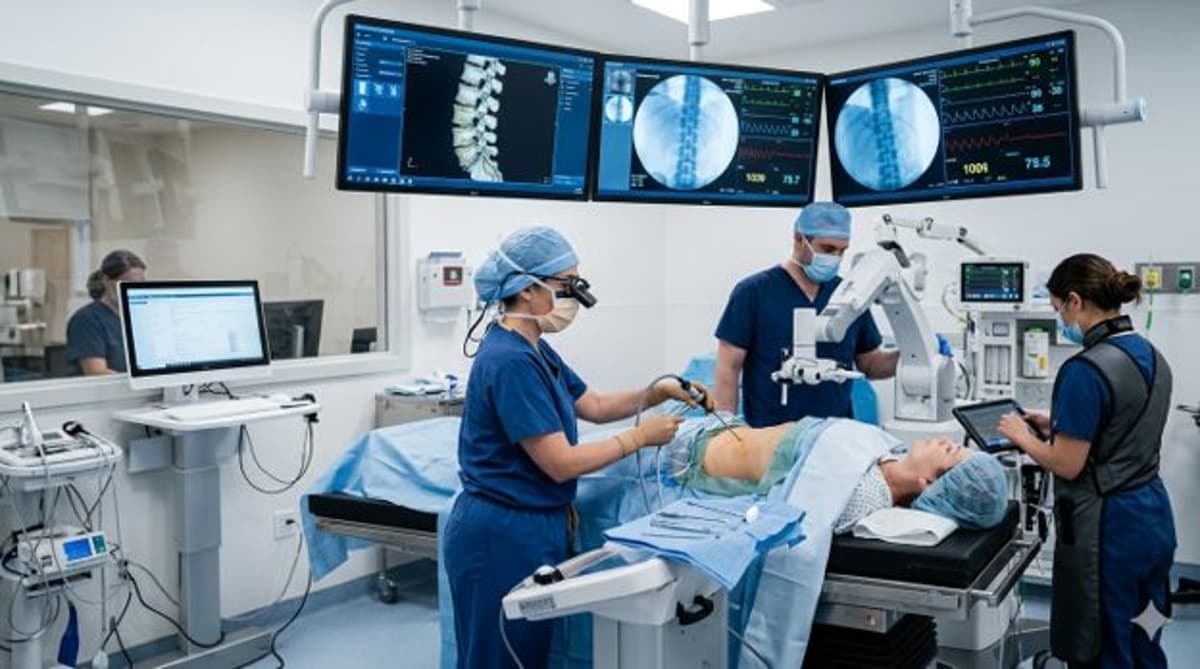
The Digital Clinic: How Ultra-Minimally Invasive Spine Procedures Are Redefining Outpatient Workflow Efficiency
Why It Matters
UMIS reshapes outpatient spine care by boosting operational efficiency, profitability and patient outcomes, giving facilities a competitive edge in a value‑based reimbursement landscape.
Key Takeaways
- •UMIS cuts Phase I PACU stay to 30‑60 minutes.
- •OR turnover time drops due to compact endoscopic kits.
- •Regional blocks replace general anesthesia for most spine cases.
- •Same‑day discharge boosts daily case volume without extra staff.
- •Predictable schedules reduce overtime and improve surgeon satisfaction.
Pulse Analysis
Ultra‑minimally invasive spine (UMIS) surgery leverages high‑definition endoscopes, micro‑working channels and purpose‑built dilators to treat disc herniations, stenosis and other pathologies through incisions smaller than a centimeter. By preserving paraspinal musculature and virtually eliminating intra‑operative blood loss, the technique reduces tissue trauma, postoperative pain and opioid requirements. Clinical series consistently report faster ambulation, lower complication rates and discharge within hours rather than days. This patient‑centric improvement aligns with the broader move toward value‑based care, where outcomes and experience outweigh volume alone.
For ambulatory surgical centers, the clinical gains translate into measurable workflow efficiencies. Because most UMIS cases can be performed under conscious sedation or regional blocks, the need for prolonged general anesthesia and its associated recovery time disappears, shrinking Phase I PACU stays from two‑plus hours to a predictable 30‑60‑minute window. The compact endoscopic instrument kits reduce tray count, simplifying setup and sterilization, which in turn cuts OR turnover time dramatically. Predictable case blocks enable schedulers to pack more procedures into a day without incurring overtime, directly boosting profitability while easing staff burnout.
The strategic ripple effect extends beyond the operating room. Facilities that adopt UMIS position themselves as high‑throughput, low‑overhead spine centers, attracting referrals from physicians seeking rapid, safe outpatient solutions. Same‑day discharge lowers exposure to hospital‑acquired infections and improves patient satisfaction scores, key metrics in bundled‑payment models. Moreover, the digital tracking tools that log real‑time milestones reinforce the data‑driven culture essential for continuous improvement. As insurers increasingly reward efficiency and outcomes, UMIS is poised to become a benchmark technology for modern digital clinics aiming to scale while maintaining clinical excellence.
The Digital Clinic: How Ultra-Minimally Invasive Spine Procedures Are Redefining Outpatient Workflow Efficiency
Comments
Want to join the conversation?
Loading comments...