Healthcare News and Headlines
  • All Technology
  • AI
  • Autonomy
  • B2B Growth
  • Big Data
  • BioTech
  • ClimateTech
  • Consumer Tech
  • Crypto
  • Cybersecurity
  • DevOps
  • Digital Marketing
  • Ecommerce
  • EdTech
  • Enterprise
  • FinTech
  • GovTech
  • Hardware
  • HealthTech
  • HRTech
  • LegalTech
  • Nanotech
  • PropTech
  • Quantum
  • Robotics
  • SaaS
  • SpaceTech
AllNewsDealsSocialBlogsVideosPodcastsDigests

Healthcare Pulse

EMAIL DIGESTS

Daily

Every morning

Weekly

Sunday recap

NewsDealsSocialBlogsVideosPodcasts
HealthcareNewsThis Startup Developed a First-of-Its-Kind Brain Function Assessment Device
This Startup Developed a First-of-Its-Kind Brain Function Assessment Device
HealthTechHealthcareBioTechHardware

This Startup Developed a First-of-Its-Kind Brain Function Assessment Device

•February 17, 2026
0
Medical Design & Outsourcing
Medical Design & Outsourcing•Feb 17, 2026

Why It Matters

By providing objective, bedside neuro‑functional data, Delphi‑MD could reshape diagnostic pathways and treatment monitoring across neurology and psychiatry, accelerating personalized care and reducing reliance on subjective assessments.

Key Takeaways

  • •First FDA de novo TMS‑EEG combined device.
  • •Real‑time brain function reports via proprietary algorithms.
  • •Operable by non‑expert staff; quick setup.
  • •Breakthrough designations for stroke, dementia, hydrocephalus.
  • •Normative database currently ages 50‑75, expansion planned.

Pulse Analysis

The convergence of transcranial magnetic stimulation and electroencephalography has long been a research curiosity, but QuantalX’s Delphi‑MD marks the first commercial system to integrate these modalities into a single, FDA‑cleared platform. By eliminating the technical barriers that previously confined TMS and EEG to specialist labs, the device democratizes access to functional neuro‑imaging. Its automated artifact‑reduction pipeline and real‑time quality monitoring ensure data fidelity, while a user‑friendly probe and cap enable clinicians to obtain reliable measurements in minutes, positioning Delphi‑MD as a practical point‑of‑care tool.

Clinically, the device’s ability to benchmark patient responses against a multi‑center normative database opens new diagnostic avenues. Early‑stage FDA Breakthrough Device designations highlight its potential for stroke and dementia risk stratification, as well as predicting outcomes for ventriculoperitoneal shunt procedures in normal‑pressure hydrocephalus. These indications suggest Delphi‑MD could complement existing imaging modalities, offering functional insights where structural scans fall short. Neurologists and psychiatrists may soon rely on its objective metrics to differentiate Parkinson’s disease from Lewy‑body dementia, assess traumatic brain injury, and monitor disease progression, thereby enhancing treatment precision.

Looking ahead, QuantalX plans to broaden its normative database beyond the current 50‑75 age range and to accumulate condition‑specific datasets. This expansion will enable more granular, indication‑focused reporting, fostering a data‑driven approach to brain health. As hospitals and outpatient clinics adopt the technology, the market could see a shift toward continuous, personalized neuro‑functional monitoring, similar to how wearable cardiac devices transformed cardiology. The convergence of robust analytics, regulatory endorsement, and scalable usability positions Delphi‑MD to become a cornerstone of next‑generation neurological care.

This startup developed a first-of-its-kind brain function assessment device

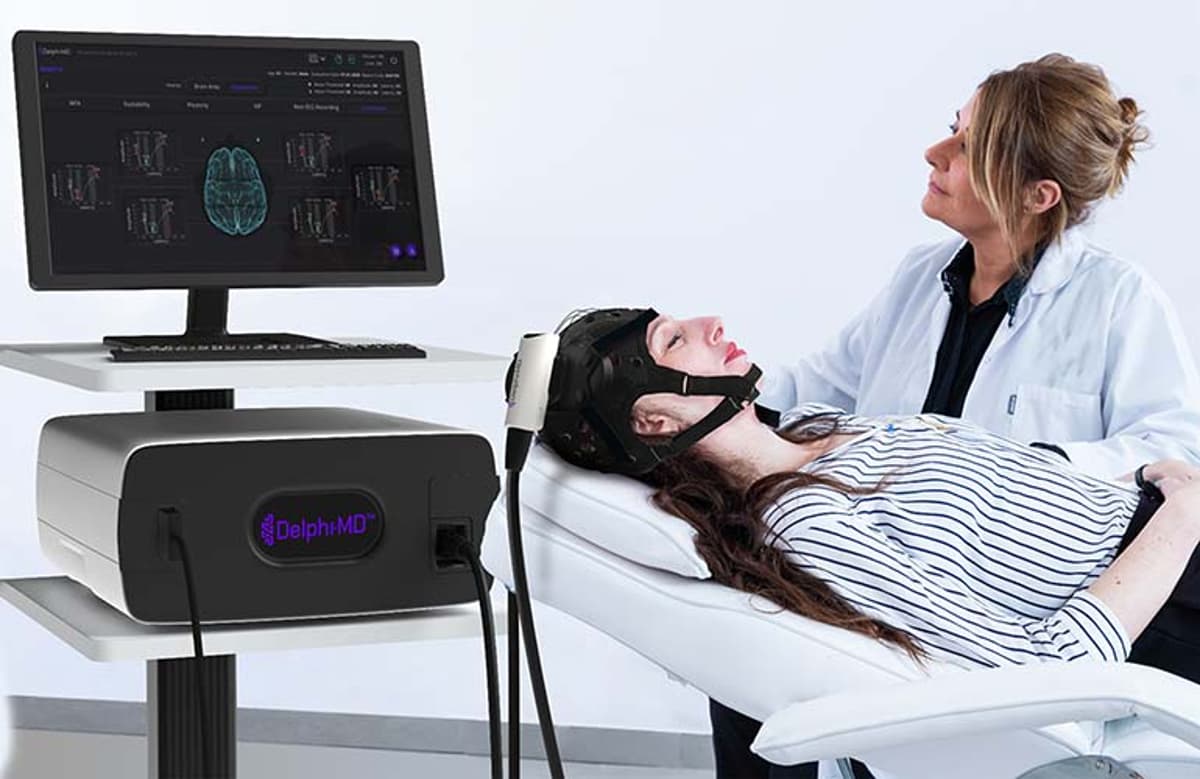
QuantalX Neuroscience combined transcranial magnetic stimulation (TMS) and electroencephalography (EEG) technology in its first‑of‑its‑kind brain network function assessment device, Delphi‑MD.

Image 1: An image of the QuantaIX Delphi‑MD system being used on a patient.

Delphi‑MD provides a real‑time assessment of brain function using combined TMS and EEG technology. Image courtesy of QuantalX

QuantalX earned FDA de novo classification for Delphi‑MD in November 2025, and announced the beginning of commercialization today.

In a Medical Design & Outsourcing interview ahead of the announcement, QuantalX co‑founder and CEO Dr. Iftach Dolev discussed Delphi‑MD’s technology and the system’s development.

The system provides a real‑time assessment of brain function by triggering brain responses from targeted networks using TMS. Then, EEG nodes capture those responses and proprietary algorithms interpret the signals using an age‑correlated database to provide a comprehensive brain function report.

The following has been lightly edited for length and clarity.

MDO: What’s the big advance or technology aside from TMS and EEG that made this device possible?


Dolev: “TMS and EEG are not new technologies. Both are used separately in routine clinical care. The true innovation is their integration into a single, clinically practical system.

“Delphi‑MD is a first‑in‑class, FDA de novo‑classified system that brings combined TMS‑EEG technology into routine clinical care, enabling physicians to access direct neuro‑functional data in an accessible, noninvasive and easy‑to‑use format.

“This integration is made possible through our specialized device design and automated algorithms, which make both the technology and the results accessible to medical assisting staff for data collection and to neuro‑specialists, such as neurologists and psychiatrists, for interpretation. The system is designed to function seamlessly across a variety of clinical settings.”

MDO: What was the biggest technical challenge in the development of Delphi‑MD and what was the solution?


Dolev: “Several major technical challenges were addressed during the development of Delphi‑MD. One of the most significant was integrating magnetic stimulation and electrophysiological recording into a unified device while overcoming stimulation‑related artifacts and noise. This was achieved through a specialized system design that minimizes interference and incorporates uniquely engineered stimulation and recording components.

“Another key challenge was ensuring clinical accessibility. The system needed to be operable by non‑expert users for data acquisition while still delivering high‑quality recordings and clinically meaningful outputs for physicians. We addressed this through thoughtful usability design, including a lightweight stimulation probe approximately the size and weight of an iPhone, a specialized EEG cap that can be applied within minutes, and a streamlined workflow.

“The system also includes a real‑time internal data quality monitoring and alert mechanism that guides users during data acquisition and notifies them immediately if there are issues affecting data integrity.

“A central component of Delphi‑MD is its fully automated intelligent algorithm. This algorithm processes and analyzes the data and delivers readable, clinically actionable results benchmarked against a validated internal normative database of healthy individuals collected in a multi‑center study. This database provides a meaningful benchmark that supports the validity of the technology and enables direct clinical insight.”

MDO: How does Delphi‑MD’s software account for stimulation‑related artifacts when analyzing data?


Dolev: “Delphi‑MD incorporates multiple strategies to minimize auditory and somatosensory confounds. These include the use of earplugs to attenuate auditory input, a foam interface layer to reduce somatosensory effects, and a proprietary focused magnetic stimulation probe. The system also includes uniquely designed EEG electrodes optimized specifically for use within the Delphi‑MD platform. In addition, we utilize a dedicated artifact‑removal processing pipeline tailored to TMS‑EEG‑related artifacts.

“While it is important to acknowledge that interfering factors can never be entirely eliminated, given the complexity of the brain, they can be substantially reduced. Most importantly, the system produces reproducible, reliable results that remain consistent with clinical outcomes and gold‑standard imaging. The signal‑to‑noise ratio remains sufficiently high to ensure meaningful interpretation.”

MDO: With Delphi‑MD advertised as “applicable in any care setting” for investigational use only right now, what sort of future applications do you see for this technology?


Image 2: An image of the QuantaIX Delphi‑MD system.

Proprietary algorithms interpret the brain’s response signals using an age‑correlated database to provide a comprehensive brain function report. Image courtesy of QuantalX

Dolev: “Delphi‑MD is available for clinical use as a tool for evaluating brain network function across a variety of care settings, including neurologist offices, ICUs, hospital wards and other point‑of‑care environments. The system is not approved for the diagnosis of a specific disease.

“Similar to MRI or ultrasound, physicians may use Delphi‑MD to gain additional objective insight into brain function for any clinical indication they deem appropriate. The results are benchmarked against a healthy reference population to provide context.

“The underlying Delphi technology has received two FDA Breakthrough Device designations: one for early detection of risk for stroke or dementia and one for diagnosis and prediction of ventriculoperitoneal shunt (VPS) treatment success in normal pressure hydrocephalus (NPH), a common form of reversible dementia.

“Additionally, the technology has demonstrated promising results in differential diagnosis of Parkinson’s disease and Lewy body dementia, as well as in detecting white matter damage in traumatic brain injury (TBI) and stroke.”

MDO: The system currently compares readings to a validated normative database between the ages of 50‑75. Do you see this technology expanding outside of this age range in the future?


Dolev: “Our intention is to expand the normative database to include broader age ranges. Direct neuro‑functional imaging can provide valuable insights across virtually all brain‑related conditions and treatments. This is particularly important for functional disorders that cannot be measured using traditional structural imaging, such as MRI or CT. These conditions are often diagnosed and monitored using subjective behavioral or cognitive testing that primarily evaluates symptoms. Expanding the database will enhance the system’s clinical applicability and support broader indications across age groups.”

MDO: Looking at your field of medtech, what’s in the future and what technologies do you need to get it there?


Dolev: “The future lies in expanding the Delphi‑MD database and collecting extensive indication‑specific data to enable condition‑focused reporting. As more data are collected across specific neurological and psychiatric indications, the system will be able to provide increasingly refined, indication‑specific diagnostic support. This will optimize neurological and psychiatric care through more objective and personalized assessment.”

Read Original Article
0

Comments

Want to join the conversation?

Loading comments...