Survey: Legal Teams Lack Visibility Into AI Agents’ Actions, Icertis Research Finds
Key Takeaways
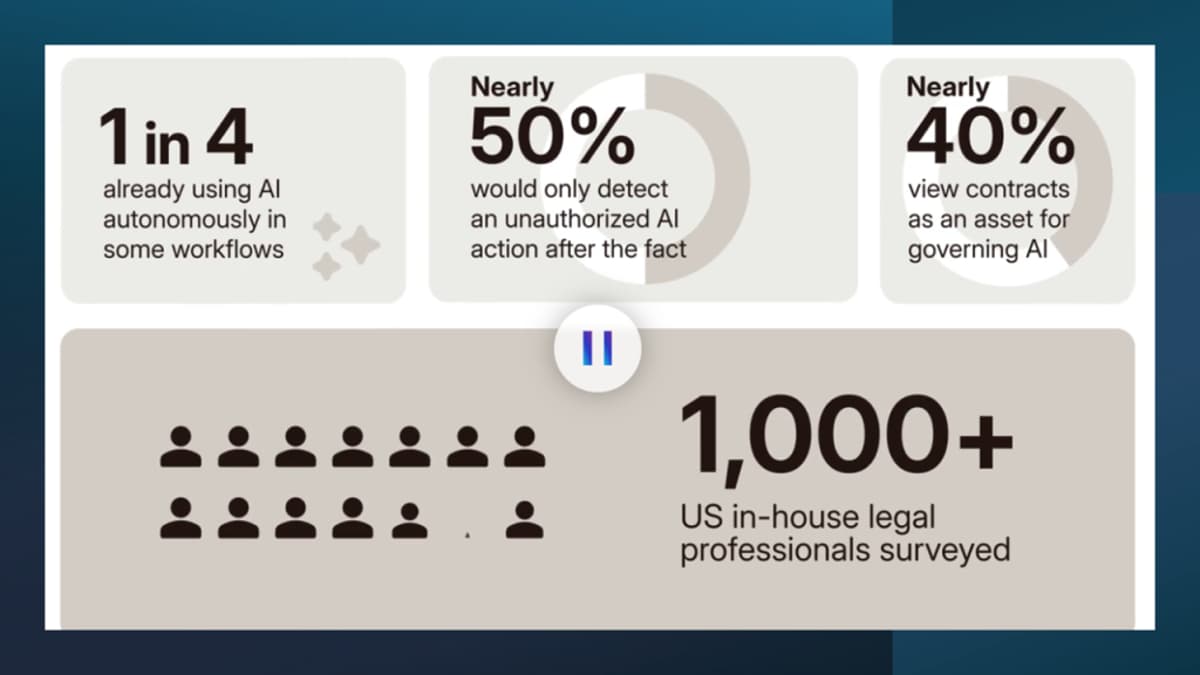
- •48% of legal teams lack real‑time AI action visibility.
- •25% let AI operate without human oversight.
- •50% discover unauthorized AI actions only after they occur.
- •40% view contracts as primary AI governance tool.
- •Survey covered over 1,000 U.S. in‑house lawyers.
Pulse Analysis
Legal departments are racing to embed generative AI into contract drafting, review and compliance workflows, but the speed of adoption has outpaced the development of oversight mechanisms. As AI agents can autonomously retrieve, modify, or execute contractual language, any lapse in monitoring creates exposure to unintended obligations, data‑privacy violations, or regulatory non‑compliance. The lack of real‑time visibility means that errors may remain hidden until they surface in downstream disputes, a risk that senior counsel can no longer afford to ignore.
The Icertis survey, conducted with over 1,000 U.S. in‑house lawyers, quantifies this governance gap. Nearly half of respondents admit they would not notice an unauthorized AI action until days or weeks later, while a quarter allow AI to act without any human checkpoint. Conversely, 40% view contracts themselves as the primary lever for governing AI behavior, underscoring the growing relevance of contract lifecycle management platforms that can embed usage policies, audit trails, and automated alerts directly into legal agreements. These data points signal a market shift toward integrating AI controls at the contract level rather than relying on ad‑hoc oversight.
Looking ahead, the convergence of AI risk management and contract technology will likely drive new standards and vendor offerings. Companies may adopt AI‑aware clause libraries, continuous monitoring dashboards, and AI‑specific compliance modules to achieve the visibility demanded by regulators and boardrooms. In parallel, upcoming legislation such as the AI Accountability Act will compel firms to demonstrate proactive governance, making the ability to track AI actions in real time not just a best practice but a legal requirement. Early adopters that embed these capabilities now will gain a competitive edge while mitigating the costly fallout of hidden AI errors.
Survey: Legal Teams Lack Visibility Into AI Agents’ Actions, Icertis Research Finds
Comments
Want to join the conversation?