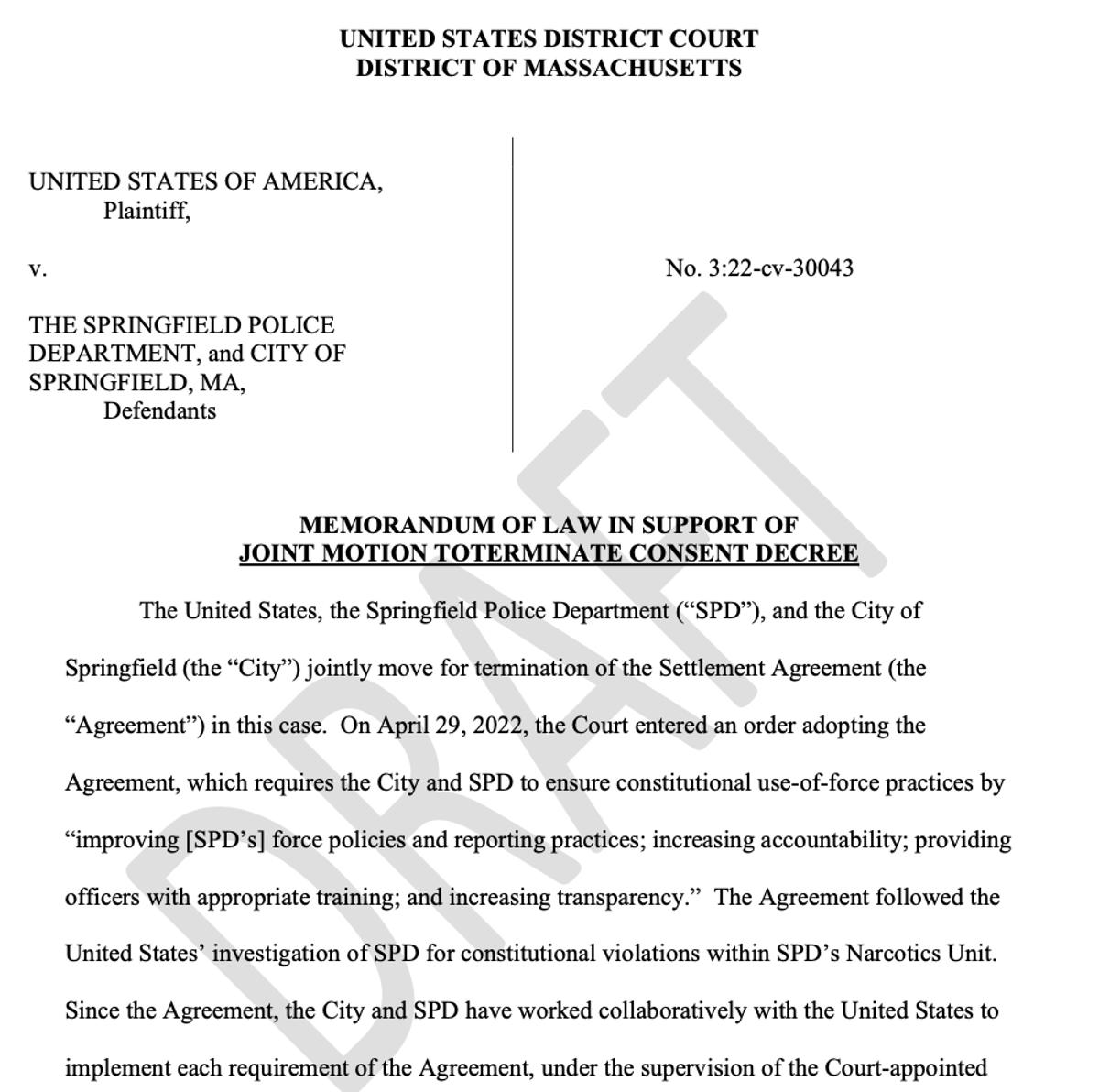
DOJ Forgets To Remove ‘DRAFT’ Watermark Splashed Across Every Page Of Filing
Why It Matters
A visible draft watermark in a public filing damages the DOJ’s credibility and raises doubts about its capacity to effectively oversee police‑reform agreements, a core civil‑rights function.
Key Takeaways
- •DOJ filed 14‑page motion with visible “DRAFT” watermark.
- •Motion seeks to terminate Springfield police consent decree after compliance.
- •Civil Rights Division lost ~70% of attorneys since 2021.
- •Draft watermark underscores broader staffing and management issues at DOJ.
Pulse Analysis
The accidental inclusion of a prominent “DRAFT” watermark on a filing submitted to the federal courts is more than a clerical embarrassment; it signals a lapse in basic document‑control protocols at a department tasked with safeguarding civil rights. In an era where legal filings are instantly accessible via PACER, any hint of carelessness can be weaponized by opponents and erode public confidence. The DOJ’s Civil Rights Division, already under scrutiny for its aggressive stance on consent‑decree terminations, now faces a credibility test that extends beyond the Springfield case.
Underlying the watermark mishap is a deeper staffing crisis. Since the onset of the second Trump administration, roughly 70 percent of the division’s attorneys have departed, been reassigned, or taken deferred resignations. This attrition has depleted institutional knowledge and strained the division’s ability to monitor and enforce consent decrees that curb police misconduct. The loss of seasoned litigators also hampers the division’s capacity to craft precise, error‑free filings, increasing the likelihood of procedural oversights that can jeopardize cases.
For municipalities and law‑enforcement agencies, the incident raises concerns about the reliability of federal oversight. Consent decrees are pivotal tools for correcting systemic abuse, and their premature termination—especially when announced through a draft‑stamped document—may embolden jurisdictions to relax reforms prematurely. The DOJ must reinforce its document‑management systems and address the talent gap to restore trust. Failure to do so could weaken the enforcement of civil‑rights protections and invite further criticism of the department’s overall effectiveness.
DOJ Forgets To Remove ‘DRAFT’ Watermark Splashed Across Every Page Of Filing
Comments
Want to join the conversation?
Loading comments...