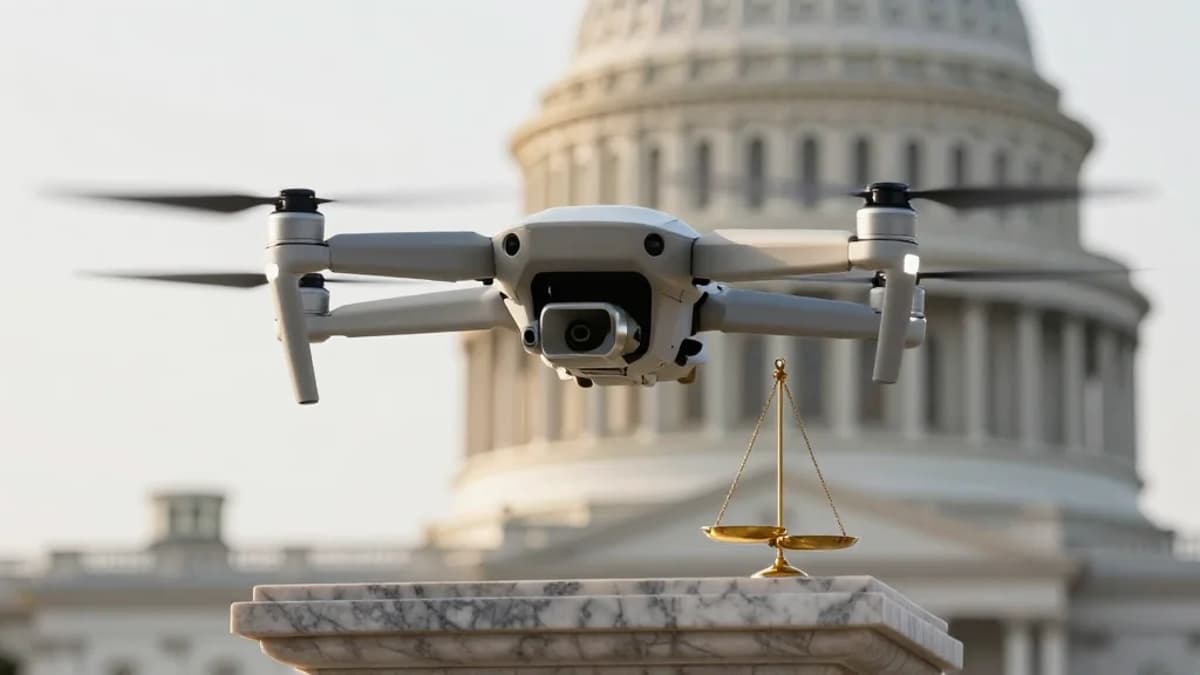
The ruling solidifies a broad liability shield for firms conducting government‑sponsored research, reducing patent risk and encouraging participation in SBIR/STTR programs. It also forces patent holders to pursue compensation from the federal government, limiting injunctive leverage.
Section 1498 of Title 28 was enacted to balance the government’s eminent‑domain power with patent rights, allowing the United States to use patented inventions without facing traditional infringement suits. Under the statute, a contractor who manufactures or uses a patented invention “by or for the United States” is insulated from direct liability; any compensation claim must be brought against the federal government in the Court of Federal Claims. This framework has long been a safety net for defense and aerospace contractors, but its reach into civilian‑focused research programs such as SBIR and STTR has remained uncertain—until now.
The Federal Circuit’s affirmation in *Arlton v. AeroVironment* removes that uncertainty by explicitly extending § 1498 protection to early‑stage R&D performed under SBIR and STTR awards. The court focused on the contractual language that granted the government “authorization and consent” to use patented technology, demonstrating that even prototype design and testing qualify as government‑directed work. For contractors, the decision highlights the practical importance of capturing clear FAR 52.227‑1 clauses and maintaining meticulous records of government direction. Companies can now structure SBIR/STTR projects with greater confidence that patent disputes will not derail development.
Patent owners, however, must adjust their litigation strategy. Because § 1498 channels remedies exclusively to the United States, they lose the ability to seek injunctions or direct damages against the contractor, limiting leverage to monetary compensation from the federal treasury. This shift may encourage patentees to focus on licensing negotiations rather than aggressive lawsuits. For the broader innovation ecosystem, the ruling reinforces the attractiveness of federal R&D programs, potentially accelerating technology transfer and commercialization. Firms should still segregate commercial and government work to preserve the immunity shield and avoid inadvertent exposure.
February 18, 2026
Authors: Alexander Hastings, Matthew Rizzolo, Scott Whitman – Morgan Lewis
In the recent decision of Arlton v. AeroVironment the U.S. Court of Appeals for the Federal Circuit reaffirmed the broad scope of 28 U.S.C. § 1498, holding that AeroVironment, Inc. was immune from patent‑infringement liability for work performed under Small Business Innovation Research (SBIR) and Small Business Technology Transfer (STTR) contracts. The court concluded that because AeroVironment had performed all allegedly infringing activities pursuant to SBIR and STTR contracts, those activities were conducted for the government and with its authorization, bringing them squarely within § 1498’s liability‑shifting framework.
In this LawFlash we break down the SBIR and STTR programs, how they fit into the broader federal procurement system, and the significance of this decision—both from a government‑contracts and patent‑law perspective.
The dispute arose from patent‑infringement allegations tied to AeroVironment’s development of Ingenuity, an unmanned aerial vehicle (UAV), as a subcontractor to the California Institute of Technology’s Jet Propulsion Laboratory for the National Aeronautics and Space Administration. AeroVironment’s work took place under SBIR and STTR contracts, programs designed to advance early‑stage R&D and technology maturation for government use.
The plaintiffs claimed in their complaint filed in the U.S. District Court for the Central District of California that AeroVironment’s UAV systems embodied their patented “rotary‑wing vehicle” design, including features such as an elongated tubular backbone and a counter‑rotating coaxial rotor system, and therefore infringed their patent.
AeroVironment moved for summary judgment, arguing that because its activities were performed on behalf of the federal government and with its authorization and consent, § 1498 immunized it from patent‑infringement liability. AeroVironment argued that the plaintiffs would need to seek relief against the federal government in the Court of Federal Claims.
The district court agreed, granting summary judgment and dismissing the case. In its decision on February 4, the Federal Circuit affirmed.
The SBIR program is structured to move early‑stage ideas through the technical and testing stages and into government‑usable prototypes, all while preserving the contractor’s commercial rights. SBIR is a staged process: agencies fund Phase I and Phase II efforts to mature technologies that address defined mission needs, whereas Phase III—commercialization or follow‑on government procurement—is intentionally outside the SBIR funding framework.
From a government‑contracts standpoint, this means a contractor’s Phase I/II work is performed squarely “for the government,” under tightly scoped statements of work, deliverables, and reporting obligations. SBIR contracts specify the technical tasks, schedule, and level of effort, and the government generally exercises continuous oversight. As a result, development work performed under an SBIR award has a nexus to government direction.
The STTR program operates in a similar vein, but with a required research partnership between the small business and a nonprofit research institution. That collaboration does not dilute the government‑directed nature of the work. STTR awards still involve detailed statements of work, government‑defined research objectives, and agency oversight. The mandatory research partnership harnesses federally funded research occurring at laboratories and injects those advances into deployable prototypes that meet government mission requirements.
This structure translates to the government acting not only as a funder but also as a guiding participant with an up‑close view of any advances so as to be able to shape technical priorities and deliverable expectations. As with SBIR, STTR awards typically involve no guaranteed production or follow‑on procurement. Nevertheless, the absence of a downstream commitment has no effect on a recipient’s ongoing obligation to the government: contractors and research institutions are performing defined tasks at the government’s request, making the government purpose of the work central and unmistakable.
Section 1498 of Title 28 of the U.S. Code provides that where “an invention … is used or manufactured by or for the United States,” the patent owner’s “remedy shall be by action against the United States in the United States Court of Federal Claims” for “reasonable and entire compensation.”
The statute also makes explicit that a contractor’s work counts as “for the United States” where it is performed “for the government and with the authorization or consent of the government.” It can be invoked both as a defense (by a defendant in district court) or as a cause of action (by a plaintiff in the Court of Federal Claims).
Section 1498 is grounded in principles of eminent domain and effectively treats patent infringement in this context as a taking by the United States, funneling any remedy exclusively to the Court of Federal Claims and shielding the contractor from direct liability.
For patent holders, this means that the proper defendant when challenging alleged infringement of government‑driven work, as defined by the statute, is the government itself. For contractors, it means that when executing a government‑directed R&D effort—particularly where the government defines the technical objectives and sponsors the work—§ 1498 provides a defense against assertions of patent infringement.
The availability of the § 1498 defense does not immunize conduct relating to commercial products sold outside the government‑directed scope. But when the alleged infringement arises from work the government asked the contractor to perform, the statute applies with full force, shifting risk away from the contractor and reinforcing the stability of R&D‑driven procurement.
The defendant invoked § 1498—pointing to the fact that it had developed its allegedly infringing UAV solution as a subcontractor to the federal JPL—and argued that the government, not AeroVironment, was the proper defendant. The Federal Circuit agreed.
In reaching its decision, the Federal Circuit first rejected the plaintiffs’ contention that the SBIR/STTR regime foreclosed the § 1498 defense. A prior company associated with the plaintiffs, Lite Machines, had received multiple SBIR and STTR Phase I and II awards for R&D relating to similar technology, and the plaintiffs argued that the government could not validly authorize or consent to AeroVironment’s patent infringement because doing so would conflict with its obligation to award any SBIR Phase III contract to Lite Machines.
The court held that the relevant SBIR‑related statute, 15 U.S.C. § 638, does not conflict with § 1498 or otherwise limit the government’s discretion to authorize or consent to the use of third‑party inventions.
On the substance, the court looked to the contracting record and the undisputed facts surrounding the program under which AeroVironment developed the UAV at issue, which demonstrated that the work was performed “for the government” and “with the authorization or consent of the government.” Specifically, the court pointed to the NASA–JPL prime contract and AeroVironment’s JPL subcontracts, which expressly provided that the government “authorizes and consents to all use and manufacture” of any patented invention “in the performance of” the prime contract or any lower‑tier subcontract.
The court also credited record evidence tying the allegedly infringing development and testing to government needs, including declarations and testimony that “Terry” (the terrestrial Ingenuity counterpart the plaintiffs averred constituted further infringement) was built at JPL’s prompting and used for government/JPL purposes, as well as the government’s stated position in the appeal expressly confirming authorization and consent.
Accordingly, the Federal Circuit concluded § 1498 mandated that any remedy be sought against the United States in the Court of Federal Claims—not against AeroVironment. In doing so, the Federal Circuit reinforced longstanding precedent that § 1498 offers broad protection for contractors engaged in government‑authorized R&D. The decision also suggests several other important takeaways both from government‑contract and patent‑law perspectives.
Section 1498 Remains an Effective Liability Shield for Federal Contractors
The decision reinforces that § 1498 is not merely procedural but operates as a true liability‑shifting statute: where alleged infringement occurs in the course of work performed “by or for the United States,” the contractor is not the proper defendant. For patent purposes, the case cannot proceed in district court against the contractor, and the patentee’s sole remedy becomes a compensation action against the United States in the Court of Federal Claims—injunctive relief against the contractor is off the table.
Early‑Stage R&D and Prototype Work Are Squarely Covered
The ruling confirms that § 1498 applies well beyond production contracts: the statute also reaches prototype design, feasibility testing, technology maturation, and other early‑phase activities when those efforts are undertaken at the government’s direction. This gives contractors greater confidence that exploratory engineering work will not expose them to private infringement suits so long as the work stays within the scope of government‑directed performance.
Documenting “Authorization or Consent” Is Important
While authorization or consent is often expressly stated in a prime contract or flowed‑down subcontract, it can also be demonstrated through how the work is structured and performed. Contractors should ensure that statements of work map directly to government‑stated mission needs, that program officials understand the technology the contractor intends to use, and that any government‑requested changes, testing, or design decisions are well documented.
Examples of authorization‑or‑consent clauses to look for (or suggest equivalent language):
Communications/Services Authorization (FAR 52.227‑1, Alternate II): Government authorizes/consents to use/manufacture of patented inventions for communication services/facilities, including delivered articles and required methods/tools.
Broad Authorization (FAR 52.227‑1, Alternate I): Government authorizes/consents to all use and manufacture of any patented invention used in performing the contract or any subcontract.
Basic Authorization & Consent (FAR 52.227‑1): Government authorizes/consents to all use or manufacture of patented inventions embodied in delivered items or required by contract compliance.
Having the requisite authorization‑and‑consent documentation in place may determine whether a § 1498 defense can be resolved at summary judgment, as it was here.
Patent Owners Face a High Procedural Barrier to Suing Contractors Directly
Where § 1498 applies, the patent owner cannot sue the contractor in district court and cannot seek injunctive relief; instead, the patentee must bring a monetary‑only claim against the United States in the Court of Federal Claims. This shift dramatically affects leverage, remedies, and litigation posture.
Efforts to characterize contractor activity as “commercial”—whether through demonstrations, publicity appearances, or investor outreach—will not necessarily defeat a § 1498 defense if the core activities were still undertaken as part of government‑directed effort. For patentees, this raises the bar for keeping a contractor in the case; for contractors, it provides a strong early‑exit path when the relevant work is tied to government authorization.
Separate Commercial and Government‑Directed Work
Section 1498 may be broad, but it still applies only to work performed “for the Government.” Contractors should keep a clear line between commercial development and government‑contract performance—using separate prototypes, distinct workstreams, and dedicated documentation wherever possible. This reduces the risk that a contractor inadvertently pulls commercial product development into the § 1498 analysis or, worse, loses the protection due to activities no longer appearing tied to government direction.
SBIR/STTR Participants Should Take Note
Because these programs inherently involve government‑directed research tasks, participants often fall within the protective sphere of § 1498 in the event that patent allegations arise. This protection reduces the risk that an early‑stage technical demonstration or prototype test becomes the basis for a private infringement action against the company.
Practically, contractors performing pursuant to the SBIR and STTR programs should view § 1498 as part of their overall IP‑risk strategy and treat authorization‑and‑consent documentation as routine contract management, not an afterthought.
Comments
Want to join the conversation?
Loading comments...