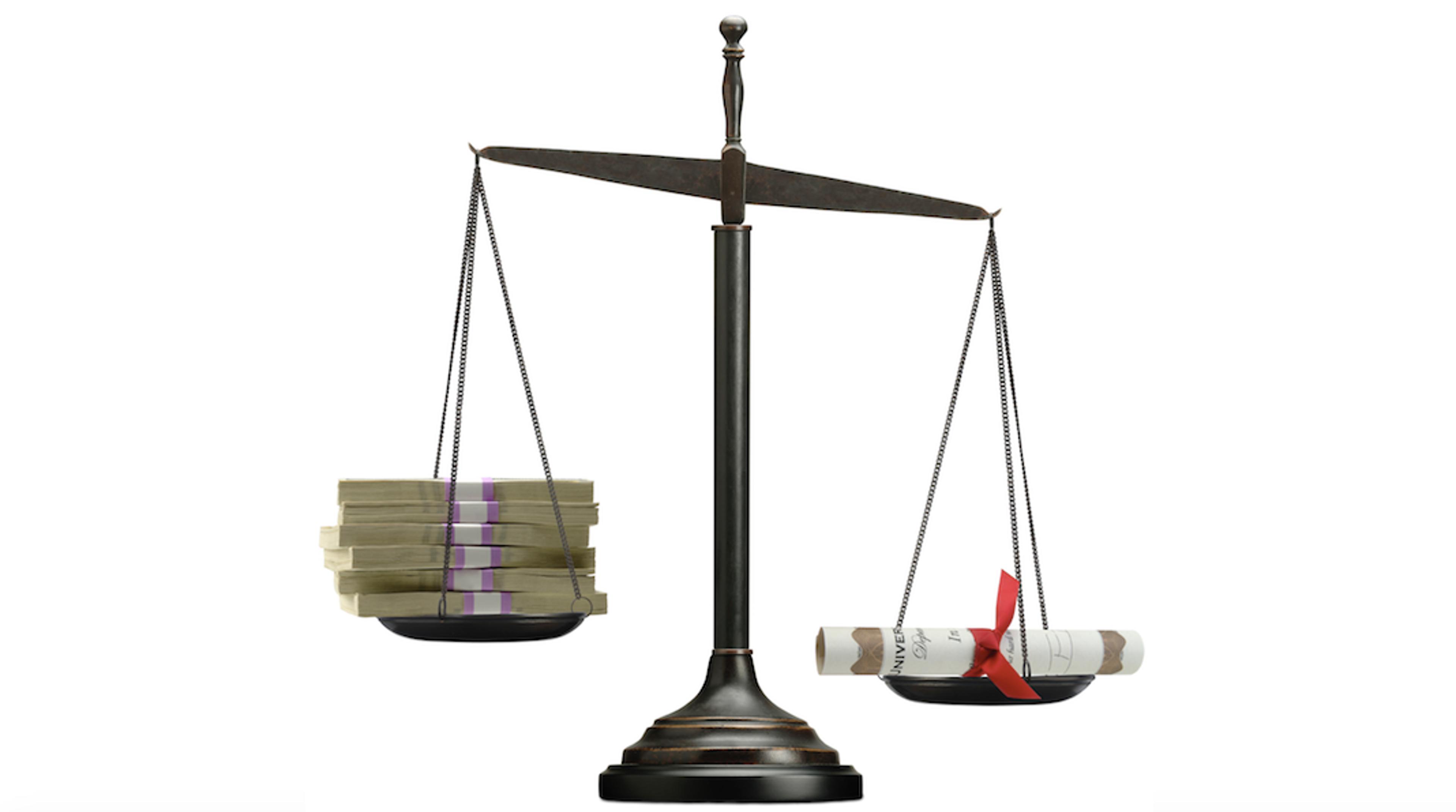
Got In To Your Dream Law School? Federal Loan Caps Could Change The Math
•February 17, 2026
0
Why It Matters
The cap reshapes law‑school financing, threatening enrollment diversity and expanding the private‑lender market, while compelling students to scrutinize debt‑to‑earnings trade‑offs.
Key Takeaways
- •Federal loan cap: $50k annually, $200k total.
- •T14 tuition often exceeds cap, requiring private financing.
- •Private loans carry higher interest, non‑dischargeable terms.
- •Lower‑income applicants risk being priced out.
- •Schools may boost scholarships to remain competitive.
Pulse Analysis
The July 2026 loan cap reflects a broader federal effort to curb soaring student debt across professional programs. By fixing borrowing limits at $50,000 per year, policymakers aim to reduce exposure to high‑cost federal loans, but the rule arrives as law‑school tuition continues to climb past $100,000 at many T14 institutions. This mismatch forces students to bridge the gap with private financing, which typically carries higher rates and lacks discharge protections, fundamentally altering the financial calculus of a legal education.
Law schools are already feeling pressure to adapt. Administrators anticipate a dip in applications from lower‑income candidates, a demographic that historically relies on federal aid to access elite programs. In response, several schools are bolstering merit‑based scholarships and exploring income‑share agreements to stay attractive. Meanwhile, private lenders see a new growth niche, offering loans that fill the shortfall but at steeper costs, potentially widening the debt burden for graduates and influencing the competitive dynamics of legal‑education pricing.
For prospective students, the cap underscores the importance of a rigorous ROI analysis. Beyond prestige, candidates should compare post‑graduation salaries, regional job markets, and the total debt service required for each school. Regional institutions with strong placement records may deliver comparable earnings with substantially less borrowing. Leveraging tools like interactive law‑school rankings and negotiating scholarship packages can mitigate financial risk, ensuring that the decision to attend a top‑tier law school remains a strategic investment rather than a debt trap.
Got In To Your Dream Law School? Federal Loan Caps Could Change The Math
Getting accepted to a T14 law school can brings lots of prestige. It can also bring on a ton of debt. Student loans aren’t to be taken lightly — the hundreds of thousands of dollars prospective lawyers take out for school can set back other milestone life goals like owning a home, having children and buying groceries. For years, relatively low interest loans from the government were a godsend for students that wanted the career opportunities law could unlock but lacked the capital needed to fund their educations. Then everything changed when the Fire Nation attacked; the Trump administration capped annual federal loan borrowing for professional schools to $50k a year. That is enough if you’re attending a local law school, but you’re headed for most of the T14, you may need to scrounge up the rest of the cash elsewhere. Reuters has coverage:
For tens of thousands of aspiring lawyers, the math of paying for a U.S. law degree changes on July 1, 2026, when a new cap is set to limit federal loans for professional degree programs at $50,000 a year and $200,000 in total.
The change could force more students to obtain higher-interest, non-dischargeable private loans in the coming months, seven law school administrators and education financing experts told Reuters, potentially shutting out lower-income students and increasing the overall price tag of a law degree.
…
“We probably will have better answers come July 1, but there’s still a lot of variables we don’t know,” said Joseph Lindsay, assistant dean of admissions and financial aid at the University of California, Berkeley School of Law, where current tuition and living costs total $104,145 and students borrowed an average of $64,087 in federal funds last year.
For the students willing to take on debt from private lenders, the cap acts as a subsidy for those lenders. For those who aren’t, it may mean giving up on their dream school.
The practical thing may be to look past the prestige or personal preference held for your costly dream school and see the investment in your future as an investment. How much greater, if at all, would the ROI on attending your dream school be compared to an alternative that requires less debt? If you make HYS (Harvard/Yale/Stanford)you should probably go to HYS, but is there a regional option that performs well in the market you intend to work in? That might just mean picking SLU and their health law program over WashU. There are of course other options — a generous scholarship from WashU may tip the odds back in their favor. It could also mean picking WashU over a higher ranked school that would require more debt to finish. A great resource to consider in your decision making is ATL’s Interactive Law School Ranking. Unlike our competitors, we give less weight to inputs (average LSAT scores of incoming classes) then we do to outcomes (projected costs, were you able to get a damned job).
Make the most of your investment! And wherever you do end up, ignore the impulse to not care about Civ Pro or Legal Writing.
US Law Schools, Students Fear Rising Costs From New Federal Loan Cap Reuters
Earlier: The Big Beautiful Bill Will Limit Federal Student Loans, Hoping To Fix A Big Ugly $1.7T Mess
The 15 Most Expensive Law Schools (2024-2025)

Chris Williams became a social media manager and assistant editor for Above the Law in June 2021. Prior to joining the staff, he moonlighted as a minor Memelord™ in the Facebook group Law School Memes for Edgy T14s . He endured Missouri long enough to graduate from Washington University in St. Louis School of Law. He is a former boatbuilder who is learning to swim, is interested in critical race theory, philosophy, and humor, and has a love for cycling that occasionally annoys his peers. You can reach him by email at [email protected] and by tweet at @WritesForRent.
The post Got In To Your Dream Law School? Federal Loan Caps Could Change The Math appeared first on Above the Law.
0
Comments
Want to join the conversation?
Loading comments...