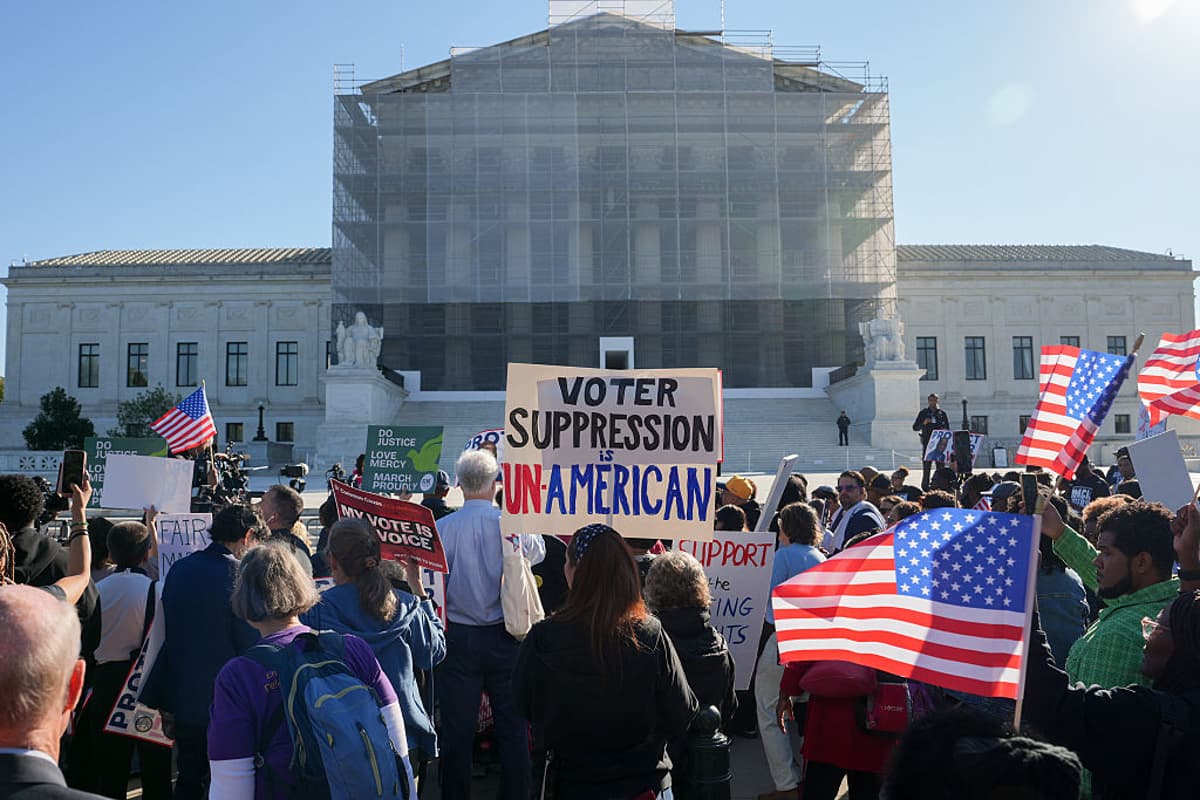
How Voting Rights Groups Are Rallying to Fight After the Supreme Court Hollowed a Landmark Law
Why It Matters
The ruling threatens minority representation in Congress and could shift the partisan balance of power, while prompting a renewed push for state‑level safeguards and federal legislation to preserve voting equity.
Key Takeaways
- •Supreme Court narrows Section 2, deeming race‑based districts unconstitutional
- •Republicans celebrate; Democrats warn of diluted minority voting power
- •NAACP and partners launch voter‑registration roadshows in the South
- •Advocates push state voting‑rights acts and the John Lewis bill
- •Constitutional claims may still support legal challenges to discriminatory maps
Pulse Analysis
The Court’s 6‑3 decision marks a seismic shift in voting‑rights jurisprudence, effectively overturning decades of precedent that used Section 2 of the Voting Rights Act to curb racially discriminatory redistricting. By framing the creation of a Black‑majority district as an unconstitutional racial gerrymander, the majority opinion narrows the legal standard to require proof of intentional discrimination, a hurdle that many civil‑rights litigators deem nearly impossible to meet. This reinterpretation echoes the 2013 Shelby County v. Holder ruling, which already weakened preclearance requirements, and signals a broader judicial trend toward limiting federal oversight of state election maps.
Grassroots organizations are reacting swiftly. The Power Coalition for Equality and Justice is touring Louisiana with a voter‑education roadshow, targeting registration gaps among Black and Latino voters. In Mississippi, the NAACP is coordinating town halls across 71 counties to explain the decision’s implications and to boost turnout ahead of the 2026 midterms. The Southern Leadership for Voter Engagement (SOLVE) network is leveraging its existing infrastructure from previous voting‑rights battles, emphasizing community empowerment and rapid registration drives. These efforts aim to translate heightened awareness into concrete ballot participation, hoping to elect representatives who will defend or restore voting protections.
Legislatively, the ruling has reignited calls for both state and federal action. State‑level voting‑rights acts are being drafted to fill the protection gap left by the weakened federal law, while congressional leaders are urged to revive the John Lewis Voting Rights Advancement Act, which would restore preclearance and strengthen Section 2. Some advocates, like senior counsel Hillary Harris Klein, argue that Congress could also ban partisan gerrymandering and explore alternative electoral systems such as proportional representation, sidestepping constitutional amendments. Although the Supreme Court’s decision raises the bar for legal challenges, constitutional guarantees under the 14th and 15th Amendments still provide a foundation for future lawsuits aimed at preventing overtly discriminatory map draws.
How Voting Rights Groups Are Rallying to Fight After the Supreme Court Hollowed a Landmark Law
Comments
Want to join the conversation?
Loading comments...