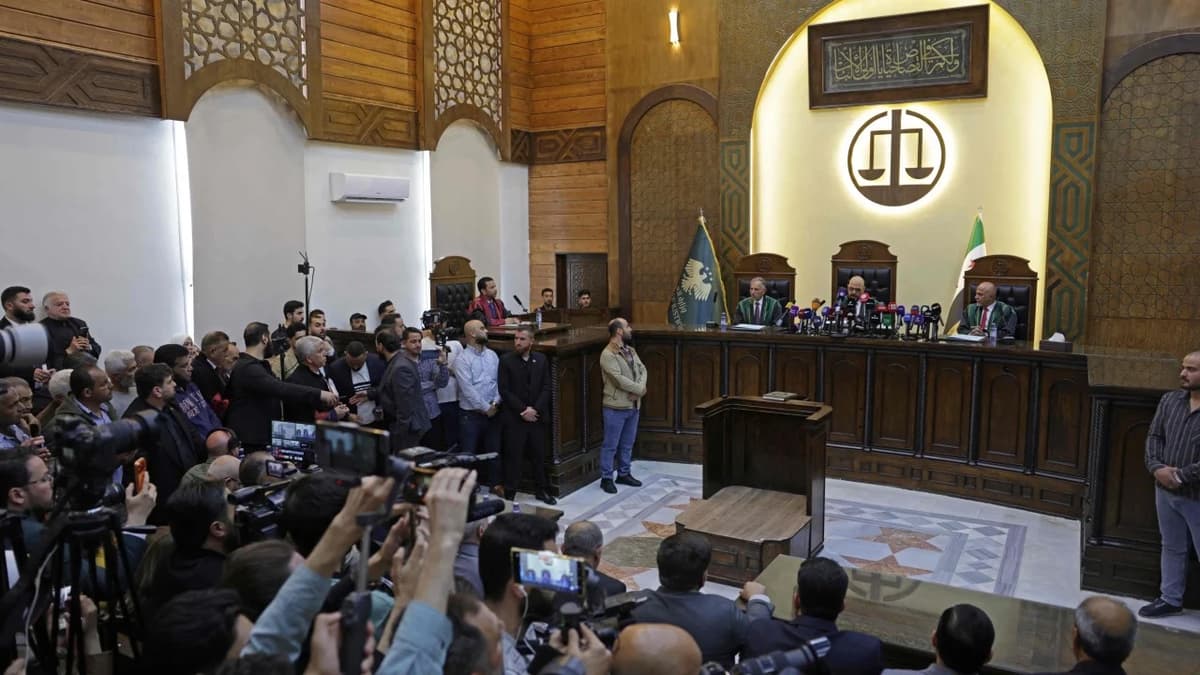
Syria Begins Long-Awaited First Trial of Assad-Era Officials
Why It Matters
The proceeding demonstrates the interim government’s willingness to hold former regime officials accountable, a crucial step toward national reconciliation and restoring rule of law after a 14‑year conflict.
Key Takeaways
- •First public trial of Assad-era officials opened in Damascus.
- •Former brigadier general Atef Najib faces crimes against Syrian people.
- •Najib is only defendant physically present; others tried in absentia.
- •Trial signals interim government’s push for transitional justice.
- •Crowds celebrated, reflecting public demand for accountability.
Pulse Analysis
The trial of Atef Najib arrives at a watershed moment for Syria, a nation still reeling from a 14‑year civil war that claimed roughly half a million lives and displaced millions. After the December 2024 rebel offensive that toppled Bashar al‑Assad and forced him into exile in Russia, the interim administration under President Ahmad al‑Sharaa has been under pressure to deliver a credible transitional‑justice framework. International donors and human‑rights groups have repeatedly warned that without visible accountability, post‑conflict reconstruction and foreign aid could stall.
Najib’s appearance in the Palace of Justice carries symbolic weight beyond the legal charges. As head of the Political Security Branch in Daraa during the 2011 protests, his alleged involvement in arrests and torture directly links him to the spark that ignited nationwide unrest. While he is the sole defendant physically present, the decision to try Assad and his brother Maher in absentia underscores a broader strategy: signaling that even the highest echelons of the former regime are not immune. The courtroom’s packed galleries and celebratory crowds outside reflect a public appetite for justice that has long been suppressed under authoritarian rule.
The broader implications extend to regional stability and diplomatic engagement. A transparent judicial process could pave the way for Syria’s reintegration into the Arab League and unlock stalled reconstruction funds from the World Bank and Gulf states. Conversely, perceived tokenism or procedural flaws might embolden remaining loyalist factions and hinder reconciliation efforts. As the trial proceeds, observers will gauge whether Syria can balance retributive justice with the political pragmatism needed to rebuild a fractured society.
Syria begins long-awaited first trial of Assad-era officials
Comments
Want to join the conversation?
Loading comments...