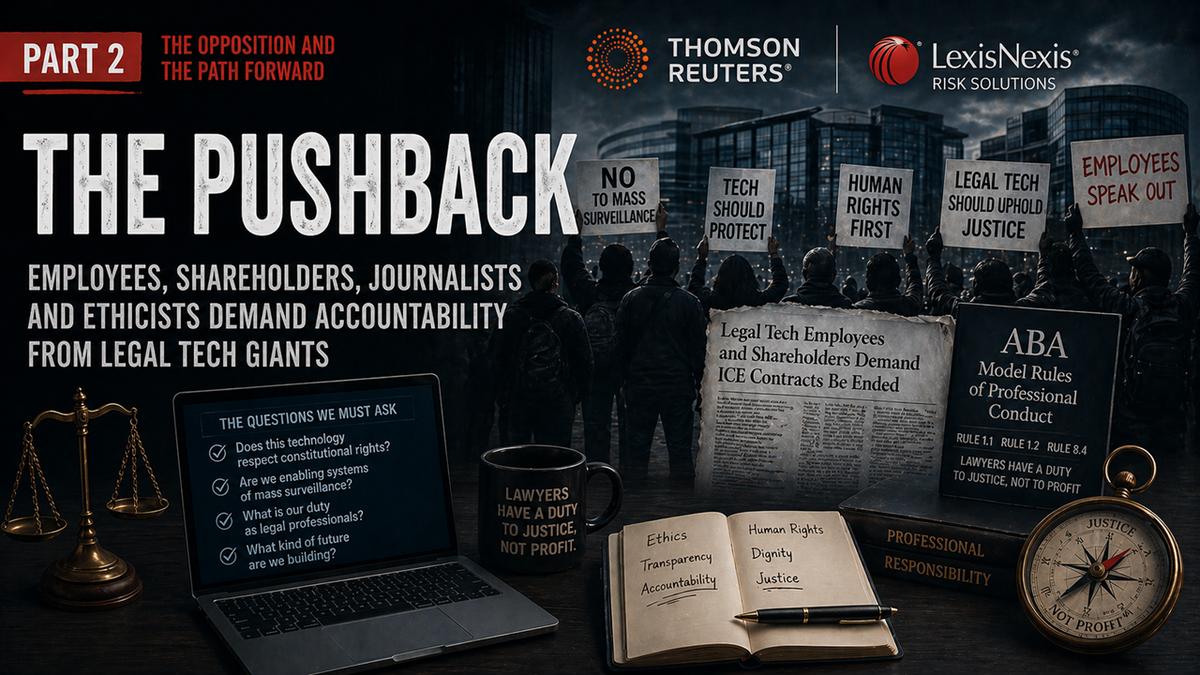
The Legal Tech Giants Powering ICE, Part 2 — The Pushback: Employees, Shareholders, Lawyers and the Fight Over May 31
Key Takeaways
- •200 Thomson Reuters staff demand non‑renewal of $22.8M ICE contract.
- •200 Law360 journalists push RELX to drop $22.1M DHS deal.
- •BCGEU campaign secured UN Guiding Principles adoption by Thomson Reuters.
- •Whistleblower lawsuit filed after senior attorney‑editor was fired.
- •Lawyers risk ethical conflicts using Westlaw linked to ICE data.
Pulse Analysis
The legal‑tech market is dominated by Thomson Reuters and LexisNexis, whose combined revenues exceed $10 billion and whose platforms power the research workflow of most U.S. law firms. Their contracts with ICE and DHS, while modest in absolute dollar terms, grant federal agents access to vast data sets that can pinpoint migrants’ locations and family ties. This integration of commercial legal research with immigration enforcement illustrates a broader trend where private‑sector data tools become essential components of government surveillance, raising questions about corporate responsibility and the limits of public‑private partnerships.
Employee and journalist pushback in early 2026 reflects a growing internal conscience within the legal‑information ecosystem. Over 200 Thomson Reuters staff in Minnesota, spurred by local ICE raids and fatal shootings, demanded that the company halt its $22.8 million contract, while Law360 reporters raised similar concerns about LexisNexis’ $22.1 million DHS deal. Parallel shareholder activism by the British Columbia General Employees’ Union has forced Thomson Reuters to adopt the UN Guiding Principles on Business and Human Rights, though the firm still maintains the contracts. The ethical debate centers on ABA Model Rules—conflict of interest, confidentiality, and vendor oversight—suggesting that lawyers may need to reassess their reliance on platforms that double‑serve law‑enforcement customers.
Looking ahead, the May 31 renewal deadline could become a litmus test for the legal profession’s willingness to align vendor choices with ethical standards. Alternatives to Westlaw and LexisNexis, though still niche, are gaining traction among firms seeking to distance themselves from surveillance‑linked services. If the contracts lapse or are renegotiated with stricter firewalls, the industry could see a shift toward more transparent data‑governance models, potentially spurring new entrants focused on privacy‑first legal research. Conversely, a renewal would reinforce the status quo, prompting continued scrutiny from civil‑society groups, investors, and regulators concerned about the intersection of big‑data policing and the rule of law.
The Legal Tech Giants Powering ICE, Part 2 — The Pushback: Employees, Shareholders, Lawyers and the Fight Over May 31
Comments
Want to join the conversation?