The Week in Data May 5: A Look at Legal Industry Trends by the Numbers
Companies Mentioned
Why It Matters
The data underscores how law firms are retooling growth strategies—through disciplined BD, cross‑border revenue pushes, and strategic mergers—to stay competitive in a rapidly consolidating market.
Key Takeaways
- •Am Law 100 firms continue topping revenue charts since 2000
- •Law.com highlights need for structured partner development over rainmaking
- •US firms collectively surpassed $1 billion London revenue, fueling UK growth
- •Hogan Lovells and Cadwalader plan merger, adding dual New York offices
- •Weekly data visualizations reveal top lateral moves across U.S. firms
Pulse Analysis
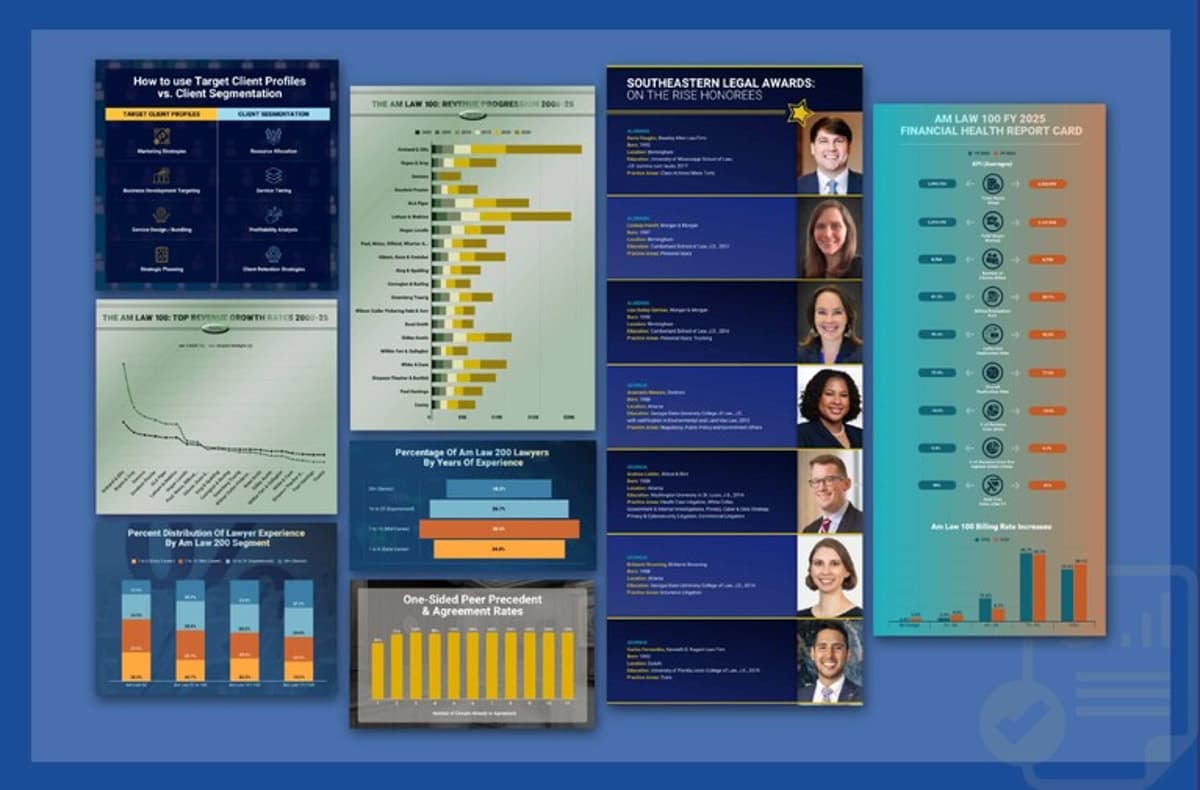
Law firms are increasingly relying on granular data to steer strategic decisions, and Law.com’s weekly data briefings have become a barometer for industry health. The latest Am Law 100 analysis shows that the top 20 firms have consistently stacked the highest revenues since the turn of the millennium, reinforcing the concentration of market power among legacy players. This continuity signals that scale and diversified service lines remain critical levers for sustaining profitability in a market where client budgets are tightening.
Beyond raw revenue, the narrative is shifting toward how firms generate that top‑line growth. A featured commentary argues that traditional rainmaking—relying on charismatic partners to bring business—must give way to systematic business‑development (BD) infrastructure. Structured partner development programs, backed by data‑rich pipelines and performance metrics, promise more predictable earnings and reduce reliance on a few star lawyers. This evolution mirrors trends in other professional services where disciplined client‑acquisition models outperform ad‑hoc approaches.
Cross‑border expansion and consolidation are the other twin forces reshaping the legal landscape. U.S. firms collectively breached the $1 billion threshold in London revenues, a clear indicator of their appetite for the U.K. market despite regulatory headwinds. Simultaneously, the announced Hogan Lovells‑Cadwalader merger, which will create dual New York hubs and extend presence in Washington, D.C., and London, exemplifies the drive toward scale and geographic diversification. Together, these moves suggest that firms are betting on larger, more integrated platforms to capture global client demand while navigating talent mobility, as evidenced by the week’s highlighted lateral moves across the country.
The Week in Data May 5: A Look at Legal Industry Trends by the Numbers
Comments
Want to join the conversation?
Loading comments...