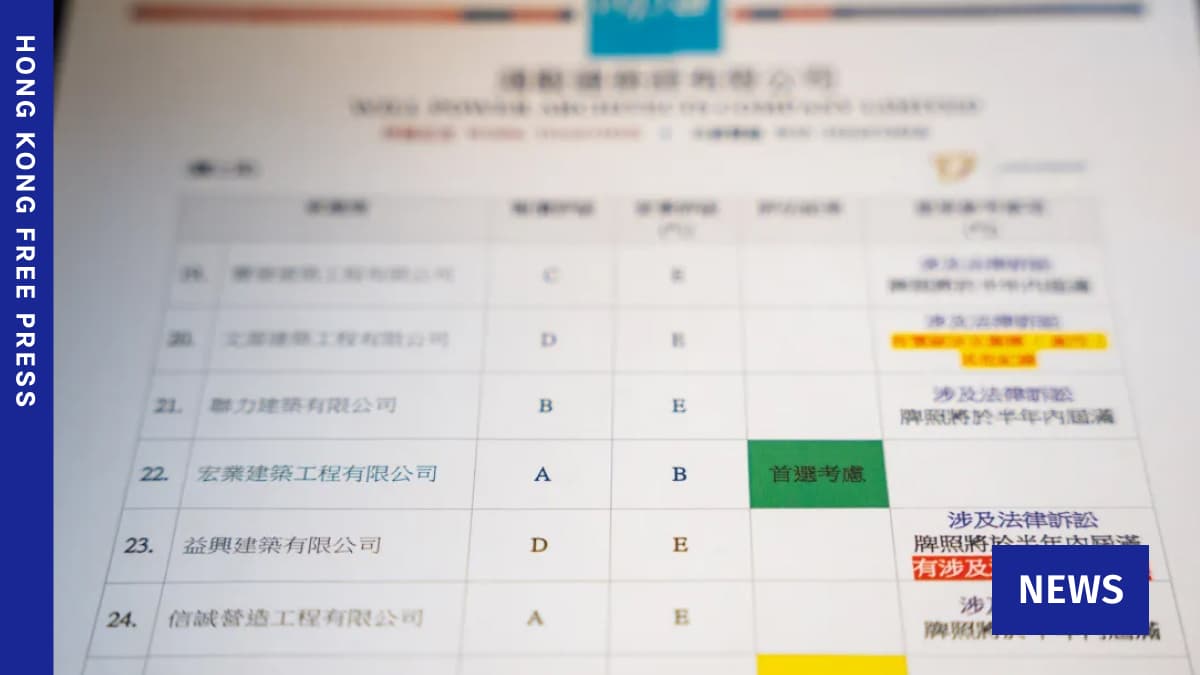
Urban Renewal Authority Did Not Consider Bid-Rigging Risks at Wang Fuk Court, Fire Inquiry Hears
Why It Matters
The lapse highlights how inadequate tender oversight can enable collusion, jeopardising safety and public funds in large‑scale housing projects. It pressures regulators to tighten procurement controls for subsidised estates.
Key Takeaways
- •URA ignored bid‑rigging warnings for Wang Fuk Court renovation
- •Consultancy Will Power charged HK$308k (~$39k) and HK$220k (~$28k)
- •Prestige Construction, linked to consultant, won the renovation contract
- •URA’s “Smart Tender” platform cannot guarantee collusion detection
- •Over 10,000 tenders processed annually, limiting detailed scrutiny
Pulse Analysis
The tragic November blaze at Wang Fuk Court, which claimed 168 lives, has exposed a deeper governance flaw within Hong Kong’s public‑housing renewal framework. The Urban Renewal Authority, tasked with managing tender applications for the estate’s massive refurbishment, failed to flag glaring price discrepancies in the consultancy contract awarded to Will Power Architects. By accepting a consultancy fee of roughly $39,000 and an additional $28,000 for estate inspections—figures far below market rates—the URA inadvertently opened the door for the consultant to steer the subsequent construction contract to its affiliated firm, Prestige Construction & Engineering. This sequence underscores how low‑cost bids can mask collusive arrangements, especially when oversight mechanisms are lax.
Bid‑rigging has long been a concern in Hong Kong’s building‑maintenance sector, with the Competition Commission noting pervasive collusion across dozens of projects. In the Wang Fuk Court case, the URA’s reliance on its “Smart Tender” platform, which anonymises bidders and uses third‑party price estimates, proved insufficient to detect deliberate manipulation. URA officials argued that processing over 10,000 tenders each year makes granular scrutiny impractical, yet the inquiry revealed that such volume should not excuse the omission of basic risk assessments. The consultancy’s suspiciously low fees should have triggered a deeper audit, but the authority’s hands‑off stance allowed the tender to proceed unchecked.
The fallout from the inquiry is likely to reshape procurement policy for government‑subsidised housing. Regulators may mandate stricter due‑diligence protocols, including mandatory price‑reasonableness checks and independent audit trails for consultancy contracts. Enhancing transparency could involve publishing detailed tender data and expanding the scope of third‑party monitoring beyond the current “Smart Tender” algorithm. Ultimately, restoring public confidence will require a balance between efficient tender processing and robust safeguards against collusion, ensuring that safety and fiscal responsibility remain paramount in future renovation projects.
Urban Renewal Authority did not consider bid-rigging risks at Wang Fuk Court, fire inquiry hears
Comments
Want to join the conversation?
Loading comments...