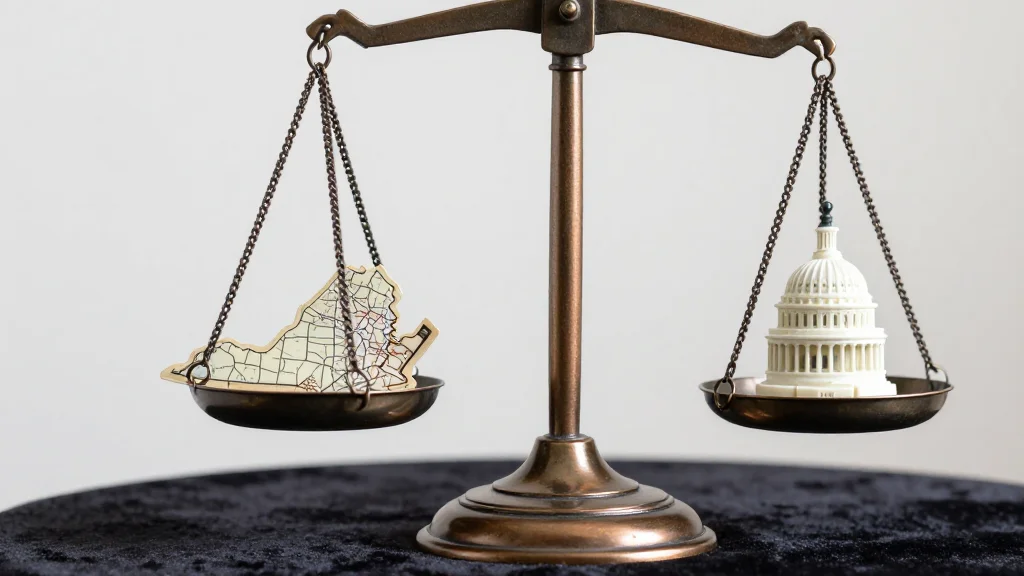
Virginia Voters Pass Redistricting Amendment, Potentially Adding Four Democratic House Seats

Why It Matters
The Virginia amendment raises fundamental questions about the balance of power between legislatures, independent commissions, and the electorate in the redistricting process. By allowing a partisan body to redraw maps for a decade, the measure could reshape legal standards for future challenges to gerrymandering, especially as courts grapple with the distinction between process and outcome. If upheld, it may encourage other states to pursue similar voter‑driven constitutional changes, potentially accelerating a wave of litigation that tests the limits of state constitutional authority versus federal equal‑protection and voting‑rights doctrines. Beyond the courtroom, the amendment directly impacts the composition of the U.S. House, a body whose control determines legislative agendas, committee leadership, and the ability to pass or block the President’s agenda. With the 2026 midterms looming, the legal validation of Virginia’s map could tip the balance of power at the federal level, affecting everything from budget negotiations to impeachment proceedings.
Key Takeaways
- •Virginia voters approved a constitutional amendment by a 51%‑49% margin, allowing the Democratic‑led General Assembly to redraw congressional maps through 2030.
- •The amendment could shift Virginia’s House delegation from a 6‑5 Democratic edge to a potential 10‑1 Democratic advantage, adding four seats for Democrats.
- •Pro‑amendment groups raised over $64 million, including $40 million from House Majority Forward; opponents raised about $21 million.
- •The Virginia Supreme Court is reviewing the amendment’s legality, with a decision expected later in 2026.
- •If upheld, the change could influence the national balance of power in the U.S. House, where control hinges on a handful of seats.
Pulse Analysis
Virginia’s referendum illustrates a strategic shift in how parties are fighting the redistricting battlefield. Rather than relying solely on court challenges, Democrats have turned to direct democracy to secure map‑making authority, effectively bypassing the bipartisan commission created after the 2020 census. This approach leverages voter sentiment against what the party frames as Republican overreach, but it also opens a new front of constitutional litigation that could redefine the permissible scope of state‑level redistricting reforms.
Historically, mid‑decade redistricting has been rare, reserved for extraordinary circumstances such as population shifts or court orders. The Trump‑era push for early maps in Texas set a precedent that both parties now emulate, turning redistricting into a continuous campaign tool rather than a decennial event. Virginia’s amendment, if it survives, could embolden other swing states to adopt similar measures, potentially eroding the bipartisan commission model that many reform advocates championed as a safeguard against partisan gerrymandering.
Looking ahead, the legal battle in Virginia will serve as a bellwether for the broader national contest. A court ruling that upholds the amendment could legitimize voter‑initiated map changes, prompting a cascade of similar initiatives in states with closely divided delegations. Conversely, a decision striking down the amendment on procedural grounds would reinforce the primacy of independent commissions and could stall further partisan attempts to seize map‑making power before the next census. Either outcome will shape the strategic calculus of both parties as they prepare for the 2026 midterms, where control of the House may hinge on a handful of contested districts.
Virginia Voters Pass Redistricting Amendment, Potentially Adding Four Democratic House Seats
Comments
Want to join the conversation?
Loading comments...