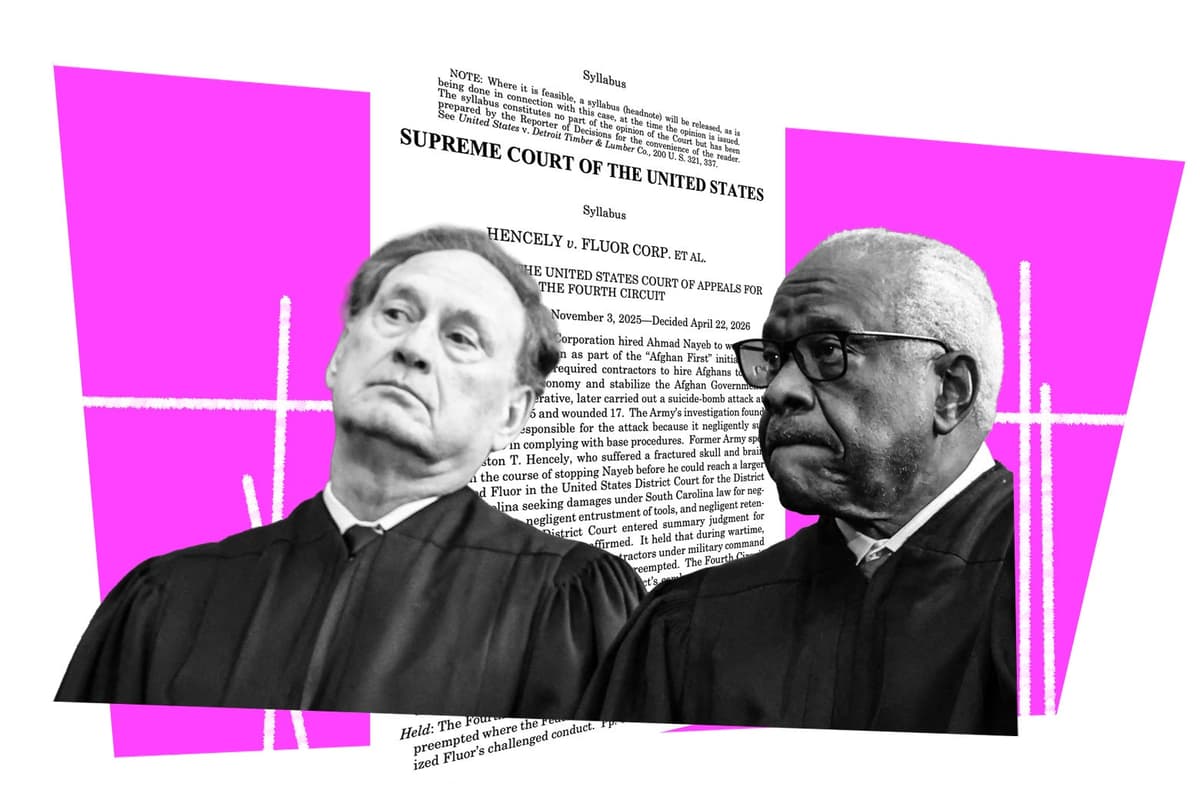
Why Clarence Thomas Just Handed a Major Legal Victory to Wounded Veterans
Why It Matters
The decision opens the door for state‑law negligence claims against defense firms, curbing unchecked contractor immunity and reshaping the legal balance between federal war powers and state oversight.
Key Takeaways
- •Supreme Court permits state negligence suit against Fluor Corp.
- •6‑3 ruling joins conservative and liberal justices
- •Court rejects “battlefield preemption” defense for contractors
- •Veteran Winston Hencely can seek damages for injuries
- •Decision may reshape liability landscape for defense industry
Pulse Analysis
The Hencely v. Fluor ruling marks a rare convergence of the Court’s ideological blocs to address a long‑standing gap in wartime litigation. By holding that no federal statute grants blanket immunity to defense contractors, the majority underscored the principle that Congress must expressly preempt state law. This approach dismantles the so‑called “battlefield preemption” argument, reinforcing that traditional state tort doctrines—such as negligence—remain viable even when federal interests are at stake. The decision therefore reasserts the judiciary’s role in policing government‑contractor conduct.
Legal analysts see the verdict as a watershed for the defense industry’s liability exposure. With the Supreme Court refusing to create a de facto shield, contractors may now face a surge of state‑law suits alleging safety lapses, supervision failures, or other breaches. The ruling could prompt firms to tighten internal compliance programs and renegotiate contract terms to allocate risk more explicitly. Moreover, it signals to lower courts that preemption defenses must be grounded in clear congressional intent, potentially limiting future attempts to sidestep state accountability.
For policymakers and military planners, the case introduces a new calculus when delegating operational responsibilities to private contractors. While the decision does not impede the government’s ability to hire firms for critical missions, it introduces a layer of legal scrutiny that could affect cost structures and procurement timelines. As the United States engages in new overseas operations, contractors will likely encounter heightened oversight and may need to invest in robust safety and monitoring systems to avoid costly litigation. The ruling thus reshapes the intersection of national security, federalism, and corporate responsibility, setting a precedent that could reverberate through future defense contracts.
Why Clarence Thomas Just Handed a Major Legal Victory to Wounded Veterans
Comments
Want to join the conversation?
Loading comments...