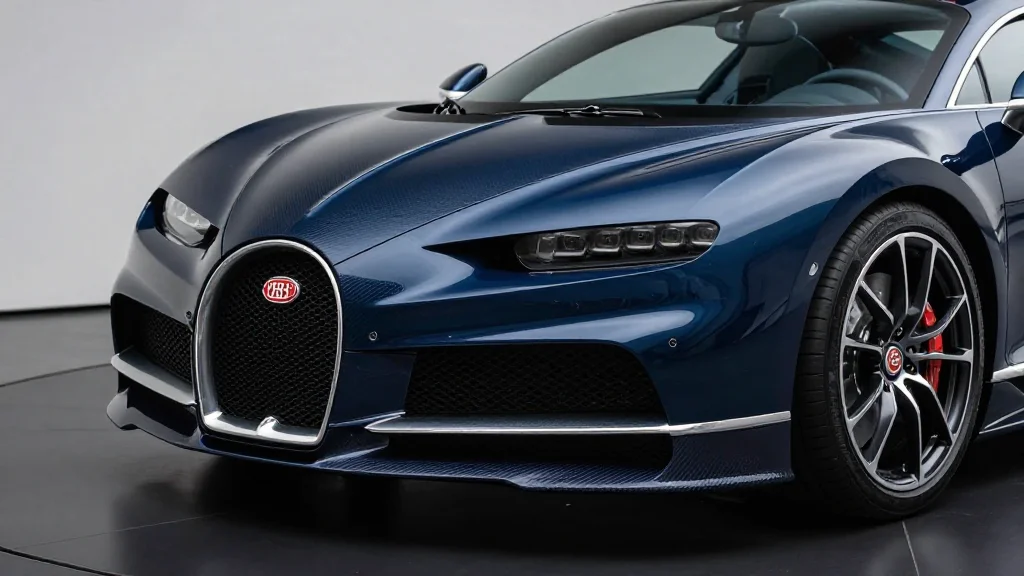
Bugatti Unveils $5 Million One‑Off W16 Mistral ‘Le Retour Du Jeune Prince’

Companies Mentioned

Rolls‑Royce
Why It Matters
Bugatti’s launch of a $5 million, one‑off W16 Mistral demonstrates that the ultra‑luxury automotive market still values exclusivity, narrative, and raw performance over the industry’s electrification push. By anchoring its flagship model in a literary theme and maintaining a pure‑combustion powertrain, Bugatti reinforces a niche where heritage and craftsmanship outweigh regulatory pressures. This move could encourage other high‑end marques to explore bespoke, story‑driven projects that cater to a dwindling but affluent collector base, potentially reshaping how luxury brands differentiate themselves in a crowded market. The limited‑run strategy also highlights a broader business model where scarcity drives desirability and price premiums. As mainstream manufacturers race toward electric vehicles, Bugatti’s approach may preserve a distinct segment of the market that remains insulated from mass‑market trends, ensuring that the brand’s identity as the pinnacle of hypercar performance endures.
Key Takeaways
- •Bugatti unveiled a one‑off W16 Mistral roadster called “Le Retour du Jeune Prince.”
- •The bespoke hypercar is priced at roughly $5 million before customization.
- •Only 99 Mistral units will be produced, each featuring unique artistic details.
- •The model retains a pure W16 engine, rejecting electrification trends.
- •The launch underscores a niche market for ultra‑exclusive, story‑driven hypercars.
Pulse Analysis
Bugatti’s decision to launch a $5 million, one‑off W16 Mistral is as much a branding exercise as it is a product rollout. Historically, Bugatti has leveraged halo cars—models that exist primarily to elevate the brand’s cachet rather than to generate volume sales. The “Le Retour du Jeune Prince” continues this tradition, marrying literary romance with mechanical excess to create a collectible that is as much a conversation piece as a vehicle. In a market where many luxury manufacturers are pivoting to electric powertrains, Bugatti’s steadfast commitment to a W16 engine signals a deliberate differentiation strategy: it will occupy a parallel universe where combustion is celebrated as an art form.
From a financial perspective, the $5 million price tag places the Mistral well above the $3‑4 million range of most contemporary hypercars, positioning it alongside the most exclusive offerings from Rolls‑Royce and Pagani. The limited production run of 99 units ensures that supply constraints will keep secondary‑market values high, creating a virtuous cycle of scarcity and prestige. This scarcity model also mitigates risk; by selling a handful of ultra‑high‑margin units, Bugatti can fund R&D for future projects without diluting its brand equity.
Looking forward, the success of the Mistral could inspire a wave of narrative‑driven collaborations across the luxury sector. Brands may seek to embed stories, art, and bespoke craftsmanship into their flagship models to appeal to a clientele that values uniqueness over utility. However, the sustainability of this approach hinges on the continued appetite of ultra‑wealthy collectors for combustion‑driven excess in an era of increasing environmental scrutiny. If regulatory pressures intensify, Bugatti may eventually need to reconcile its heritage with greener technologies, perhaps by offering hybridized versions of its iconic engines. For now, the Mistral stands as a bold statement that, at the very top of the luxury pyramid, the rules of the broader market can be bent—or outright ignored.
Bugatti Unveils $5 Million One‑Off W16 Mistral ‘Le Retour du Jeune Prince’
Comments
Want to join the conversation?
Loading comments...