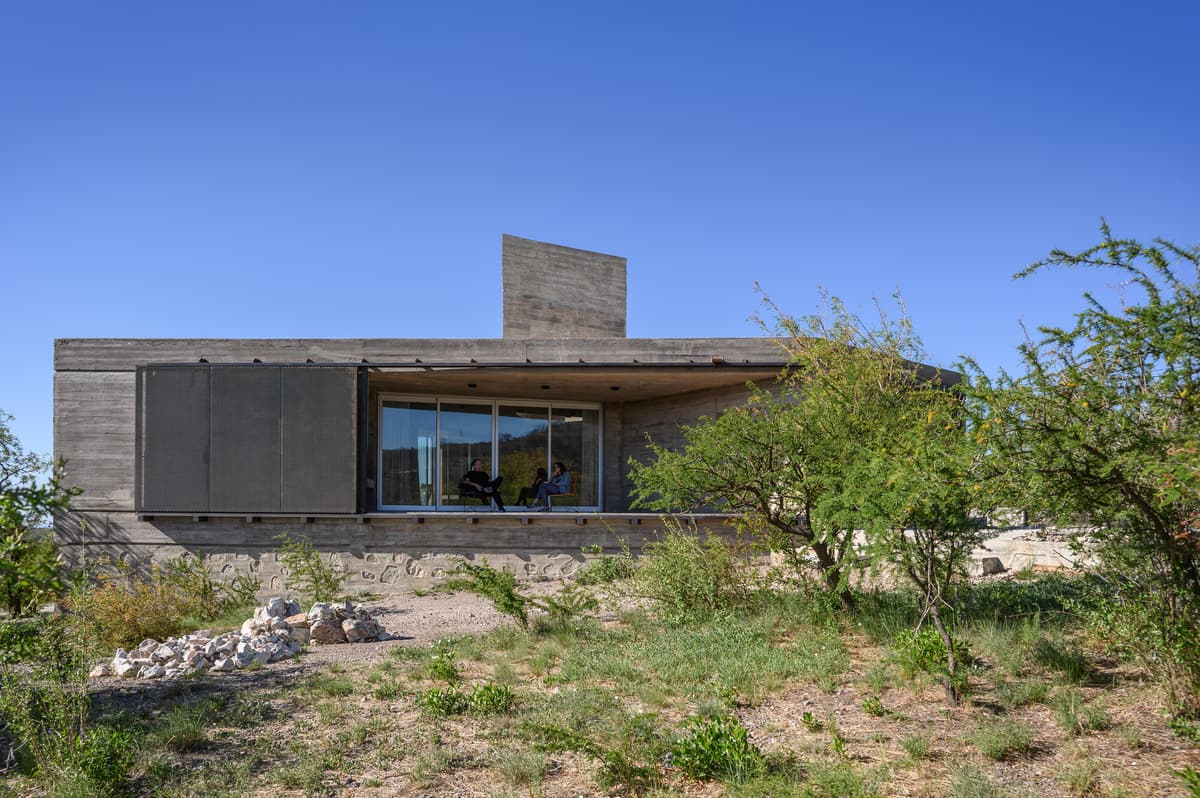
Why It Matters
The project shows how contemporary architecture can blend site‑specific orientation, passive thermal performance, and expressive materiality, providing a template for sustainable luxury homes in arid regions.
Key Takeaways
- •Cosmos House sits on 355 m² sloped lot in Córdoba’s Punilla Valley.
- •Design orients three main views: reserve, Cerro Uritorco, Dique El Cajón.
- •Triangular skylight acts as a natural clock measuring daylight.
- •40 cm poured stone walls provide earth-retaining support and thermal mass.
Pulse Analysis
In an era where architects increasingly prioritize climate‑responsive design, Cosmos House stands out for its rigorous site‑specific orientation. By anchoring the program to three distinct vistas—the protected nature reserve, the iconic Cerro Uritorco, and the reflective waters of Dique El Cajón—the house transforms panoramic views into functional zoning tools. This triangulated layout not only maximizes visual connection but also leverages the natural slope to create varied ceiling heights, enhancing spatial drama while reducing the need for extensive mechanical interventions.
The building’s envelope showcases a disciplined material palette that marries durability with thermal efficiency. Forty‑centimeter poured stone walls act as both retaining structures and thermal mass, absorbing daytime heat and releasing it nocturnally, a crucial strategy in the semi‑arid climate of Córdoba. Exposed concrete walls, lined with wooden boards and insulated cores, further tighten the hygro‑thermal envelope. The centerpiece—a triangular skylight—functions as a passive chronometer, channeling sunlight across the interior throughout the day and subtly cueing occupants to the passage of time without reliance on artificial lighting.
Beyond its aesthetic merits, Cosmos House offers a replicable model for high‑end residential projects seeking sustainability without sacrificing luxury. Its integration of passive cooling, material honesty, and contextual framing aligns with growing market demand for eco‑conscious yet expressive homes. Developers and designers can draw lessons from Nanzer’s approach: leverage topography, employ locally sourced, high‑performance materials, and embed natural rhythms into the architecture, thereby delivering both environmental stewardship and a compelling client experience.
Cosmos House / Cristian Nanzer
Comments
Want to join the conversation?
Loading comments...