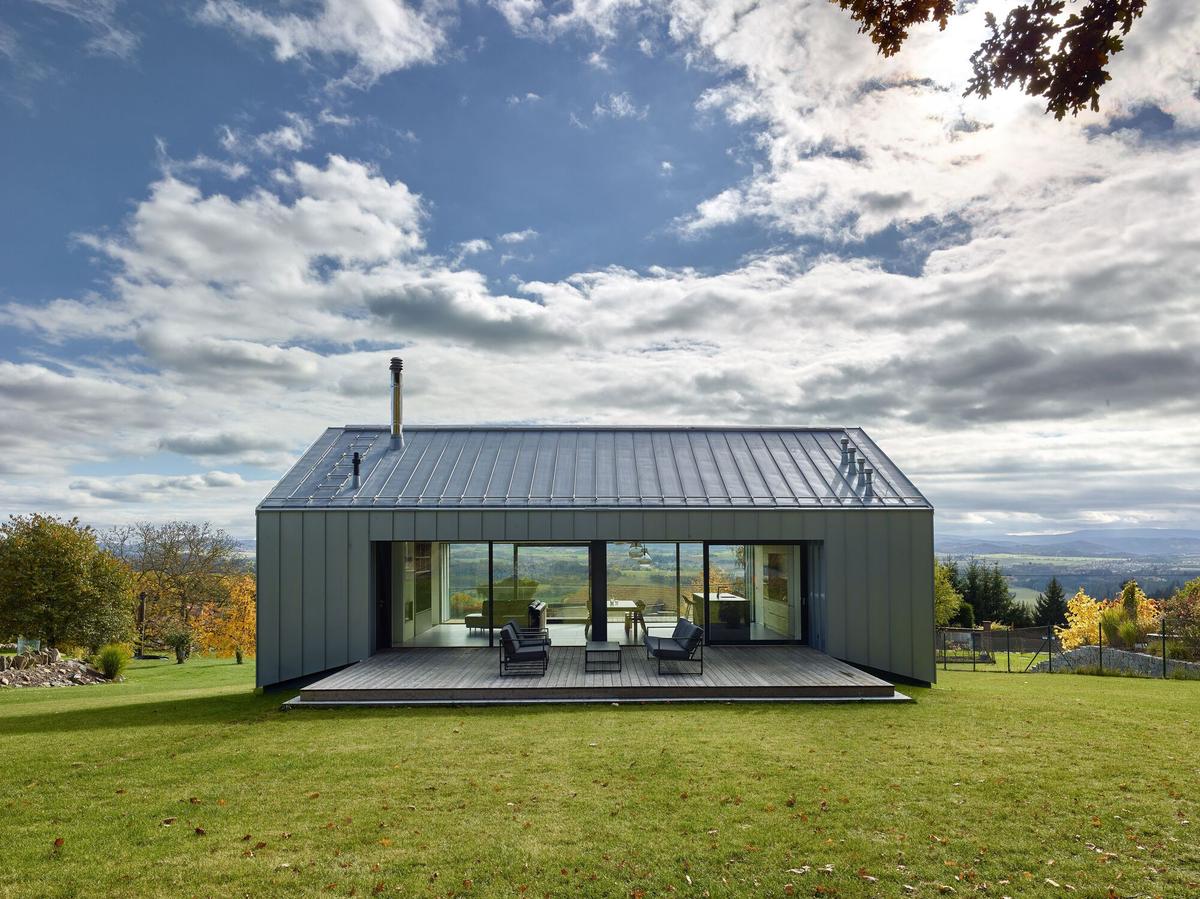
House with a Mountain View / Stempel & Tesar Architects
Why It Matters
The project demonstrates how thoughtful material selection and terrain‑responsive layout can deliver privacy, energy efficiency, and striking views, setting a benchmark for sustainable luxury residences in mountainous regions.
Key Takeaways
- •House integrates into sloping Czech terrain, minimizing visual impact
- •Lower floor uses ceramic blocks, providing stability and earth connection
- •Upper floor clad in titanium‑zinc metal reflects sky, modern aesthetic
- •Glass walls and loggias deliver panoramic mountain and forest views
- •Design reverses traditional layout, placing bedrooms underground for privacy
Pulse Analysis
The House with a Mountain View, completed in 2025 by Stempel & Tesar Architects, exemplifies a growing movement in Central European residential design that prioritises topography‑driven form. Nestled on the outskirts of Klatovy, the 246 m² family home is carved into a gentle slope, allowing the structure to disappear into the landscape while preserving uninterrupted sightlines to the surrounding peaks. By sinking the lower level into the earth, the architects achieve natural insulation and a reduced visual footprint, a strategy increasingly adopted to meet both aesthetic and environmental objectives in low‑density settlements.
Materiality is central to the house’s dialogue with its setting. The ground floor is constructed from load‑bearing ceramic blocks finished with earthy plaster, a choice that anchors the building physically and visually while offering high thermal mass for passive temperature regulation. In contrast, the upper volume is sheathed in titanium‑zinc sheet metal, a lightweight alloy that ages gracefully, developing a patina that mirrors seasonal sky tones. Extensive glass façades and sliding doors open onto north‑ and south‑facing loggias, delivering year‑round daylight, cross‑ventilation, and unobstructed views without compromising energy efficiency.
The project signals a broader market shift toward homes that blend privacy, sustainability, and immersive nature experiences. As remote work fuels demand for tranquil, well‑insulated residences, developers are looking to replicate the low‑impact footprint demonstrated here. Stempel & Tesar’s reversed layout—placing private sleeping quarters underground and elevating communal spaces—offers a template for maximizing daylight while shielding occupants from external noise. Consequently, the design is likely to influence upcoming Czech and Alpine housing schemes, reinforcing the commercial viability of landscape‑responsive architecture in premium residential segments.
House with a Mountain View / Stempel & Tesar Architects
Comments
Want to join the conversation?
Loading comments...