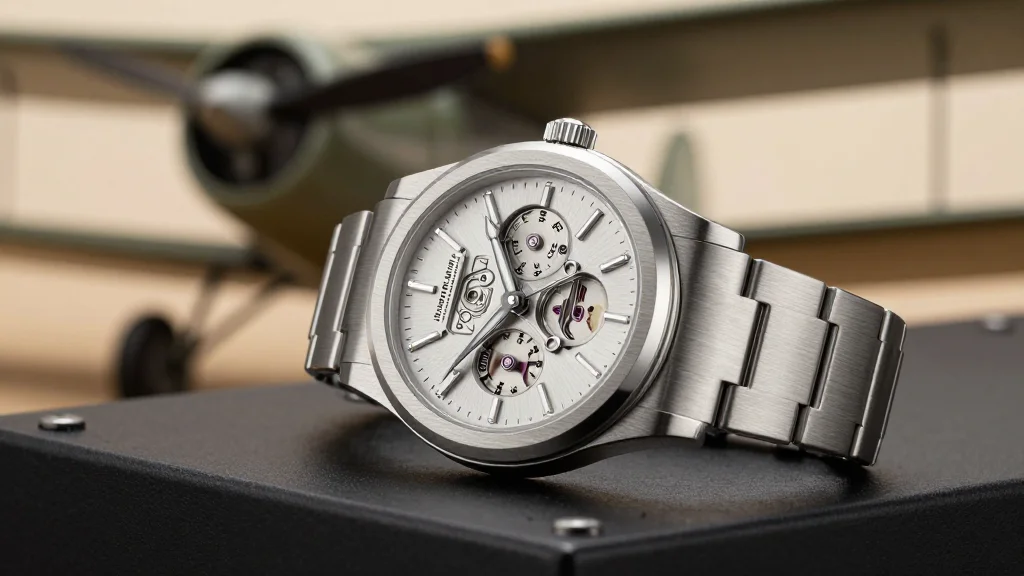
Sponsored: Meet the Sopwith Aero Marquis Thomas-Morse Scout Limited Edition
Why It Matters
The edition demonstrates how scarcity‑driven heritage materials can command premium pricing, reshaping collector demand in the high‑end watch market.
Key Takeaways
- •Only 30 watches made from WWI Le Rhône 9C engine steel.
- •Case forged by hand from historic pistons at Sopwith’s Texas foundry.
- •Mecaline Calibre 2893‑A2 Élaboré movement offers ±7 seconds/day accuracy.
- •Price set at $10,500, targeting high‑end collectors.
- •Thomas‑Morse Scout built ~600 units; ~10 survive today.
Pulse Analysis
The Sopwith Watch Company has turned a fragment of aviation history into a haute‑horlogerie statement. By salvaging steel pistons and valve guides from a Le Rhône 9C rotary engine—one of the few surviving components of the 1918 Thomas‑Morse S‑4C Scout—the brand created a 41 mm case that is literally irreplaceable. Only thirty pieces will ever be produced, each cast by hand in Sopwith’s Houston foundry and finished with a titanium‑carbide PVD coating. This approach fuses material scarcity with meticulous craftsmanship, positioning the watch as a museum‑grade artifact for the wrist.
Priced at $10,500, the Thomas‑Morse Scout lands squarely in the ultra‑luxury segment where provenance often outweighs pure mechanical performance. The Mecaline Specialities Calibre 2893‑A2 Élaboré movement, delivering ±7 seconds per day and a 42‑hour reserve, complements the historic case without compromising accuracy. Collectors are drawn to the narrative of a WWI trainer that taught a generation of American pilots, especially given that only ten of the original aircraft survive. Limited‑edition releases like this tap into a growing appetite for watches that double as tangible pieces of history.
The Sopwith launch underscores a broader shift toward storytelling‑driven luxury, where brands leverage authentic artifacts to differentiate in a saturated market. By converting a finite supply of historic steel into wearable art, the company sidesteps traditional material sourcing and adds a sustainability veneer rooted in reuse rather than new extraction. This model may inspire other manufacturers to explore heritage components—whether aerospace, automotive or military—as a means of creating scarcity‑based value. For investors and enthusiasts, the watch signals that provenance, not just complications, will increasingly dictate premium pricing in the high‑end horology space.
Sponsored: Meet the Sopwith Aero Marquis Thomas-Morse Scout Limited Edition
Comments
Want to join the conversation?
Loading comments...