Why It Matters
The project showcases how integrated thermal storage and structural innovation can deliver year‑round comfort in harsh cold climates, setting a benchmark for sustainable high‑performance residential design.
Key Takeaways
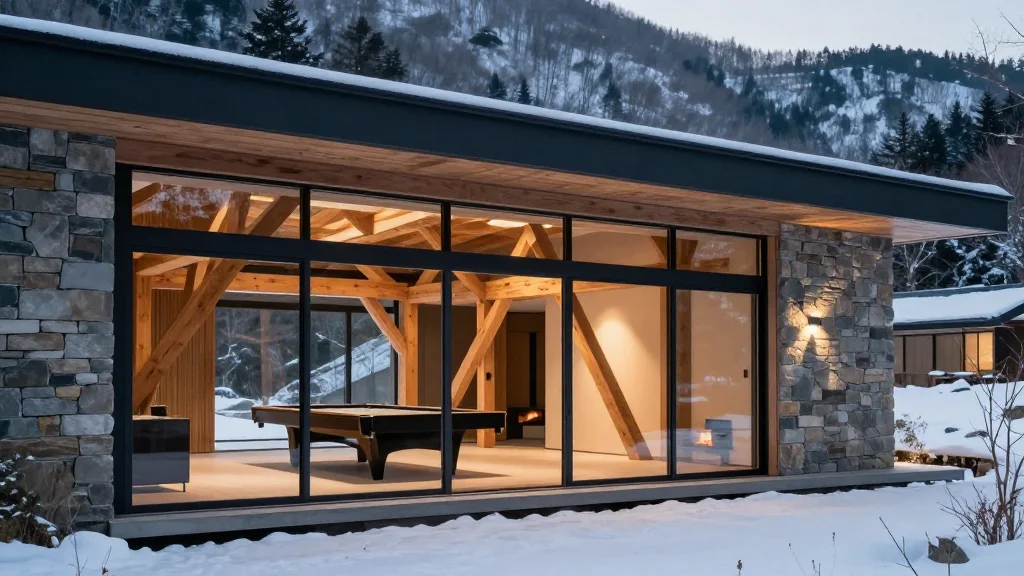
- •Below-frost foundation doubles as billiard room and thermal storage
- •Water‑based thermal storage stabilizes indoor temperature year‑round
- •Wood‑truss shear wall provides strength and visual scale
- •Six distinct floor levels create terrain‑like interior experience
- •Large southeast picture window frames layered forest views
Pulse Analysis
Remote work is reshaping residential priorities, especially in regions like Karuizawa where summer relief meets bitter winter lows. Architects must balance comfort, energy efficiency, and connection to the landscape. Hirobe’s design tackles this by embedding a water‑based thermal‑energy storage system beneath the floor, leveraging the deep foundation to buffer temperature swings while heat‑pump units and a wood‑stove provide flexible climate control. This approach reduces reliance on external heating, cuts operational costs, and aligns with low‑carbon building standards.
The house’s structural strategy is equally inventive. A 60‑mm wood‑truss shear wall, reinforced with diagonal members, delivers high buckling resistance and serves as a visual anchor that manipulates perceived scale. By integrating the below‑ground space as a full‑size billiard room, the design maximizes usable area without expanding the footprint, a clever response to the site’s limited accessibility and steep valley. The thermal mass of the foundation doubles as a storage medium, illustrating how multifunctional elements can enhance both performance and lifestyle.
Internally, the residence unfolds across six interlocking levels, creating a layered “terrain” that mirrors the external slope. This spatial choreography, combined with expansive southeast picture windows, frames the cascading forest and deepens the indoor‑outdoor dialogue. Such nuanced zoning not only accommodates varied functions—work, leisure, and hospitality—but also elevates occupant experience. The YMK House thus exemplifies a holistic, climate‑responsive architecture that blends engineering precision with aesthetic nuance, offering a template for future high‑performance homes in similar environments.
YMK House / Takeshi Hirobe Architects
Comments
Want to join the conversation?
Loading comments...