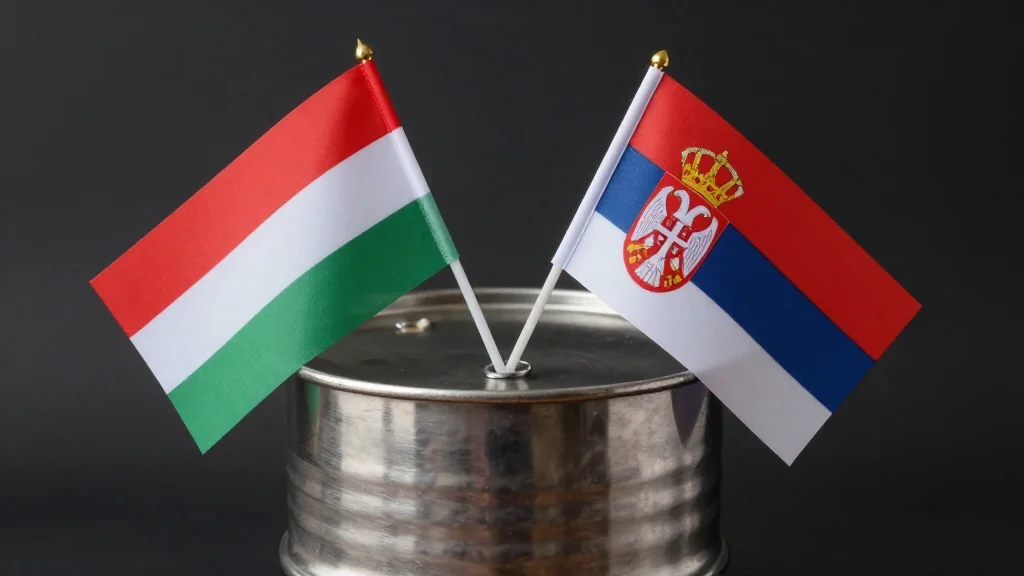
Hungary's MOL Steps Closer to Taking Control of Serbian Operator
Why It Matters
The deal shifts a strategically vital Serbian energy asset away from Russian control, bolstering regional energy security and expanding MOL’s footprint in Central and Eastern Europe.
Key Takeaways
- •MOL signed shareholders' agreement with Serbian government for NIS governance.
- •OFAC granted MOL a license to negotiate Gazprom Neft stake until July 1.
- •MOL will acquire 56% of NIS, reducing Russian control.
- •Serbia will receive 5% of NIS, boosting its stake to ~35%.
- •Deal expands MOL’s footprint across Central and Eastern Europe.
Pulse Analysis
The United States’ sanctions on Gazprom Neft’s 56% stake in Serbia’s NIS have left the Balkan nation scrambling for a reliable energy partner. Since the sanctions took effect in January 2025, NIS has faced financing constraints and operational uncertainty, prompting Belgrade to seek a Western‑aligned investor. MOL, Hungary’s integrated oil and gas group, emerged as the frontrunner, leveraging its existing refinery assets in Slovakia and Croatia to offer a stable, regionally integrated alternative.
MOL’s recent shareholders’ agreement with the Serbian government outlines governance reforms, a guaranteed refinery capacity at Pančevo, and a 5% equity transfer back to the state. The OFAC licence, renewed through July 1, 2026, removes a major legal hurdle, allowing MOL to finalize the purchase while complying with U.S. export controls. By acquiring Gaz‑Neft’s majority share, MOL not only eliminates the Russian sanction risk but also positions itself to influence NIS’s upstream development, downstream distribution, and retail network across the Western Balkans.
Strategically, the transaction reinforces Europe’s broader effort to reduce dependence on Russian energy assets. For MOL, the acquisition deepens its presence in a market that supplies roughly 70% of Serbia’s refined fuels, creating synergies with its Slovnaft and INA operations. For Serbia, retaining a 35% state stake safeguards revenue streams and ensures governmental oversight of critical supply chains. Analysts expect the deal to stabilize regional fuel prices and could serve as a template for other sanctioned Russian holdings in Europe seeking Western partners.
Hungary's MOL steps closer to taking control of Serbian operator
Comments
Want to join the conversation?
Loading comments...