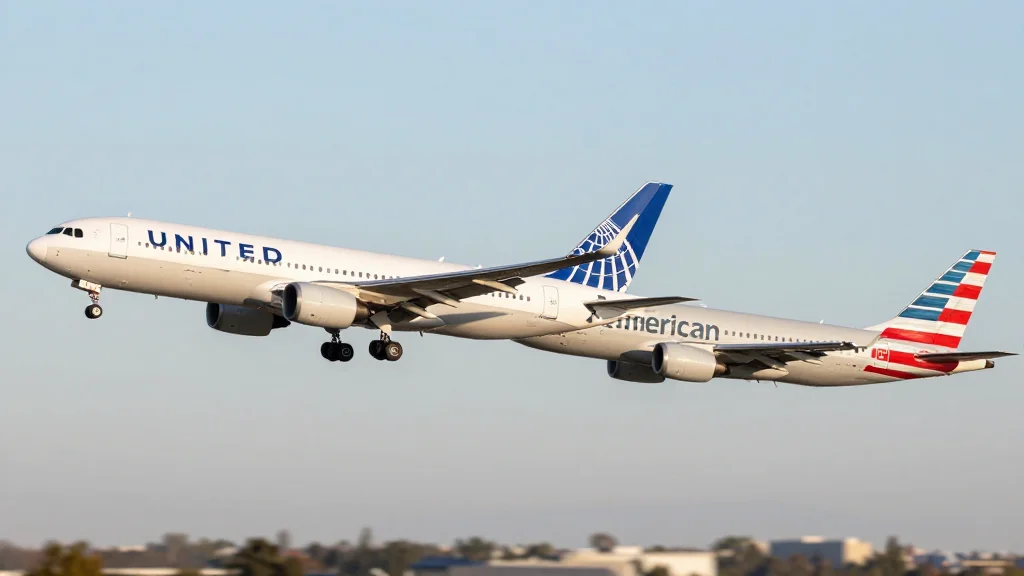
United and American Airlines Weigh Merger as Antitrust Scrutiny Intensifies

Companies Mentioned
Why It Matters
A United‑American merger would consolidate over half of the U.S. domestic market under a single banner, reshaping competition, pricing power, and route structures. Antitrust authorities will need to balance the potential efficiency gains against the risk of higher fares and reduced service to smaller cities, setting a precedent for future mega‑mergers in a sector already dominated by four major players. The deal also intersects with broader geopolitical and economic forces. Rising jet‑fuel costs, driven by the Iran‑related supply crunch, have already forced airlines to reconsider cost structures. A combined carrier could leverage scale to negotiate better fuel contracts, but regulators may view such advantages as anticompetitive, especially if they translate into higher consumer prices. Furthermore, the involvement of the White House signals a rare instance of direct political interest in airline consolidation, reflecting the administration’s industrial‑policy agenda. How the government navigates this high‑profile case could influence future policy on corporate mergers across critical infrastructure sectors.
Key Takeaways
- •United and American Airlines are in early merger talks after a Feb. 25 White House meeting.
- •United holds 82% of the market at Dulles Airport; American dominates the Texas hub network.
- •Antitrust regulators are expected to scrutinize the deal due to the industry's 80% concentration among four carriers.
- •Jet‑fuel prices have nearly doubled since the Iran conflict, heightening the strategic value of scale.
- •Press secretary Karoline Leavitt said the administration has no official position on the proposal.
Pulse Analysis
The United‑American merger proposal arrives at a crossroads of industry consolidation, political ambition, and volatile energy markets. Historically, airline mergers have been justified on the grounds of cost synergies and network optimization, yet each wave has been met with fierce antitrust pushback. The current environment amplifies both the incentives and the obstacles. On one hand, soaring jet‑fuel costs—up 100% since early 2025—make scale a defensive necessity; larger carriers can hedge fuel purchases and spread fixed costs across a broader revenue base. United’s dominant position at Dulles and American’s deep Texas roots create a complementary network that could, in theory, improve load factors and reduce redundant routes.
On the other hand, the merger threatens to further entrench the Big Four’s grip on 80% of domestic traffic, potentially eroding competition in key markets. The Department of Justice will likely demand divestitures of slots at congested airports, a remedy that could dilute the strategic benefits United and American seek. Moreover, the political dimension adds a layer of complexity: the Trump administration’s willingness to entertain industrial‑policy‑style interventions may embolden the airlines, but it also risks politicizing the antitrust process, inviting congressional scrutiny and public backlash.
If the merger survives regulatory hurdles, it could set a new benchmark for scale in the airline industry, prompting other carriers to pursue similar mega‑deals or strategic alliances. Conversely, a blocked merger would reaffirm the strength of antitrust enforcement in preserving competition, especially in sectors where market concentration directly impacts consumer prices and service availability. Either outcome will reverberate through the broader M&A landscape, influencing how regulators and policymakers assess the trade‑off between efficiency gains and market power in high‑impact industries.
United and American Airlines weigh merger as antitrust scrutiny intensifies
Comments
Want to join the conversation?
Loading comments...