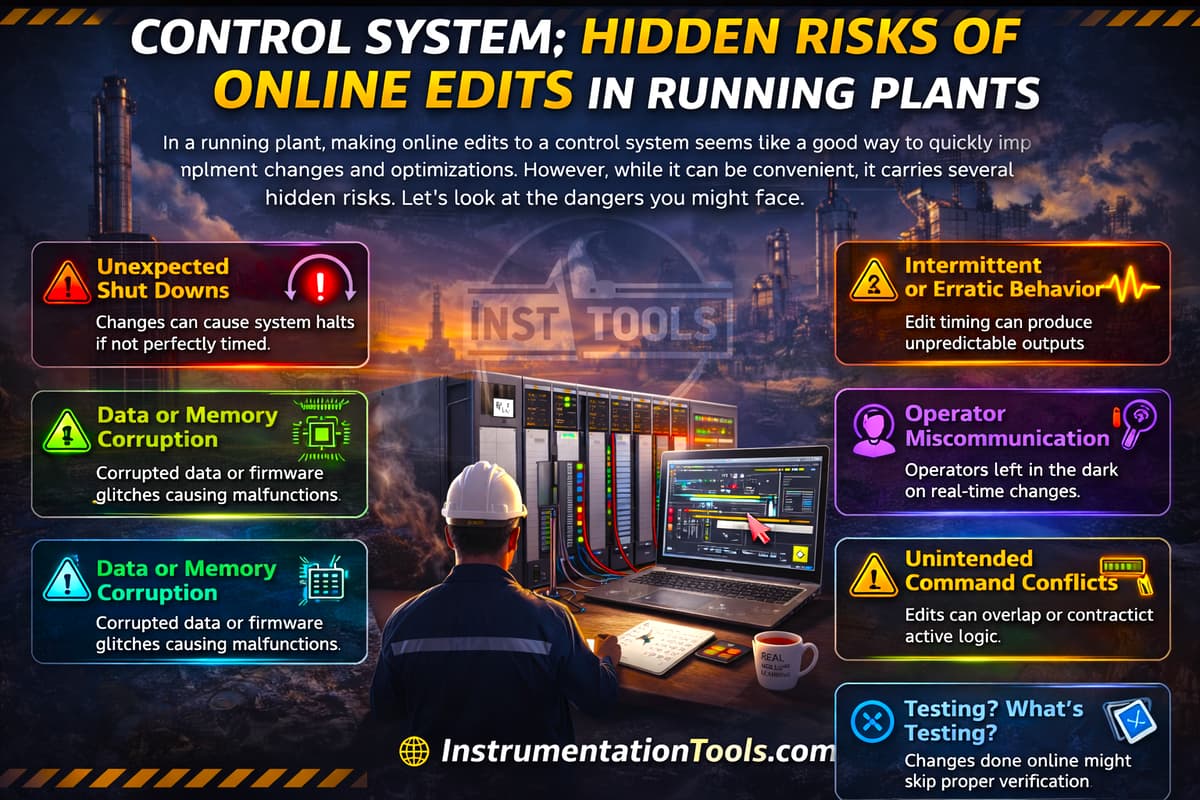
Control System: Hidden Risks of Online Edits in Running Plants
Key Takeaways
- •Online PLC edits can cause one‑scan glitches affecting valves or motors
- •Memory reallocation may reset timers and counters, disrupting batch cycles
- •I/O image desynchronization can trigger false alarms or interlock trips
- •HMI/SCADA may display stale data during live logic changes
- •Alarm flooding obscures real faults, leading to unnecessary shutdowns
Pulse Analysis
Online editing of programmable logic controllers (PLCs) has become a staple in modern process industries because it eliminates the need for costly shutdowns during troubleshooting. Engineers can inject new ladder logic or function‑block code while the plant runs, instantly correcting faults and accelerating commissioning. However, the convenience masks a complex interplay of scan cycles, memory allocation, and communication latency that can generate micro‑second disturbances invisible to the operator interface. Understanding these dynamics is essential for any facility that relies on continuous operation.
When a PLC receives an online edit, the controller must recompile the affected routine and re‑map variables on the fly. This brief reorganization can cause a single scan to execute partially old and partially new code, creating one‑scan pulses that falsely trigger start commands or interlocks. Timers and counters stored in volatile memory may be reinitialized, resetting batch timers and compromising product quality. Simultaneously, the internal I/O image can fall out of sync with real‑world sensor data, leading to erroneous decisions such as premature valve closure or unintended motor starts. The downstream effect is a cascade of false alarms, operator confusion, and potential safety breaches.
Mitigating these hidden risks requires disciplined change‑management practices. Many leading firms now enforce offline simulation or digital‑twin validation before any online edit, ensuring that logic changes are vetted against a replica of the plant. Version‑controlled repositories, automated rollback scripts, and brief “quiet‑mode” windows during edits further reduce exposure. Additionally, synchronizing HMI/SCADA tag updates with PLC recompilation and implementing alarm‑filtering algorithms help operators distinguish genuine faults from transient glitches. As the industry moves toward tighter integration of IIoT and edge computing, robust governance around online PLC edits will be a decisive factor in maintaining uptime and safety.
Control System: Hidden Risks of Online Edits in Running Plants
Comments
Want to join the conversation?